One of the first Indians in finance, business and banking, Dwarkanath Tagore went beyond into the realm of politics, religious reform and journalism until his death in London in 1846, but remained largely unknown here until recently.
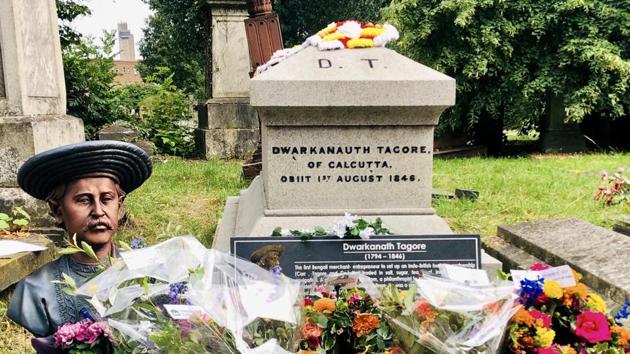
The grandfather of Nobel laureate Rabindranath Tagore, his grave lay in a dilapidated state for long in the Kensal Green Cemetery, until some groups came together and restored it through thermo-chemical cleaning carried out by surveyors specialising in restoring Victorian era structures.
On Sunday several people from India and the UK came together at the cemetery to pay tributes to his contribution to modern India. Tagore, along with the reformer Rammohun Roy (who also died in England), financed and contributed to several path-breaking initiatives in early 19th century.
The vice-chancellor of Rabindra Bharati University, Sabyasachi Basu Ray Chaudhury, joined in a video call from India as others, including Mohammed Rashid Khan of the Indian High Commission and Henry Vivian-Neal of the Friends of Kensal Green Cemetery, spoke of his life and times.
Sourav Niyogi of the Bengal Heritage Foundation said: “Long before Rabindranath Tagore became internationally acclaimed and created storm through his writings, his grandfather had seen the dreams of a revolutionised Bengal”.
{{/usCountry}}Sourav Niyogi of the Bengal Heritage Foundation said: “Long before Rabindranath Tagore became internationally acclaimed and created storm through his writings, his grandfather had seen the dreams of a revolutionised Bengal”.
{{/usCountry}}“The tomb in Kensal Green was in an obscure situation until last year when the Bengal Heritage Foundation along with London Sharad Utsav with support from Ilead , Friends of Kensal Green cemetery came forward to do a restoration work”.
Known as ‘Prince Dwarkanath’, Tagore (1794-1846) founded the first joint stock commercial bank in India, the Union Bank; he was also involved in charity work, was a partner in Carr, Tagore & Co, and had interests in tea, steam navigation, indigo and much else, besides providing the financial muscle for Roy’s social reform activities.
A little known aspect is Tagore’s stake in some of India’s first newspaper published from Calcutta and his support to Roy’s celebrated opposition to restrictions on the press imposed by the East India Company in the early 19th century.
Anirban Mukhopadyay of London Sharad Utsav said: “This year is special as it marks Tagore’s 225th birth anniversary. We are happy that through this initiative we are making more and more Indians settled in the UK aware of Dwarkanath’s tomb in London.”
Speakers at the event included researcher Sagarika Golder and Amit Guha of the Bengal Heritage Foundation). Several songs were presented by Tanusree Guha, Anamika Sarkar, Mahua Bej, Sambrita Das and Amit Guha along with a Beethoven piece played by Amith Dey, remembering Tagore’s love for western music.