
 E-Paper



A society should take pride in its heritage: Yogi
The CM said that after the foundation of the Ram temple was laid, tens of millions of devotees came, and after the “praan pratistha” programme, over 240 million pilgrims visited Ayodhya

 Prefer HTon Google


“We will reach all the places, and we have already reached.”
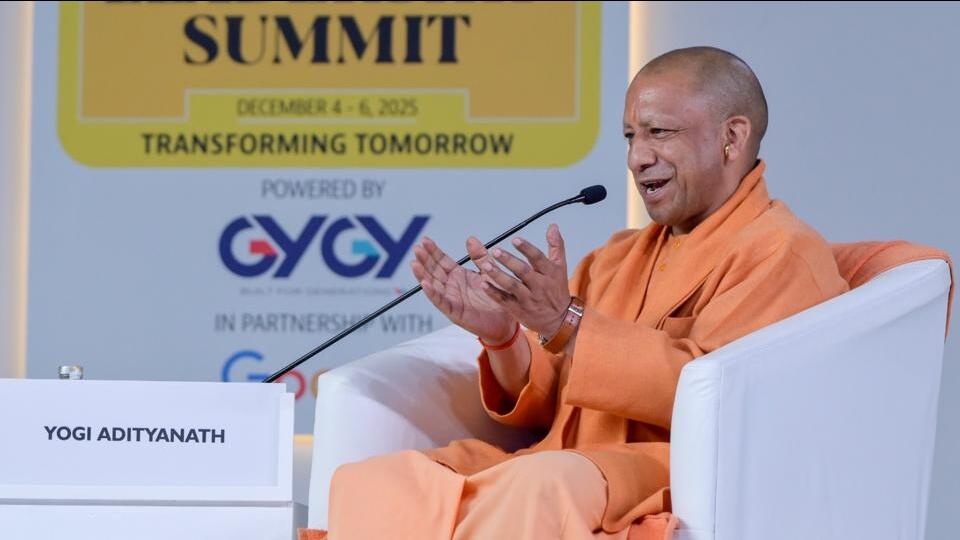
This was the response of Uttar Pradesh chief minister Yogi Adityanath on Saturday when he was asked about the movements by Hindu groups in Varanasi and Mathura to build temples, against the backdrop of the completion of the Ram Temple in Ayodhya.
At the 23rd Hindustan Times Leadership Summit, Adityanath – who became the first leader in Uttar Pradesh to serve a full-term and then win a second consecutive term when he secured a thumping majority in 2022 – also expanded on his development vision, called the completion of the Ram Temple an iconic moment of his tenure, and said his government would continue to defend the honour of women and dignity of citizens.
“Any society should feel a sense of pride in its heritage. And all these efforts have begun in that direction. We are grateful to the Honourable Supreme Court for its verdict after reviewing the facts and evidence presented before it. It is the biggest victory of Indian democracy that this decision of the Supreme Court was accepted by all,” Adityanath told Hindustan’s editor-in-chief Shashi Shekhar.
Prime Minister Narendra Modi performed a ceremony earlier this month to mark the completion of the Ram Temple. But Hindu groups in Varanasi and Mathura have also moved local courts asking for two mosques to be removed, arguing that they were built in the medieval ages by destroying ancient temples.
When asked to comment on a slogan doing rounds during the Ram Mandir movement, “abhi ayodhya kee baari hai, Kashi, Mathura baaki hai (it’s Ayodhya’s turn, Kashi and Mathura are next)”, Adityanath said, “We will reach all the places, and we have reached. Any community should have pride in its heritage, and in that direction, all these efforts have started.”
When asked about his tenure, Adityanath said that Uttar Pradesh had changed a lot over the last eight years. “Uttar Pradesh is the largest state in the country and for more than eight years, our party has given me the opportunity to serve there. In these eight years, a lot has changed within Uttar Pradesh and I am happy to be a part of that change.”
When asked about one thing that can be called a masterstroke in his tenure, Adityanath said it was difficult to shortlist and pick one from the long list of achievements. “When the tenure is long, the list of achievements is also long. No one will be able to tell just one occasion, be it Diwali or Chhath... it will be a challenge to name one thing but the construction of Shri Ram Janmabhoomi Temple after 500 years was one iconic moment in my career,” he said.
“It was an important moment in my life when, after 500 years, the foundation stone for the construction of the temple was laid in Ayodhya by PM Modi. After 500 years, a Ram Temple was constructed in Ayodhya and the ‘Dharam Dhwaj’ was hoisted…I have three generations associated with the movement.”
The chief minister said that after the foundation of the Ram temple was laid, tens of millions of devotees came, and after the “praan pratistha” programme, over 240 million pilgrims visited Ayodhya. He added that during festivals, 3.5-4 million devotees come to Ayodhya, while on normal days, it is between 100,000-150,000.
Adityanath said he had set a target for Uttar Pradesh to become a $1-trillion economy by 2029-30 and one of the things that was needed to kickstart this development was the restoration of law and order in the state.
“Our goal is that, by 2029-30, Uttar Pradesh will become a $1-trillion economy and it will become a $6-trillion economy by 2047. We have held a long discussion in the assembly on it. Uttar Pradesh will definitely achieve it. The progress of the last three years is in this direction and I believe we will achieve a developed Uttar Pradesh, self-reliant Uttar Pradesh,” he said.
The chief minister said investing in Uttar Pradesh was meaningless eight years ago because when a person was not safe, how could capital be. “To change this, we adopted a policy of zero tolerance towards crime and criminals, towards corruption and the corrupt, and I am happy to say there is a big improvement in law and order….there is no one district one mafia, but one district one product.”
When asked about encounters, the chief minister said there was zero tolerance on crime.
“The earth should be freed of the burden of some people. This freedom from burden is not for the earth alone, but also for the people themselves. We said zero tolerance. And we often say that if you play with the safety of our daughter, then a ‘yamaraj’ will be waiting for you at the next crossroads,” Yogi Adityanath said.
“Every person wants justice, and wants timely justice. Whichever path this justice may take. And the audacity of the criminals, the mafia should be stopped... If their language is different, we will have to explain things to them in their language. And we have done that,” he added.
The chief minister underlined the infrastructure boom under his administration, focussing on metros, expressways and airports. He also underlined connectivity, citing the example of the new airport set to open in Noida’s Jewar. “We will inaugurate it within the next two months,” he said. The Jewar airport is being built to handle 12 million passengers annually in its first phase, and will be expanded later to handle up to 120 million passengers by 2050.
He also spoke about housing reform and the steps taken to ensure law and order, saying that when it came to women’s safety and the dignity of citizens, his government will not hesitate to take difficult steps.


