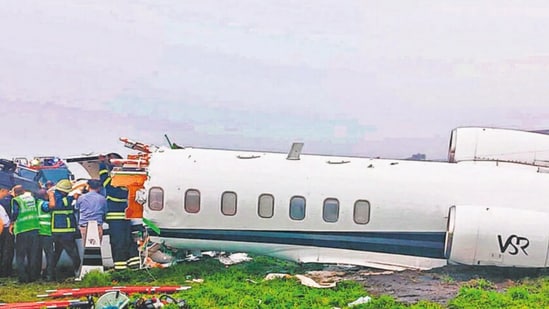
The Aircraft Accident Investigation Bureau (AAIB) has blamed the September 2023 Learjet crash at Mumbai airport on the crew’s decision to continue an unstable approach in poor weather. It also found lapses in pilot training, record-keeping and internal audits at VSR Ventures, the operator whose Learjet crashed at Baramati in January, killing Maharashtra deputy chief minister Ajit Pawar and four others.
The AAIB also recommended that the DGCA carry out “a one-time check of all the training records of fixed wing pilots specially for Non-Scheduled/General Aviation organizations” to verify that mandatory simulator exercises were completed.
Also Read I DGCA bans MOBIKINS model power bank on flights after IndiGo fire incident
What the final report reveals
The final report, made public on Friday, comes more than three years after the accident, well beyond the 12 months recommended under International Civil Aviation Organization norms. In January, after the Baramati crash, HT found that the Mumbai report was among those still pending. Experts said then that its findings could have shown whether VSR needed stricter oversight.
The Learjet 45XR, registered VT-DBL, crashed while landing on runway 27 on September 14, 2023, on a non-scheduled flight from Visakhapatnam. All eight people on board were seriously injured.
{{/usCountry}}The Learjet 45XR, registered VT-DBL, crashed while landing on runway 27 on September 14, 2023, on a non-scheduled flight from Visakhapatnam. All eight people on board were seriously injured.
{{/usCountry}}Also read | Ajit Pawar plane crash: DGCA grounds four aircraft of VSR after Baramati crash audit over safety lapses
“The probable cause of the accident was the flight crew’s decision to continue the un-stabilized approach under marginal weather conditions and inappropriate handling of aircraft which led to an aerodynamic stall at low altitude from which the aircraft did not recover,” the report said.
Several factors contributed to the accident. The crew did not monitor airspeed against a rising low-speed cue, and the monitoring pilot was late in calling for a go-around. Rain impaired the crew’s visual cues, the aircraft had a high tailwind, and the crew showed “undue commitment” to land before restrictions at Mumbai took effect. Both engines were working normally, and the aircraft’s serviceability did not contribute, the report said.
Audits and surveillance reports
During the recurrent training of some of the company’s Learjet pilots, investigators found, skill checks on critical emergency items were not carried out “in toto” in the one-year cycle, including on simulators. Technical and airframe log books were not maintained properly, and “the internal audits were not carried out diligently by the company,” the report said.
Audit and surveillance reports of the Directorate General of Civil Aviation (DGCA) reviewed by investigators did not contain the findings that emerged during the probe.
Also read | Ajit Pawar plane crash: Rohit Pawar claims factual errors in AAIB’s preliminary report, suspects cover up
After the Baramati crash, the civil aviation ministry said the DGCA’s last audit of VSR, in February 2025, had raised no level-I findings, the most serious category.
The also AAIB recommended that the DGCA carry out “a one-time check of all the training records of fixed wing pilots specially for Non-Scheduled/General Aviation organizations” to verify that mandatory simulator exercises were completed. It asked the regulator to add stall recovery in landing configuration to recurrent training.
Also read | Runway not in sight, oh s***, then crash: Blow-by-blow account of what happened on Ajit Pawar's flight
It also asked for a direction to non-scheduled and general aviation operators to ensure pilots complete all mandatory training, including critical emergency exercises.
These operators should require pilots to go around whenever an approach is not stabilised, the report said. It also called for stronger crew resource management training so that the monitoring pilot is assertive in calling out deviations.
For VSR, the bureau recommended proper challenge-and-response checklists and better maintenance record-keeping. It asked the DGCA to verify operators’ manuals against regulations and to check how effective their internal audits are during inspections.