
 E-Paper



Aditya L1 launch: ISRO to perform first Earth-bound firing today. Top updates
Aditya-L1 mission: Aditya-L1 will stay Earth-bound orbits for 16 days, during which it will undergo five manoeuvres to gain necessary velocity for its journey.

 Prefer HTon Google


The Indian Space Research Organisation (ISRO) said the first Earth-bound firing to raise Aditya-L1's orbit is scheduled at around 11:45 am on Sunday, a day after the Polar Satellite Launch Vehicle or PSLV-C57.1 rocket carrying the orbiter lifted off successfully from the Satish Dhawan Space Centre in Andhra Pradesh's Sriharikota.
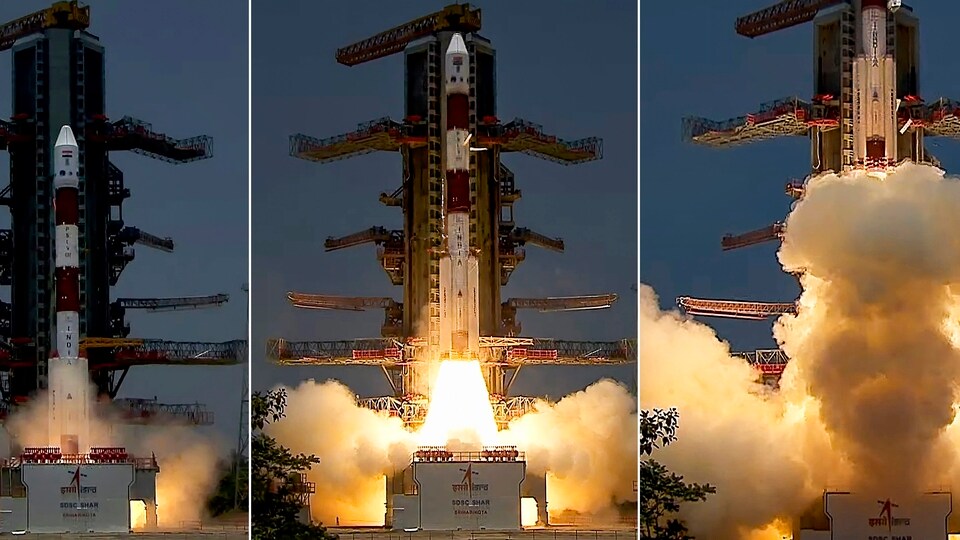
The successful launch of ISRO’s first solar mission came a week after its historic lunar landing mission — Chandrayaan-3.
Top updates on Aditya-L1 solar mission
1. "Aditya-L1 started generating the power. The solar panels are deployed. The first Earth-Bound firing to raise the orbit is scheduled for September 3 around 11:45 hours," the ISRO said on Saturday.
2. The Earth-bound manoeuvres will involve the rockets firing and some adjustments to angles, as required. How this will work can perhaps be understood by taking the example of when a person is on a swing — to make the swing go higher, a pressure (by shifting body weight) is applied when in the phase when the swing is coming down towards the ground. In Aditya-L1’s case, once it gains enough velocity, it will slingshot around to its intended path towards L1.
Also Read | Aditya-L1 launch: Meet the women who helmed Sun mission success
3. The PSLV has placed the Aditya-L1 satellite precisely into its intended orbit, the agency said.
4. Aditya-L1 will stay Earth-bound orbits for 16 days, during which it will undergo five maneuvres to gain the necessary velocity for its journey, the ISRO said.
5. Subsequently, Aditya-L1 will undergo a trans-Lagrangian1 insertion manoeuvre, marking the beginning of its 110-day trajectory to the destination around the L1 Lagrange Point, it said.
6. Once arrived at the L1 point, another manoeuvre will bind Aditya-L1 to an orbit around L1, a balanced gravitational location between the Earth and the Sun. The satellite will spend its whole mission life orbiting around L1 in an irregularly shaped orbit in a plane roughly perpendicular to the line joining the Earth and the Sun.
7. According to the agency, the Aditya-L1 mission is expected to reach the observation point in four months. It will be placed in a halo orbit around Lagrangian Point 1 (or L1), which is 1.5 million km away from the Earth in the direction of the Sun.
8. It is carrying seven different payloads, which will conduct a detailed study of the Sun. While four of the payload instruments will observe the light from the Sun, the remaining three will measure in-situ parameters of the plasma and magnetic fields.
9. This strategic location will enable Aditya-L1 to continuously observe the Sun without being hindered by eclipses or occultation, allowing scientists to study solar activities and their impact on space weather in real-time.
10. The spacecraft's data will help identify the sequence of processes that lead to solar eruptive events and contribute to a deeper understanding of space weather drivers.
(With inputs from agencies)


