Attorney General of India KK Venugopal on Tuesday urged the Supreme Court to initiate contempt action against the Maharashtra State Board of Wakfs for trying to remove him and his team from an important case that seeks to settle the definition of waqf properties and decide the contours of religious trusts.
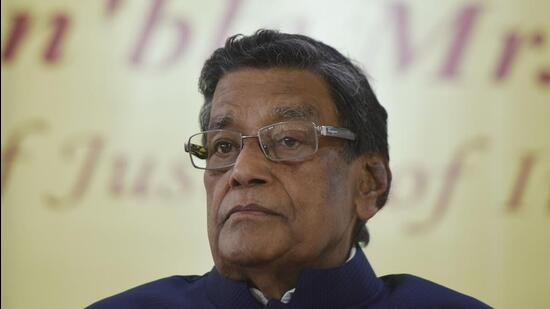
Appearing before a bench headed by Chief Justice of India NV Ramana, Venugopal expressed shock at the conduct of the Wakfs Board in dealing with the AG’s office so casually, and demanded initiation of contempt of court action against the body for its endeavour to interfere with the administration of justice.
AG referred to his unprecedented letter sent to the registrar (judicial) in the Supreme Court on Monday, in which the veteran lawyer brought the latest development to the notice of the CJI. He highlighted that removing counsel representing the parties at the last minute was a “serious, uncalled for and unwarranted attempt to interfere with the administration of justice.”
When the matter was called out on Tuesday, CJI Ramana acknowledged having received the AG’s letter and pulled up the counsel for the Wakfs Board. “This is not the way you behave with AG. You forced him to write a letter. He was down with Covid and you changed the counsel? We take very strong note of this,” the CJI told the lawyer appearing for the Wakfs Board.
Also read: Pegasus panel gives report to Supreme Court
{{/usCountry}}Also read: Pegasus panel gives report to Supreme Court
{{/usCountry}}The Board’s lawyer told the court that he received a communication from the Board CEO on Sunday that since the matter required to be decided urgently and the AG was down with Covid, a new legal team was being positioned to argue the case further.
But the bench disapproved of the submission. “So, you do it in this manner? This is not proper. What is it that you were thinking?” asked the bench, which also comprised justices Krishna Murari and Hima Kohli.
The Board’s lawyer then expressed apology and informed the bench that the letter removing the AG has since been withdrawn.
Venugopal, however, insisted that such conduct in the highest court of the land should not be tolerated and that the Supreme Court must dwell on the contemptuous action of the Wakfs Board. “So far, this has never happened. This cannot be allowed in the highest court. This is disgraceful,” he added.
To this, the bench agreed to examine AG’s complaint on the next date of hearing as it also told the other side, being represented through senior advocates Harish Salve and Abhishek Manu Singhvi, that the case would not be preponed and would be heard on August 19.
In his two-page letter that HT has seen, Venugopal complained that he along with his entire team, including senior counsel Gopal Sankaranarayanan, advocate Javed Sheikh (who, the AG called an authority on Wakf law) and the advocate-on-record (AoR), had been removed abruptly by the Wakfs Board. “This is clearly an act of contempt of court,” the letter read.
It added that AoR being changed made no difference on the AG’s right of audience. “It will be noted that when the Attorney General exercises his right of audience under Article 76(3) of the Constitution, he does it on his own right and need not exercise the right only on instructions from an advocate on record,” the letter said.
The batch of cases in the top court involves substantial questions of law pertaining to the contours of the Wakf Act and the Bombay Public Trust Act. One of the moot issues raised before the top court in 2011 appeals is as to whether every charitable trust established by someone professing Islam is necessarily a waqf and therefore, out of the ambit of the Bombay Public Trust Act.
Also read: Supreme Court directs SBI to pay ₹30 lakh to 80-yr old for bank locker theft
In September 2011, the Bombay high court had set aside the circular issued by the Maharashtra government by which it had constituted the Wakfs Board, which administers all Muslim religious trusts in the state under the Wakf Act. It had dissolved the Board terming it “defective”, and directed that the provisions of the Bombay Public Trust Act will govern Muslim trusts till the Waqf Boards are reconstituted after taking into consideration relevant data indicating the total number of Muslim religious charitable trusts and their categorisation among Shia and Sunni Wakfs.
The high court judgment was stayed by the Supreme Court in November 2011 after the Wakfs Board filed an appeal.