
 E-Paper



AI bubble will break; India should be worried: Economist Joseph E Stiglitz at HT Leadership Summit
Nobel laureate and economist Joseph E Stiglitz said at HT Leadership Summit on Saturday that the AI investment bubble will break.

 Prefer HTon Google


India should be worried about artificial intelligence (AI) because it has first hit sectors that drove the country's growth, Nobel laureate and economist Joseph E Stiglitz said on Saturday, warning that the investment boom behind the technology is a bubble that will break.
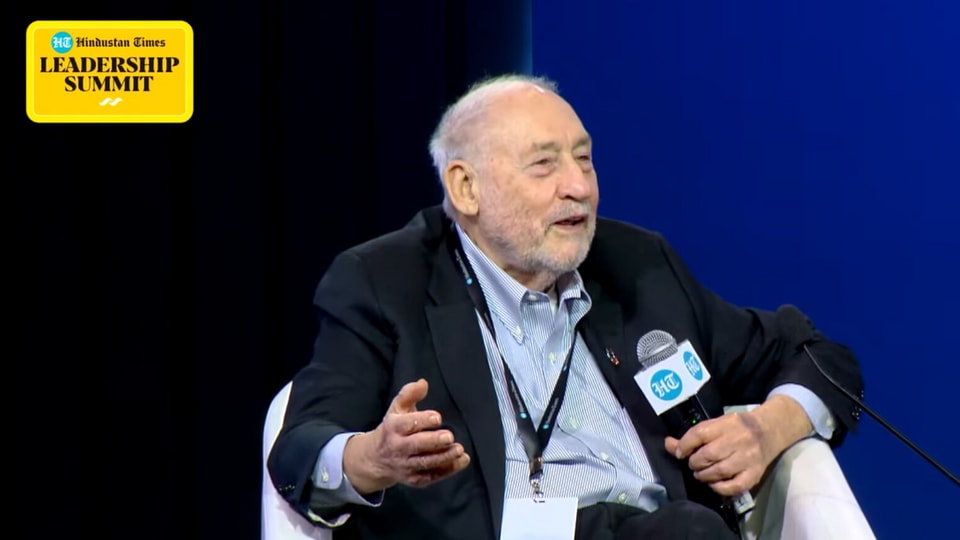
"I think India should be worried. If you look at where AI has affected most quickly, it has been in the tech sector. It's an irony that AI was really good at replacing coders, programmers..." Stiglitz said at the 24th Hindustan Times Leadership Summit, in conversation with Dr Niranjan Rajadhyaksha, executive director of Artha Global.
The sectors AI had affected most in the US were the ones that had been "very supportive of the Indian transformation," he said. "The question is, how do you pivot? That's an open question not only in India but in the US and all countries."
Stiglitz has warned before that the US lacks the policies to manage job losses from AI, telling Fortune in March: "We do not have the macro or micro framework for managing that kind of displacement."
At the summit on Saturday, he said one cannot tell if something is a bubble until it breaks. "I think the AI bubble is a bubble and it will break and there will be big consequences," Stiglitz said. "I don't think there is a macroeconomic model for AI. And if you don't have a macroeconomic model, they will fracture the economy. It is hard to see how the bubble will not break."
He said rivals were catching up with the leaders quickly. "If you see the race between Anthropic and OpenAI, here's a company 2-3 years old that's catching up. Then you have DeepSeek, not quite caught up [on capability] but at marginal costs."
He questioned how AI companies were pitching themselves to investors ahead of share sales. "AI companies, they are advertising as they try to issue their IPO. It is the strangest advertising. We are producing a product that is very dangerous and will kill you all," he said.
The gains, he said, would not be shared across countries. "In principle, in the US, we could tax the winners of the AI revolution and use some of it to support a progressive AI agenda where you use it to make investments in people and society. But across borders? Where the winners are in the US and losers are in other states? There, that redistribution will not happen," said Stiglitz, who shared the 2001 Nobel Prize in economics, chaired Bill Clinton's Council of Economic Advisers from 1995 to 1997 and was the World Bank's chief economist from 1997 to 2000.


