
 E-Paper



Air Force team deployed in Baramati after crash kills Ajit Pawar: What was lacking at ‘uncontrolled’ airport?
As the guardian minister of Pune district, Maharashtra deputy chief minister Ajit Pawar was also seeking an upgrade to the Baramati airport.

 Prefer HTon Google


Basic navigation aids, fire tender and a proper air traffic control service - a lot remains missing at Maharashtra's Baramati airport, where the plane carrying deputy chief minister Ajit Pawar and four others crashed on Wednesday morning. A team of the Indian Air Force (IAF) has been deployed at the airport following the deadly crash, and is providing the basic Air Traffic Control (ATC) and meteorological services there for now.
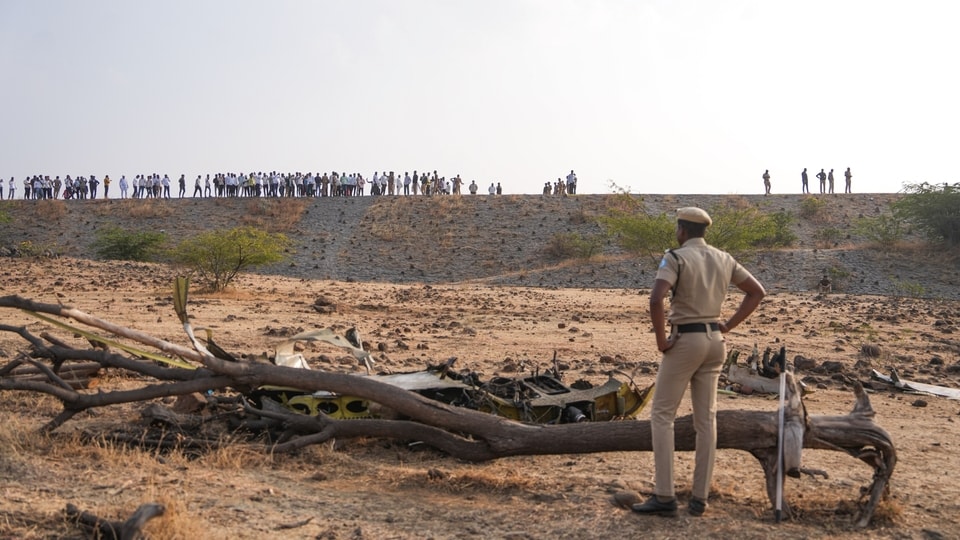
“This rapid assistance underscores IAF's commitment to national service in times of need,” the Air Force said in a tweet.
According to the civil aviation ministry, the Baramati airport is categorised as "uncontrolled", also known as category A of the four buckets Indian airports fall into. Currently, the Air Traffic Control (ATC) in Baramati is run by pilot cadets from local flying schools - Redbird Aviation and Carver Aviation, who take turns to manage the facility on alternate days.
As the guardian minister of Pune district, Ajit Pawar was also seeking an upgrade to the Baramati airport and had ordered the implementation of some basic facilities.
When the Learjet 45, carrying Ajit Pawar, was trying to make a landing in Baramati on Wednesday, the ATC was being manned by a flight instructor from Carver Aviation, said Pramesh Parikh, the academy's accountable manager.
No fire tender, shallow hump on runway
The Baramati airport, constructed by the Maharashtra Industrial Development Corporation, was inaugurated in 1996. Officials said that the airport usually witnesses only four to five air traffic movements weekly from other airports.
According to airport in-charge Shivaji Taware, the airport lacks proper fire tender too. There was one fire tender from Baramati Municipal Council on standby ahead of the VIP arrival of Ajit Pawar's plane yesterday.
"When we realised that the plane had crashed, we called for more fire tenders from the Baramati Municipal Council and the Maharashtra Industrial Development Corporation and arrived soon after,” Taware added.
Since Baramati has a small airport, the width of the runway here is just 30 metres, as opposed to big airports, said Sanjay Karve, who retired in 2025 as Maharashtra aviation director. "This runway also has a shallow hump which can alter a pilot’s perception. In my opinion it’s not suitable for VIP operations,” Karve said.
No metrological facility, basic navigation aids
According to Karve, the Baramati airport lacks basic navigational aids like VOR, a radio navigation beacon that allows an aircraft with a receiver to determine their position and navigate it, or PAPI (Precision Approach Path Indicator), which tells whether the aircraft is high or low on approach.
The official also said that the airport does not have an independent meteorological facility and relies on data from Pune airport. On the day Ajit Pawar's jet was trying to land, the area was shrouded in dense fog, with visibility reduced to 3,000 metres, according to officials manning the ATC, who spoke to HT on condition of anonymity.
Captain Naufil Karnalkar, who learnt flying at Baramati, also confirmed that the visibility in the area was poor on Wednesday and said that the ATC there can be managed better. “The Maharashtra Airport Development Company (MADC) has not done anything about smoothening the runway surface either,” Karnalkar said.
Also Read: Pilot's 'good morning' exchange with grandmother hours before Baramati plane crash tragedy
The airport falls into the “uncontrolled” airports category, where no air traffic control is provided. “There are about 150 uncontrolled airports in India. They have a basic runway and no ATC tower or ATC frequency,” said Mihir Bhagvati, aviation expert and a DGCA-approved examiner for pilots.
When Ajit Pawar's plane was trying to land at the airport on Wednesday, a flight instructor from Carver Aviation was manning the ATC facility.
Ajit Pawar had ordered an upgrade
Deputy chief minister Ajit Pawar, one of the five victims of the plane crash in Baramati, was also reportedly seeking an upgrade in the airport's facilities. Airport incharge Shivaji Taware told HT that Pawar had undertaken many meetings in this regard.
“He had asked for basic facilities like PAPI (Precision Approach Path Indicator –– a system of lights that provide visual guidance to the runway) and night landing and a regular ATC,” Taware said.
Also Read: Face not recognisable, locals identified Ajit Pawar by his wristwatch after plane crash
Earlier, the Anil Ambani-owned Reliance Airport Developers managed the airport but MADC manager Taware said they took over on August 19 because of some “lacunae in its management”.
(With inputs from HT correspondent Yogesh Naik)


