
 E-Paper



Delhi air still severe: Worst December run in three years
Delhi faces severe air pollution for four consecutive days, with AQI at 429. No relief expected over the weekend due to low wind speeds.


The Capital recorded a fourth consecutive severe air pollution day on Friday, making it the longest streak that the air quality index (AQI) was above 400 in the month of December since 2021 with little respite on the horizon, according to weather officials.
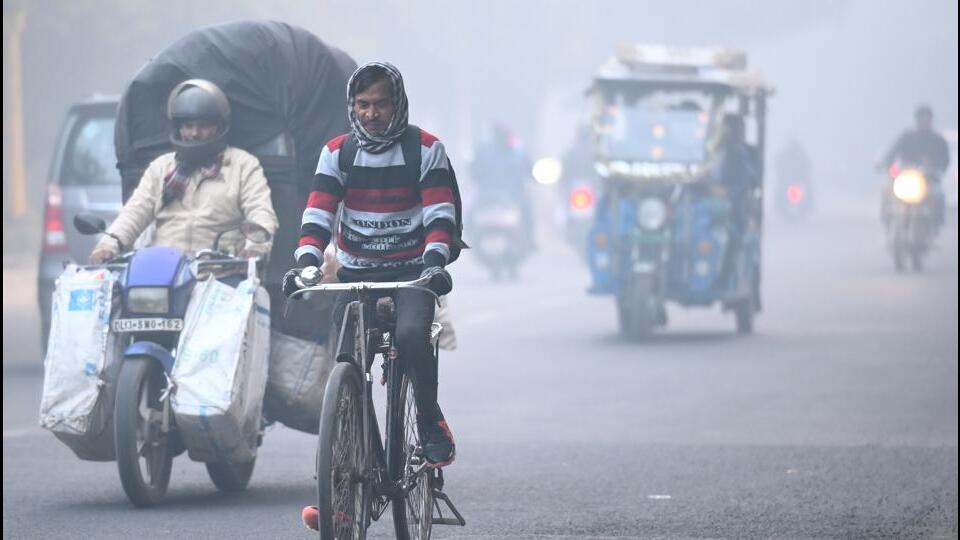
At 4pm on Friday, the 24-hour average AQI was at 429, marginally better than Thursday’s 451 (severe-plus) but just as hazardous, according to data from the Central Pollution Control Board (CPCB). In 2021, Delhi recorded six such consecutive days, between December 21 and 26.
The spell of noxious air began on Sunday when winds died down, trapping local pollutants — tailpipe emission, dust and bonfires lit by people to keep warm — in the city’s air as a layer of sooty haze. The AQI on Sunday was 294 (poor), the day when Delhi last had clear sunshine. It then entered a free fall: 379 on Monday (very poor), 433 (severe) on Tuesday, 445 (severe) on Wednesday, and 451 (severe plus) on Thursday.
According to the weather agency’s forecast, there will be no relief for residents over the weekend as the average wind speed hover in 5km/hour during the day on Saturday and Sunday. The Centre’s Early Warning System for Delhi (EWS) said the AQI will improve to “very poor” on Saturday before deteriorating yet again to the “severe” category on Sunday.
The city needs winds of at least 10km/hour on average over the day to blow away the emissions it generates locally.
Experts said one key factor was at play, leading to several conditions. “Ever since a western disturbance began impacting northwest India this week, we have seen stagnation as wind speeds have dropped. At the same time, moisture is gradually being introduced into the air, which also traps pollutants. So far, no major change is likely over the weekend and the AQI could stay severe,” said Mahesh Palawat of Skymet Weather, adding that another western disturbance was likely from December 23.
He added that another western disturbance was likely towards the end of the month, between December 28 and 29, which may even bring rain over the plains. “That is when we may see some significant improvement in AQI,” he added.
The CPCB classifies AQI between 0 and 50 as “good”, between 51 and 100 as “satisfactory”, between 101 and 200 as “moderate”, between 201 and 300 as “poor”, between 301 and 400 as “very poor”, and over 400 as “severe”.
In 2021, the AQI touched a peak of 459 on December 26, 2021. The highest-ever AQI recorded in December was 469 on December 21, 2017.
The moisture led to moderate fog recorded on Friday, dropping visibility to 300 metres at Safdarjung at around 7.30 am. It was 700 metres at Palam, but flight operations were not impacted. The India Meteorological Department (IMD) has issued a yellow alert for both Saturday and Sunday, forecasting moderate to dense fog in the region.
The minimum temperature rose at most locations in the city on Friday. Safdarjung, representative of Delhi’s weather, recorded a minimum temperature of 7.5°C — a degree below normal. It was 5°C a day earlier. The maximum was 23.3°C, a degree above normal. It was 23°C a day earlier. Forecasts show the maximum is likely to hover around 23°C over the weekend, while the minimum will oscillate between 7-8°C.


