Amar Jawan Jyoti to be merged with National War Memorial flame. This is why
While the Amar Jawan Jyoti was lit in 1972 after the 1971 war, the India Gate honors the soldiers of British Army who fell between 1914-1921. The National War Memorial honors the fallen brave hearts, who fought for independent India against Pakistan, China, Sri Lanka and in counter-terrorist ops.
At 1554 hours today, Air Marshal Balabadra Radha Krishna, Chief of Integrated Defence Staff, in the absence of serving Chief of Defence Staff will merge the flames of Amar Jawan Jyoti with the eternal flame at the National War Memorial in a ceremonial function.
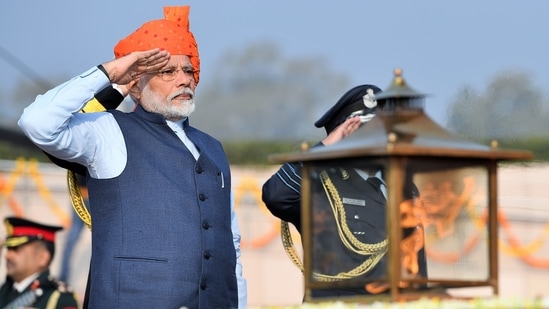
PM Modi at the National War Memorial. (Twitter/@PIB_India)
{{^htLoading}} {{/htLoading}}
According to South Block officials, the merger of flames will be done in an elaborate ceremony which begins at 3:30pm with the arrival of CISC at the Amar Jawan Jyoti at India Gate. The flame will be moved in a torch to National War Memorial along with Guard Contingent and the two flames will be merged.
The merger of flames was done as the Amar Jawan Jyoti was lit up in 1972 after the 1971 Indo-Pak war under the India Gate, which is a memorial to 90,000 soldiers of the British Indian Army who died between 1914 and 1921in the World War I, in France, Flanders, Mesopotamia, Persia, East Africa, Gallipoli and the Third Afghan War. While the Amar Jawan flames represent the immortal soldier, the India Gate is representative of Colonial India.
{{^htLoading}} {{/htLoading}}
Amar Jawan Jyoti
{{^usCountry}}
The National War Memorial, unveiled on February 25, 2019, honors and represents soldiers of Indian military who fought conflicts for independent India. The name of armed forces personnel killed during the armed conflicts with Pakistan and China as well as 1961 war in Goa, Operation Pawan in Sri Lanka and other operations including Rakshak in UT of Jammu and Kashmir are inscribed in the memorial in golden letters. This allows the near and dear ones of the fallen brave heart as well as the public to pay respects to the fallen warrior.
{{/usCountry}}
{{#usCountry}}
The National War Memorial, unveiled on February 25, 2019, honors and represents soldiers of Indian military who fought conflicts for independent India. The name of armed forces personnel killed during the armed conflicts with Pakistan and China as well as 1961 war in Goa, Operation Pawan in Sri Lanka and other operations including Rakshak in UT of Jammu and Kashmir are inscribed in the memorial in golden letters. This allows the near and dear ones of the fallen brave heart as well as the public to pay respects to the fallen warrior.
{{/usCountry}}
{{^htLoading}} {{/htLoading}}
The decision to merge the two flames was taken as there cannot be two war memorials in close proximity to each other and it is the National War Memorial which represents independent India and eternal soldier.
Shishir Gupta is Executive Editor at Hindustan Times and one of India's top journalists covering national security, strategic affairs, foreign policy and geopolitics. Over the past three decades, he has extensively reported on India's military, diplomatic and security landscape, covering every major conflict and national security challenge, from the 1999 Kargil War and the 2020 East Ladakh standoff to Operation Sindoor in 2025. He has also covered major terror attacks, including the IC-814 hijacking, the 26/11 Mumbai attacks and the 2025 Pahalgam terror strike, along with numerous Pakistan-backed terrorist incidents in the Kashmir Valley and across India. He has reported on national and state elections for more than three decades. A recognised authority on strategic affairs, Gupta has covered India's nuclear programme since the Pokhran-II (Shakti series) tests in May 1998 and has written extensively on global nuclear issues, Indian diplomacy and the country's expanding global outreach. He has also reported widely on international conflicts and terrorism, with a special focus on the Indian subcontinent. Gupta has interviewed Prime Minister Narendra Modi more than four times, including Modi's first interview with the print media after becoming Prime Minister in May 2014. His other interviews include three with the Dalai Lama, as well as conversations with Benjamin Netanyahu, Amit Shah, Yogi Adityanath, S. Jaishankar, Nirmala Sitharaman and Piyush Goyal. He is the author of Indian Mujahideen: The Enemy Within (Hachette, 2011) and Himalayan Face-off: Chinese Assertion and Indian Riposte (Hachette, 2014). He was awarded the Chevening-Wolfson Joint Scholarship at Wolfson College, University of Cambridge, UK, in 1998 and participated in the International Visitor Leadership Program (IVLP) of the US State Department in 2006. He received the Ben Gurion Prize from Israel in 2011 and the K. Subrahmanyam Prize for Strategic Studies in 2015 from the Manohar Parrikar Institute for Defence Studies and Analyses (MP-IDSA). Since 2024, he has hosted Point Blank, Hindustan Times' weekly YouTube show on global geopolitics.
Get the latest India News, breaking headlines, and real-time updates from across the nation. Stay informed on politics, government policies, crime, weather, and CEC Gyanesh Kumar row Live.
Get the latest India News, breaking headlines, and real-time updates from across the nation. Stay informed on politics, government policies, crime, weather, and CEC Gyanesh Kumar row Live.
Home/India News/Amar Jawan Jyoti to be merged with National War Memorial flame
{{^htLoading}}
Advertisement
{{/htLoading}}
SHARE THIS ARTICLE ON
{{#usCountry}}{{/usCountry}}
Notifications
Get breaking alerts directly from the newsroom
Notifications are on!You'll be notified when news breaks