
 E-Paper



Amaravati: After a long wait for capital, new promise for a future
Jai Amravati, they chant till late in the evening, only to reassemble the next day. For most of those 800 days, the slogan was one of longing, of despair. Now, there is hope.

 Prefer HTon Google


Every day for the past 800 days, Gottipati Lakshmi, 40, has done the same thing. Leave home a little before 9am, and walk close to a km to a tarpaulin tent in the heart of Thullur town. She dons a green stole, and with 200 fellow farmers, both men and women, starts chanting.
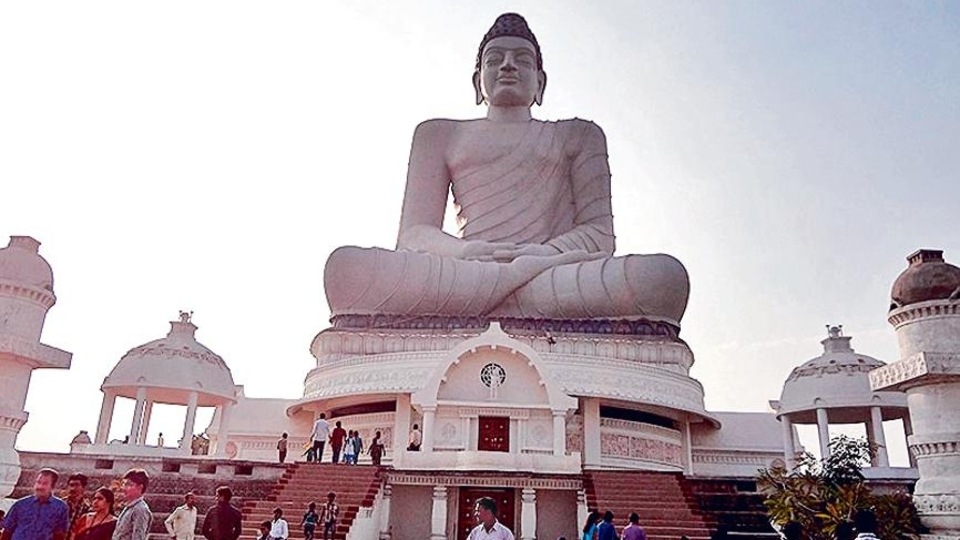
Jai Amravati, they chant till late in the evening, only to reassemble the next day. For most of those 800 days, the slogan was one of longing, of despair. Now, there is hope.
Lakshmi is one of close to 28,000 farmers from 24 villages who together gave away more than 34,000 acres of land to the state government in 2015 for the creation of Andhra Pradesh’s new capital, Amaravati. Lakshmi surrendered five acres, and dreamed that the new greenfield capital would turn her life around.
Then, in April 2019, the state government changed. Amaravati was a project chief minister Chandrababu Naidu of the Telugu Desam Party that lost the election that year. The new man at the helm, his arch nemesis Jagan Mohan Reddy from the YSR Congress Party, wasn’t quite on the same page, dropped the Amaravati project, and proposed a plan to have three capitals instead — an executive capital at Vishakhapatnam, a judicial capital at Kurnool, and only the legislative capital in Amravati.
This set off a massive battle, both on the streets, and in the courts. In December 2021, Lakshmi was one of the hundreds of farmers who walked for over 400km to reach Tirupati to mobilise public support for their agitation, asking that Amaravati to be retained as the sole state capital.
On March 3, the Andhra Pradesh High Court junked the three capital plan, and upheld Amravati as the only capital in the state. What this may mean, a challenge in the Supreme Court notwithstanding, is a revival of a slew of proposed projects which were allotted land by the TDP government, such as central government institutions, the National Institute of Design (50 acres), National Institute of Fashion Technology (10 acres), National Biodiversity Museum (25 acres), Central Public Works Department (28 acres), Reserve Bank of India (11 acres), and Comptroller and Auditor General of India (17 acres).
For farmers like Lakshmi, there is not only now a promise of a future that had once gone bleak, but a sense of justice. “We have braved police cases, lathi charges and insults all these days. We have finally got justice from the high court,” said Lakshmi, tears in her eyes. “Our long struggle has paid off.”
Why Amaravati was chosen as capital
Months after the bifurcation of Andhra Pradesh in June 2014, the TDP government headed by Naidu identified a fertile agricultural zone between Vijayawada and Guntur as the capital city and named it Amaravati, after an ancient city of the Sathavahana dynasty on the banks of Krishna River.
The selection of Amaravati was against the advice of an experts’ committee headed by former home secretary K Sivaramakrishnan, which opposed building of a super city on the lines of Hyderabad, the capital of Telangana, and suggested a decentralised model.
But Naidu had a different argument. He envisioned a capital, centrally located in the geography of the now redrawn Andhra Pradesh, spread across 7,000 sq km, larger than even Brihan Mumbai.
“When the TDP government proposed to acquire our fertile land, many of us were not willing to give up what was our only source of livelihood,” recalled Puvvada Surendra Babu, a farmers’ leader in Thullur.
But the government pressed on, and the farmers bought into the idea of a state capital, replete with towers blocks, commercial complexes, big business houses with huge employment potential, educational institutions, universities, hospitals, banks and entertainment avenues.
“We were convinced that construction of capital would definitely turn around our lives. We thought our children would get better education and employment opportunities. So, we agreed to part with our lands and signed an agreement with AP Capital Region Development Authority (APCRDA), created through a legislation for development of Amaravati as the capital city,” Babu said.
The government acquired 34,385 acres from 28,526 farmers, under a land pooling system in 2015. As per the agreement, the farmers were allotted between 250 to 400 sq yards of commercial land, and 1,000 sq yards of residential land for every acre they surrendered to the authority.
Additionally, each farmer who surrendered their lands to the capital would get an annuity payment of ₹30,000 to ₹50,000 per acre, depending on whether the land was dry or wet, for 10 years, with a 10% rise every year. It was an innovative plan — and meant the farmers were effectively shareholders in the new city.
On October 22, 2015, Prime Minister Narendra Modi laid the foundation stone for Amaravati, and immediately after, the Naidu government moved its seat of power from Hyderabad to Amaravati. Though Naidu doesn’t have a permanent residence of his own in Amaravati, he took a private bungalow on the banks of Krishna river at Vundavalli village on lease.
He set up his camp office in Vijayawada, and worked from there. In the three years that followed, among the structures that were built were an interim government complex, a temporary High Court building, a legislature complex, even bungalows and apartments for lawmakers, judges, and officers.
The TDP government spent around ₹8,572 crore on Amaravati in three years, including ₹5,674 crore on infrastructure, according to the figures available with the APCRDA. While the central government gave ₹2,500 crore, the state government obtained loans from banks and raised ₹2,000 crore through capital bonds.
On May 15, 2017, the Naidu government signed an agreement with a Singapore government consortium, which includes companies such as Ascendas Singbridge Pte and Sembcorp Development, to develop a 6.84sq km start-up area in Amaravati. It was the first public-private partnership venture which was expected to bring in big business houses, IT giants and other companies from across the world. It was supposed to be executed in three phases over 15 years. However, things did not move fast for the project due to delay in the approval of the capital city design.
Change in power, change in priorities
All that changed in 2019 when the YSR Congress stormed to power. Within hours of assuming charge as chief minister, Jagan halted the Amaravati project . For the next six months, there was practically no activity in the region and contractors abandoned Amaravati because of a lack of payment, their workers leaving too with no work.
After the change in government in May 2019, the Amaravati project was shelved and so was the Singapore consortium’s Amaravati start-up area project. The Jagan Mohan Reddy cabinet decided to wind up the agreement with the Singapore consortium, as it felt the project smacked of a major real estate scam.
Finally, on November 13, 2019, Singapore trade and industry minister V Iswaran announced closure of the start-up area project on “mutual consent” between the state government and the Singapore consortium.
“We note that the newly elected government of Andhra Pradesh has decided not to proceed with the start-up area, given its other priorities for the state,” Singapore government’s minister-in-charge of trade relations S Iswaran said in a statement.
Reddy accused Naidu of turning Amaravati into a real estate venture, and said the former chief minister indulged in a form of insider trading, leaking information about the location to those close to him, which meant they bought lands at cheaper rates that exploded manifold once the capital was formally proposed. He also argued that focusing development on one single mega capital would be an injustice to other regions of the state.
In January 2020, the YSRCP government introduced two separate bills – the Andhra Pradesh Decentralisation and Inclusive Development of All Regions Bill, 2020, seeking to establish three capital cities, and the Andhra Pradesh Capital Region Development Authority (Repeal) Bill, 2020, aimed at doing away with the authority created to develop Amaravati as the capital.
Both bills were passed by the state legislative assembly, but were stalled by the TDP in the legislative council, where it had a majority.
Even as the farmers of Amaravati launched an agitation, in June 2020, the state government reintroduced the two bills in the state assembly. While the council stalled the bills again and recommended them to a select committee, on July 31, governor Biswa Bhushan Harichandan gave his consent, which then became law.
Legal challenges
More than a hundred petitions, including some by joint action committees by farmers, were filed before the High Court. A division bench headed by former chief justice J K Maheshwari took up the hearing in August 2020 and ordered status quo.
In November 2021, another bench led by chief justice Prashant Kumar Mishra took up the hearing, but even as the matter was being heard, the Jagan Reddy government suddenly announced the withdrawal of the two laws on the three capitals and abolition of the APCRDA. Reddy announced he would reintroduce a foolproof and improved bill on the three capitals issue.
But even before a new legislation could be presented, the bench upheld Amaravati as the only capital of Andhra Pradesh on March 3. It also declared the state government cannot take up any legislation to shift or trifurcate the capital.
The court judgement, though not unexpected, has put the state government into a tight spot. It will definitely move the Supreme Court, but intends to take time to do so, an official from chief minister’s office (CMO) said on condition of anonymity. “The government has three months’ time to file the special leave petition in the Supreme Court. If necessary, it will seek more time from the apex court for filing the appeal,” the official said.
However, in its order, the court has directed the APCRDA to provide basic amenities such as roads, drinking water, drainage and electricity within one month, and hand over the developed commercial and residential plots in Amaravati to the landholders who surrendered their lands for the capital within three months.
The court also ordered that the state government and APCRDA construct and develop the Amaravati capital region as per the approved master plan within six months.
This is an uphill task. “How is it possible to the present government to complete the construction within six months with all the amenities? It requires huge money and time,” said a top official of the state municipal administration and urban development department, which is overseeing the Amaravati project. He declined to be named.
State of Amaravati and continuing uncertainty
When the Amaravati project was stalled in 2019, work on 73 bungalows (38 for judges, 35 for ministers), 288 quarters for MLAs and MLCs, and 144 residences for bureaucrats were nearing completion. Three years down the line, Amaravati is a ghost city, with crumbling buildings and dense undergrowth everywhere. The half-built villas of ministers and judges are now homes to stray animals.
In one corner, foundation pillars for the massive High Court complex, proposed to be constructed across 16.5 lakh sq ft with Buddhist Stupa architecture, are virtually submerged in a large pool of stagnant water. The four-towered integrated secretariat complex is in a similar state of decay, the standing water weakening the foundation. Even the 23km long six-lane, high-speed access road connecting Amaravati to the nearest national highway (NH16 ) is incomplete.
Following the court judgement, the state government has begun the exercise to hand over developed plots to farmers, as per the agreement with the ARCRDA.
“Out of the total number of around 60,000 plots to be returned to the farmers, the APCRDDA completed registration of 40,966 plots in their name and we are in the process of registering another 17988 plots. Allotment of some disputed plots is being probed by the Crime Investigation Department (CID) police,” the official quoted above said.
APCRDA is also registering land for 69 central and state government institutions, and 61 private institutions. So far, registrations have been completed for 36 institutions, the official said, adding that the state government has also given a guarantee to APCRDA to borrow ₹3,000 crore from financial institutions.
The farmers, however, are not keen on getting their land registered till the APCRDA develops infrastructure in the plots and all legal hurdles are cleared. “We don’t even know where the plots are, as thick bushes have come up on the plots, and there are no approach roads and no drainage or water facility,” said Surendra Babu, a farmer of Thullur.
The farmers are also apprehensive that the government will delay the process once it moves the Supreme Court. On Friday, two advocates, Y Shiva Santosh and N Srinivas, filed caveat petitions in the Supreme Court to pre-empt the government from seeking a stay on the High Court verdict.
There is a clear sense that this is a battle only half won. Even 10 days after the judgement, the makeshift camps where men and women sit in dharna every day continue to exist at several places such as Velagapudi and Thullur.
“The battle is far from over,” Lakshmi said. “We shall continue our fight till we win the last battle and Amaravati is officially declared as the only capital of Andhra Pradesh.”


