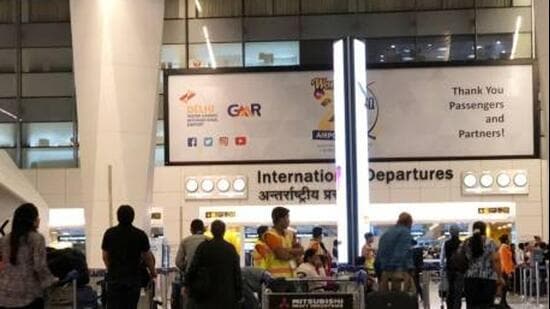
Amritsar airport lapse: Physical checks at transfer points as interim measure
Multiple officials aware of the matter said that additional checks are being carried out at transfer points to verify the nature of a passenger’s onward journey
The immigration lapse involving three Italian passengers who travelled from Amritsar to Munich via Delhi without obtaining mandatory departure immigration clearance on September 4 has prompted an interim security measure at Delhi airport.
The measure is being adopted as a precautionary step while a permanent solution is being worked out. (File photo)
{{^htLoading}} {{/htLoading}}
Multiple officials aware of the matter said that additional checks are being carried out at transfer points to verify the nature of a passenger’s onward journey and ensure that those required to undergo immigration do not bypass the process.
Immigration Lapse and Interim Security Measure
“As part of the interim arrangement, airline staff have been directed to pay closer attention to the ‘I’ and ‘D’ indicators on boarding passes of transfer passengers,” one of the officials said.
The markings indicate whether a passenger is travelling on an international or domestic sector, and are being checked to ensure passengers are routed through the designated transfer process.
“The measure is being adopted as a precautionary step while a permanent solution is being worked out by the agencies concerned,” this officer said.
{{/usCountry}}
{{#usCountry}}
“The measure is being adopted as a precautionary step while a permanent solution is being worked out by the agencies concerned,” this officer said.
{{/usCountry}}
Besides, physical checks by the ground staff deployed in the transfer areas - from domestic to international flights - have also been stepped up, another officer said.
“All international transfer passengers’ boarding passes are being thoroughly checked to avoid a repeat of the September 4 lapse,” the second official said, adding that “all stakeholders including the ministries of home, civil aviation, Bureau of Civil Aviation Security (BCAS), Central Industrial Security Force (CISF), Bureau of Immigration (BOI), airport operators and airlines are deliberating on making the system foolproof.”
The move comes after the Ministry of Civil Aviation (MoCA) issued a show-cause notice to Air India on September 12 following concerns raised by the Ministry of Home Affairs (MHA) over the incident.
The notice said the approved hub-and-spoke standard operating procedure (SOP) requires strict segregation of domestic and international passengers at the hub airport based on the “D” and “I” indicators on their boarding passes. It also states that only passengers carrying an “I” boarding pass should be directed to the international-to-international (I-to-I) transfer area.
According to the notice, the three passengers had been issued “D” boarding passes for the Amritsar-Delhi sector and an onward Lufthansa boarding pass at Amritsar. On arrival in Delhi, they were incorrectly escorted to the I-to-I transfer area instead of exiting through the designated Gate 39 in the immigration area and undergoing mandatory departure immigration clearance before boarding their Lufthansa flight to Munich.
{{^htLoading}} {{/htLoading}}
The notice also flagged the issuance of the onward Lufthansa boarding pass at Amritsar, saying the approved hub-and-spoke SOP does not provide for such an onward boarding pass to be issued at the spoke airport. It further says the SOP provides for only two types of boarding passes, carrying “D” and “I” indicators, under the hub-and-spoke operation.
The ministry also asked Air India to explain why the prescribed segregation based on the boarding-pass indicator was not followed, why the passengers were escorted through the I-to-I transfer route and the role of Air India and SATS (the ground handling agency) personnel involved in handling them.
Union home secretary Govind Mohan had called a meeting after the incident to discuss the matter. This meeting, however, was postponed and is yet to be rescheduled.
The incident has raised concerns over the processes governing passengers travelling from airports designated as spokes under the government’s hub-and-spoke model to a hub airport before taking an international flight.
Under the model, passengers travelling to international destinations from designated spoke airports are required to complete immigration at the spoke before transferring to an international flight at the hub, while at the hub they are generally required to undergo security checks before boarding their onward international flight.
Frequently Asked Questions
What incident occurred on September 4 involving three Italian passengers?
Three Italian passengers travelled from Amritsar to Munich via Delhi without obtaining mandatory departure immigration clearance.
What measures were taken in response to the incident at Delhi airport?
Interim security measures include additional checks at transfer points and closer attention to boarding pass indicators.
What does the show-cause notice issued to Air India pertain to?
The notice pertains to the failure to follow approved procedures for passenger segregation based on boarding-pass indicators.
What are passengers required to do under the hub-and-spoke model?
Passengers must complete immigration at the spoke before transferring to international flights at the hub.
Neha LM Tripathi is a Special Correspondent with the National Political Bureau of Hindustan Times. She covers the aviation and railways ministries, and also writes on travel trends. Her work spans national developments, with a focus on policy, people, and the evolving travel landscape. She has 13 years of experience. Before moving to Delhi, she was based in Mumbai, where she began her journey as a journalist. Outside the newsroom, Neha enjoys trekking and travelling.
Neeraj Chauhan is a senior journalist with Hindustan Times and an investigative reporter specialising in national security, terrorism, organised crime, narcotics, corruption, financial crime and complex investigations. With over 21 years of experience across Hindustan Times, The Times of India, The Indian Express and The Pioneer, he has built deep expertise in India’s internal security and law-enforcement landscape. Neeraj has extensively covered India’s principal investigative, intelligence and security agencies, including the NIA, CBI, ED, IB, R&AW, MHA and other central security forces. His work has included deeply reported investigations into terrorism, terror financing, cross-border crime, narcotics trafficking, cybercrime, financial fraud and political and corporate corruption. He has reported on some of the most significant terror attacks and security developments in India over the past two decades, including the Delhi serial blasts, the 26/11 Mumbai attacks, the 2019 Pulwama terror attack and the recent Pahalgam attack. His reporting has also chronicled the rise and decline of the Indian Mujahideen, the activities and subsequent crackdown on the Popular Front of India (PFI), Islamist extremist networks, the conflict in Jammu and Kashmir, insurgencies in the Northeast and Maoist violence. Some of Neeraj’s major breaking stories are in Aryan Khan drug case, Sushant Singh Rajput suicide, interception of a 3,000-kg Afghan heroin consignment worth about ₹21,000 crore at Mundra port, Sri Lanka easter bombings, Aarushi-Hemraj murders in Noida, 2G scam, coal block allocation scam, AgustWestland VVIP chopper deal and major bank frauds and extradition cases involving Mehul Choksi, Nirav Modi and Vijay Mallya. His reporting is marked by an ability to cultivate sources, analyse confidential and complex documents, and follow investigations over several years—from the initial breakthrough to chargesheets, trials and international legal proceedings. He specialises in making complicated security and investigative developments accessible while examining their wider implications for governance and public policy. A Chevening South Asia Journalism Programme Fellow at the University of Westminster, Neeraj also spent time at the Financial Times as part of the fellowship. He was also a Robert Bosch Media Ambassadors India-Germany Fellow, studying at the University of Tübingen and working with Der Tagesspiegel in Berlin. He has previously taught investigative journalism and crime reporting as a guest faculty member at the Times School of Journalism. Over more than two decades, Neeraj has established himself as an authoritative voice on India’s national security and investigative landscape, with his reporting closely followed by officials, investigators, lawyers, policymakers and readers seeking insight into some of the country’s most complex and consequential developments.
Get the latest India News, breaking headlines, and real-time updates from across the nation. Stay informed on politics, government policies, crime, weather, and CEC Gyanesh Kumar row Live.
Get the latest India News, breaking headlines, and real-time updates from across the nation. Stay informed on politics, government policies, crime, weather, and CEC Gyanesh Kumar row Live.
Home/India News/Amritsar airport lapse: Physical checks at transfer points as interim measure
{{^htLoading}}
Advertisement
{{/htLoading}}
SHARE THIS ARTICLE ON
{{#usCountry}}{{/usCountry}}
Notifications
Get breaking alerts directly from the newsroom
Notifications are on!You'll be notified when news breaks