Armed Naga cadres are likely to be absorbed into a newly formed security force under the terms of a peace agreement expected to be finalised within a fortnight to end the decades-old rebellion in Nagaland, known as the world’s oldest surviving insurgency, participants in the peace process said.
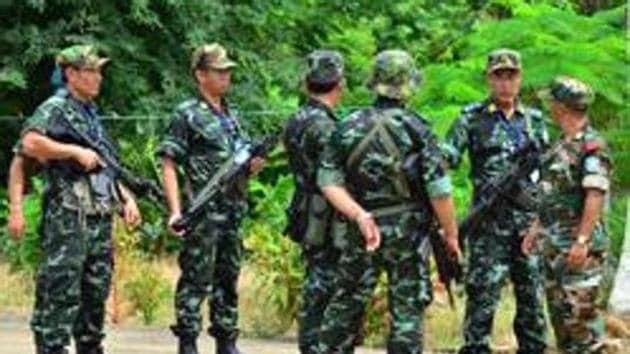
Together, the National Socialist Council of Nagaland (Isak-Muivah), or NSCN (I-M), and Naga National Political Groups (NNPGs) – an umbrella organisation comprising seven other Naga groups –have an estimated 8,000 armed cadres. The NSCN (IM), the biggest group, has an estimated 2,500-4,000 strong cadre of armed fighters.
Weapons held by all Naga rebels are to be preserved and displayed in a newly established Naga Revolutionary Museum; autonomous councils will be formed in Naga-dominated areas in the states of Manipur and Arunachal Pradesh and Assam. A bicameral Naga body to decide on local cultural issues will be formed under the peace deal that seems to have brought both New Delhi and the rebel organisations, which missed an October 31 deadline for signing the accord, on board.
After winning over Naga groups, the Centre is giving the final touches to the proposed deal and talking to the governments of Manipur, Arunachal Pradesh and Assam ,which also have large Naga populations, officials and Naga rebel representatives said.
{{/usCountry}}After winning over Naga groups, the Centre is giving the final touches to the proposed deal and talking to the governments of Manipur, Arunachal Pradesh and Assam ,which also have large Naga populations, officials and Naga rebel representatives said.
{{/usCountry}}Understandably, both sides are tight-lipped on efforts being made to plug the last-mile gaps to end the Naga insurgency. On October 31, after the last round of talks, the home ministry issued a statement saying, “it is clarified that before any settlement is arrived at with Naga groups, all stakeholders including the States of Assam, Manipur and Arunachal Pradesh will be consulted.”
“The final agreement is expected to be signed in the next fortnight provided the drafting of the agreement is completed,” Y Wangting Naga of the NSCN (Reformation)group, which is part of the NNPGs ,said. NSCN (Reformation) is a breakaway faction of the Myanmar- based NSCN (Khapalang) group.
“Nagas will continue to pursue the demand for a separate flag and constitution through political and democratic means,” he said, explaining how the thorny demands for a separate constitution and integration of Naga-inhabited areas in other states with Nagaland and other intractable issues were are being handled.
“We must realize the contemporary political situations and reality,” he said, explaining why the Naga groups had agreed to drop their earlier inflexible stand on the integration of Naga-inhabited areas, a separate flag and constitutions.
Naga groups and New Delhi have agreed on a Naga flag being displayed at social and cultural events. This cleverly sidesteps the issue of allowing a separate flag to the Nagas – difficult for New Delhi to accept, especially after it scrapped the special status of Jammu and Kashmir, doing away with the separate flag and constitution that state once was entitled to.
Last-minute hiccups surfaced that prevented an agreement being signed by the deadline set by the Narendra Modi government after it won a second term in May. That was over demands raised by NSCN (I-M) for a separate flag and constitution .
Nagaland governor and central interlocutor RN Ravi said on October 18: “Unfortunately at this auspicious juncture, the NSCN (I-M) has adopted a procrastinating attitude to delay the settlement, raising the contentious symbolic issues of separate Naga national flag and constitution on which they are fully aware of the Government of India’s position.”
NSCN (I-M), in an equally discordant statement, said that issues of a Naga flag and constitution were for Prime Minister Modi to decide on. At the same time, several armed cadres of the NSCN (IM) moved away from designated camps, the Indian army was put on a heightened state of alert and Nagaland police asked to stock up on essential supplies for at least two months.
The eerie similarities with the situation in Jammu and Kashmir, which was put under a security lockdown for over two months after its special status was effectively revoked ,couldn’t be ignored.
“There was a lot of pressure that brought to bear on the NSCN(IM),” a senior official in the security infrastructure said .
The Tatmadaw – the armed forces of Myanmar – were also vigilant along the border to prevent armed cadres moving base to contiguous areas along the Indo-Myanmar border. The NNPGs and social groups like the Naga Mothers Association also mounted pressure on the NSCN(IM) to soften its stand.
The Naga insurgency began in the 1950s with sovereignty as the key demand. But over the years, the rebel outfits have given up on that demand, seeking instead more autonomy and integration of Naga-inhabited areas in Nagaland, Manipur, Arunachal Pradesh and Assam.