Army chief General Bipin Rawat made a low-profile trip to the Sikkim border last week to meet soldiers involved in a 73-day border standoff with Chinese troops at Doklam earlier this year.
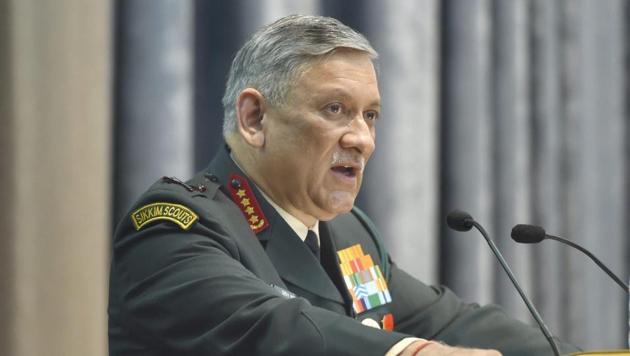
HT has learnt that Rawat spent a significant part of Saturday with Indian soldiers deployed in the sensitive sector. The last time he visited them was in June, while the standoff was still on.
The Doklam face-off ended on August 28, after both India and China agreed to pull back their troops. Bejing removed its road-laying equipment from the area too.
The neighbouring country had accused India of trespassing and preventing its troops from building a road in the remote Himalayan plateau, which is claimed by both China and Bhutan. However, a repeat of the summer standoff cannot be ruled out.
In September, a reputed defence think tank observed that the Doklam standoff between India and China was likely to be the new normal. It made a strong case for building military capabilities, considering that China “respects strength”.
In a paper titled Looking Beyond Doklam, the Centre for Joint Warfare Studies (CENJOWS) said it was crucial for India to demonstrate its strength because peace along the Line of Actual Control (LAC) will be “constantly and continuously” under stress with “a rise in frequency, intensity and depth of (Chinese) transgressions, leading to more and more standoffs”.
{{/usCountry}}In a paper titled Looking Beyond Doklam, the Centre for Joint Warfare Studies (CENJOWS) said it was crucial for India to demonstrate its strength because peace along the Line of Actual Control (LAC) will be “constantly and continuously” under stress with “a rise in frequency, intensity and depth of (Chinese) transgressions, leading to more and more standoffs”.
{{/usCountry}}The paper was authored by CENJOWS director Lieutenant General Vinod Bhatia (retd). Bhatia was the director general of military operations when India and China were locked in a tense border standoff at Depsang in Ladakh four years ago. He also commanded the Siliguri-based HQs 33 Corps, which controls the Sikkim sector.
The paper said the dual command and control structure — the LAC is manned by both the Army and the Indo Tibetan Border Police (ITBP) — was a recipe for disaster because “conflicting directions can emanate from the controlling ministries”.
While the ITBP is controlled by the home ministry, the Army comes under its defence counterpart. Bhatia recommended that the ITBP be placed under the Army’s command, so as to avoid “competition and conflict” situations.