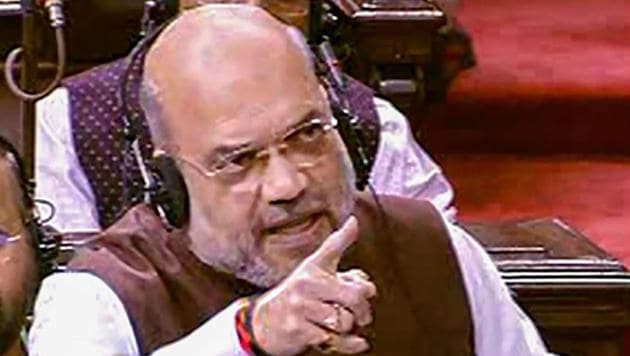
Home Minister Amit Shah on Monday proposed in Rajya Sabha the scrapping of Article 370 that accords special status to Jammu and Kashmir. Among the reasons being cited for doing so is that the provision creates ‘unnecessary chasm’ between citizens of Kashmir and the rest of India and was ‘adversely lopsided’.
“Article 370 details the relationship Kashmir will share with the rest of the country; Article 35-A grants permanent residents of Kashmir some special rights. From the get-go, the Constitutional relationship of India with this state has been adversely lopsided,” says a booklet put out by the government detailing the Article and the reasons for its scrapping.
“We must not forget that the continuance of Article 370 is the biggest hurdle to a lasting solution to the Kashmir conundrum,” the document adds.
Follow live updates: Jammu and Kashmir Live Updates: ‘Very essential for interest of J-K’, says RSS
Shah, introducing the proposal in Rajya Sabha, also proposed dividing the state into two union territories -- Jammu and Kashmir (with legislature) and Ladakh (without legislature).
Detailing how the state had done well on vital indicators, the report adds that Jammu and Kashmir has grown by 7 %, but a big reason for which is ‘heavy subsidies’. The report add that the state is an ‘economic powerhouse’ waiting to be unleashed.
{{/usCountry}}Detailing how the state had done well on vital indicators, the report adds that Jammu and Kashmir has grown by 7 %, but a big reason for which is ‘heavy subsidies’. The report add that the state is an ‘economic powerhouse’ waiting to be unleashed.
{{/usCountry}}“If Indians (non-Kashmiris) cannot invest in land or property, how can manufacturing firms or multinational corporations? These might have provided jobs to the young people of Kashmir. It also stops public colleges such as medical colleges from adequately fulfilling vacancies. Professors cannot be hired from outside the state except in extremely low quotas. These and many more ensure that unemployment increases, which make the advent of radicalization, more viable. Hence, Article 370, the pernicious basis of Article 35-A must go.
On how the contentious Article can be repealed, the report says: “The only way to repeal Article 370 would be by the President through a notification but not without the concurrence of the Constituent Assembly of Jammu and Kashmir. The Constituent Assembly, of course, disbanded in 1956 and almost all members are presumably dead. Before dissolution, the Constituent Assembly neither recommended abolishing Article 370 neither, did they advocate for it to be permanent...Article 370, via orders, has been modified so many times, it can be expelled from the Constitution as well without taking ‘concurrence’ of the now-defunct Constituent Assembly. The Constitution has been recognised as a living document, after all.”