Protests against the deployment of central paramilitary forces for surveys for a hydropower project on the Siang river at Beging in Arunachal Pradesh’s East Siang district intensified on Wednesday, with demonstrators blocking roads, clashing with security personnel and allegedly vandalising the residence of a local legislator during chief minister Pema Khandu’s visit to Yingkiong.
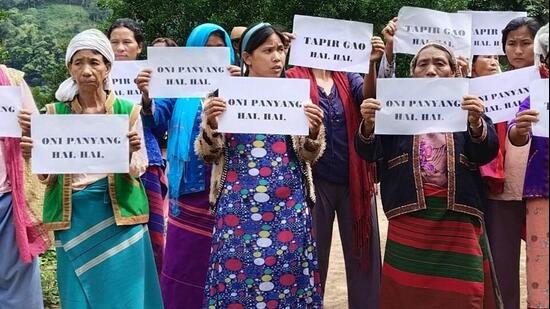
Raising their voices against the proposed over 10,000-MW Siang Upper Multipurpose Project (SUMP) and the government’s move to carry out a Pre-Feasibility Report (PFR) survey, protesters demanded an immediate halt to survey activities and the withdrawal of security forces from project-affected areas.
The agitation disrupted movement along the Yingkiong-Komkar-Geku stretch and towards Dite Dime as protesters erected blockades at several locations.
Tensions escalated after protesters entered the residence of Tuting-Yingkiong MLA Alo Libang in Yingkiong and allegedly vandalised the premises while raising anti-dam slogans. Several government vehicles were also reportedly damaged, while a police vehicle was set ablaze near Dite Dime.
Security personnel intercepted protest rallies at some locations, leading to scuffles.
Protesters also restricted movement outside a hotel where deputy chief minister Chowna Mein, ministers Ojing Tasing and Nyato Dukam, and chief minister’s advisor Ninong Ering were reportedly staying, affecting their movement to scheduled programmes.
Upper Siang deputy commissioner Ashok Tajo, however, said Khandu completed his scheduled official meeting in Yingkiong before leaving the district by helicopter.
{{/usCountry}}Upper Siang deputy commissioner Ashok Tajo, however, said Khandu completed his scheduled official meeting in Yingkiong before leaving the district by helicopter.
{{/usCountry}}There have been a series of protests against SUMP, which is estimated to affect at least 100,000 residents who could be uprooted. There are also concerns about the environmental impact of the project involving construction activities on the Siang river.
Wednesday’s unrest came two days after villagers clashed with security personnel at Geku. Government vehicles were damaged during the September 28 confrontation and four people were detained before being released.
Opposition to the PFR has continued in Geku, Komkar and adjoining areas, where villagers have blocked roads to prevent machinery from reaching proposed survey locations.
Sections of the indigenous Adi community opposing the project have raised concerns over possible displacement, loss of ancestral and customary land, livelihoods, cultural identity and environmental consequences if the project eventually goes ahead.
The Siang Indigenous Farmers’ Forum (SIFF), one of the organisations spearheading the opposition, had declined an invitation for talks during Khandu’s September 29-30 visit and sought direct dialogue with affected communities.
Khandu, meanwhile, maintained that conducting the PFR does not amount to approving construction of the project and is intended only to establish its technical feasibility.
The chief minister said the exercise, expected to take around three months, would determine whether the project is technically feasible and identify possible locations and technical parameters. He said subsequent processes, including social and environmental impact assessments, preparation of a detailed project report and public consultations, would depend on the PFR findings.
Khandu also said people have a democratic right to oppose the project and question the government, but maintained that protests should not involve destruction of public or private property.
The state government has constituted an Empowered High-Level Committee headed by rural development and panchayati raj minister Ojing Tasing to coordinate and oversee the PFR process.
In December 2024, China approved the construction of what will be the world’s biggest hydropower dam on the eastern rim of the ecologically fragile Tibetan plateau. The approval triggered concerns about the impact of the dam, which could affect millions downstream in India and Bangladesh.
The Power Construction Corp of China estimated the $137 billion dam on the lower reaches of the Yarlung Tsangpo could produce 300 billion kilowatt-hours (kWh) of electricity annually. It would produce three times more energy than China’s Three Gorges Dam, currently the world’s largest, with an installed capacity of 88.2 billion kWh.