E-Paper



Assam floods: Kaziranga submerged; 11 animals killed, 65 rescued
On Tuesday, Assam chief minister Himanta Biswa Sarma visited parts of the park and nearby areas to take stock of the situation

 Prefer HTon Google


Guwahati: Heavy rainfall in the past few days has led to flooding in most parts of Kaziranga National Park (KNP) and Tiger Reserve in Assam, officials said on Wednesday.
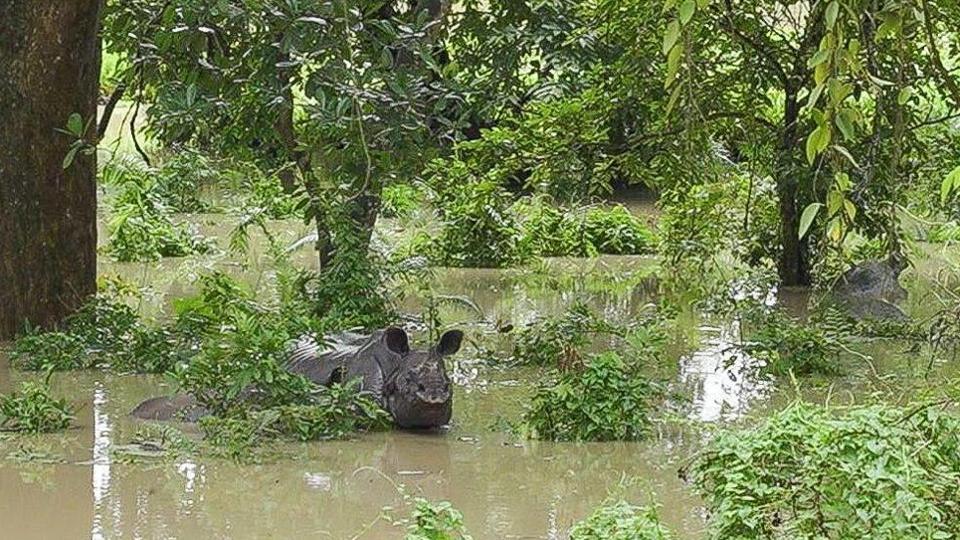
According to the officials, till Wednesday morning, 178 of the 233 forest camps located inside the park, which is home to the world’s largest population of the endangered one-horned rhinos, are under at least five feet of water.
Forest officials said that 75 of the inundated camps are in the Agratoli and Kaziranga ranges of the park. Due to rising flood waters, forest guards have abandoned nine camps located inside the park.
As the flood situation prevailed in Kaziranga National Park, 11 wild animals, including a Rhino calf, were killed while 65 animals were rescued, according to the update on the flood situation released by the forest officials on Wednesday.
“All animals have died due to natural causes – drowning and exhaustion,” Sonali Ghosh, KNP director, informed without giving details of the species of animals that have died. Officials informed on condition of anonymity, that the animals killed due to floods include hog deer and a rhino calf.
On Tuesday, Assam chief minister Himanta Biswa Sarma visited parts of the park and nearby areas to take stock of the situation. He said that National Disaster Response Force (NDRF) has been deployed for rescuing the animals.
“Flood waters have entered most parts of Kaziranga, and it has affected the wild animals. A rhino calf has been killed. Personnel from NDRF and forest department are engaged in rescuing animals and ensuring their safety,” Sarma posted on X.
On Tuesday, education minister Ranoj Pegu informed that a tiger, which is believed to have strayed from the park due to flooding, had reached Totoya village Majuli Island on the Brahmaputra river.
Also Read: IAF chopper rescues 13 fishermen stranded on flooded Brahmaputra in Assam
Officials said the Centre for Wildlife Rehabilitation and Conservation (CWRC), managed by the Assam forest department in collaboration with the International Fund for Animal Welfare and Wildlife Trust of India, have rescued several animals from rising waters and relocated them to the nearby forest areas.
Since Monday, CWRC treated over 36 animals for injuries or displacement including otter pups, barred owls, sambar deer and several hog deer, officials said.
“Comprehensive measures are in place to ensure the safety of wildlife and staff. Our frontline teams are well-trained and equipped to handle any situation, supported by ongoing capacity-building efforts,” Ghosh stated.
Officials said that three mobile veterinary service units have been stationed at the eastern range of the park under the Bishwanath Wildlife Division in the north bank, the western range Bagori and one at CWRC.
Every year, once flood waters enter Kaziranga, wild animals, including rhinos and elephants, cross the NH-37 located along the park and go to the hills and higher reaches on the other side for safety.
To avoid such accidents, from July 1, the state government has enforced few traffic regulations including a ban on commercial trucks from plying on the stretch of the national highways that runs along the park.
All passenger vehicles, both private and commercial, would be allowed to move at regulated speed and escorted by police and forest staff every 30 minutes.