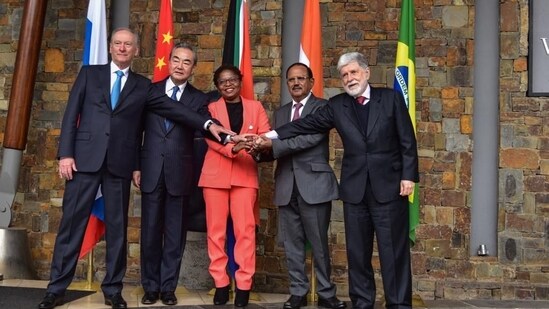
National Security Advisor Ajit Doval on Tuesday participated in the 13th BRICS NSA meeting in Johannesburg where he emphasised that terrorism remains one of the key threats to national peace and security. Doval said that BRICS members can work together in listing terrorists and their proxies under the UN counter-terrorism sanctions regime, almost a month after China blocked a joint proposal by India and the US at the United Nations to designate Pakistan-based Lashkar-e-Taiba terrorist Sajid Mir as a global terrorist.
The NSA highlighted that the terror outfits in the Af-Pak region continue to operate with impunity and stressed that the decision-making of the UNSC sanctions committee is free from politicization and double standards.
Doval expressed gratitude to South Africa for its cooperation during India's ongoing G20 Presidency and affirmed India's unwavering support for South Africa's BRICS chairmanship this year.
Addressing the gathering, Doval emphasized that the international security environment was undergoing significant changes, characterized by uncertainties and escalating tensions. He further noted the aftermath of the pandemic still affecting the global economy.
The meeting covered critical areas such as cyber, maritime, and space, which are hotly contested domains. Non-traditional challenges pertaining to food, water, and energy security were also discussed.
To address emerging challenges, Doval advocated for leveraging regional mechanisms to pursue common goals. Equitable and fair access to global commons, in accordance with international laws, should be a priority.
{{/usCountry}}To address emerging challenges, Doval advocated for leveraging regional mechanisms to pursue common goals. Equitable and fair access to global commons, in accordance with international laws, should be a priority.
{{/usCountry}}Water security has emerged as a major global concern, prompting Doval to stress the need for prudent usage and conservation as a shared responsibility. He cautioned against the weaponization of water and called for complete transparency and unhindered information sharing concerning cross-border water resources to counter any politicization of the issue.
Given India's significant role in the global food supply system and its assistance to other countries during the pandemic, Doval stressed the importance of ensuring unhindered availability of fertilizers, highlighting that today's fertilizer shortage could lead to a future food crisis.
In the cyber domain, research and development were deemed paramount to address common threats arising from emerging technologies. The BRICS working group on ICTs had identified cutting-edge areas such as AI, quantum computing, cloud security, Blockchain, and the Internet of Things as potential research topics.
Doval emphasized that the digital age's opportunities also brought forth challenges, necessitating unity to bolster cyber defenses, foster international cooperation, and develop resilient national cyberinfrastructures. The connection between cybercriminals and terrorists was identified as a growing concern.
Doval reiterated India's unwavering commitment to the BRICS process and expressed readiness to enhance cooperation in all joint endeavours.