
 E-Paper



Bastar: Intensified anti-Maoist operations prompt change in rebel strategy
Security forces dealt a major blow to Left-wing insurgency by killing Maoist chief Nambala Kesava Rao alias Basvaraju on May 20 in Chhattisgarh’s Dandakaranya.

 Prefer HTon Google


Intensified anti-Maoist operations in Chhattisgarh’s Bastar since January have forced the Maoists in India’s Maoism hotspot to reconstitute smaller units, hide in inaccessible areas in and around the inhospitable terrain of Indravati National Park, abandon military attire, and live among residents, people aware of the matter said.
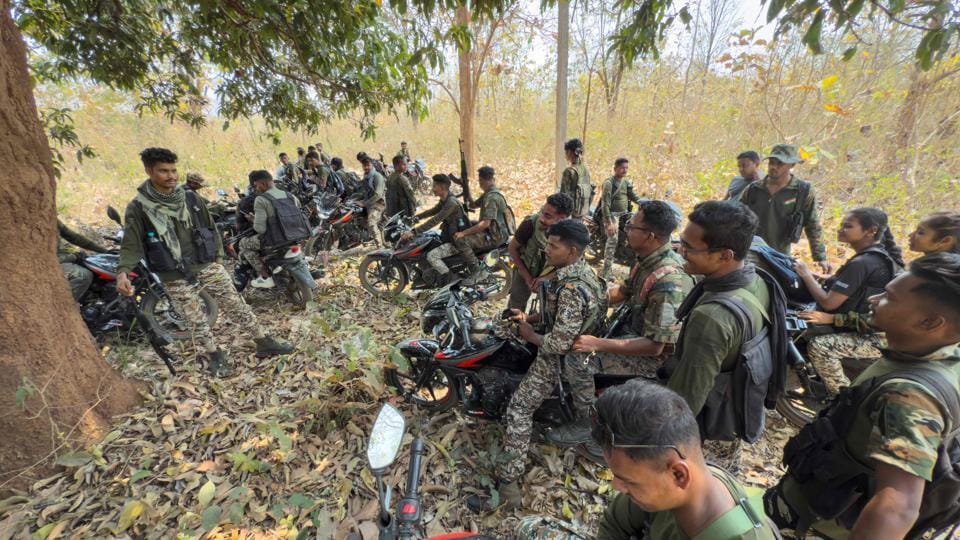
Around 20,000 security forces have been deployed in Chhattisgarh and Maharashtra for the operations. In 2024, 217 Maoists were killed. By mid-2025, the number rose to approximately 460. Security forces dealt a major blow to the Left-wing insurgency by killing Maoist chief Nambala Kesava Rao alias Basvaraju on May 20 in Chhattisgarh’s Dandakaranya. The government has set a target of eliminating Maoism from the country by next year.
A police officer cited intelligence reports and Maoist documents and said the impact of Basvaraju’s killing is visible on the ground. He added that armed Maoists were now limited to Indravati National Park compared to almost the entire region a year ago. The officer said that most Maoist cadres have left their arms and are living with the locals of Abujhmad, Bijapur, and Sukma.
An intelligence officer said the killing of a large number of cadres prompted the Maoist Politburo to hold discussions and issue a circular about a month ago, saying that the time was unfavourable for rebellion. “...as a result, all cadres were instructed to go underground, and even large formations were to be broken into small units to avoid detection,” said the intelligence officer. He added that the aim was to reduce casualties and increase survival chances for the cadre, even if identified.
The officer said that Maoist leader Rupesh confirmed the change in strategy in an interview with local journalist Vikas Tiwari. He added that Rupesh claimed senior Maoist leaders have been moved to isolated areas and disguised in rural attire to blend in with villagers to avoid detection. Tiwari said Rupesh spoke about the change in strategy in the wake of security operations after the killing of Basvaraju.
The Maoists admitted to their depleting cadres in a press note following Basvaraju’s killing. Security forces estimate the Maoist cadres in Bastar are now in hundreds compared to a few thousand.
A second intelligence officer said that the bigger Maoist battalions have been split into small ones to prevent detection through aerial surveillance and for maximum impact with depleted strength. “With their traditional bases compromised, Maoists have largely retreated to the difficult terrain of Indravati National Park, which is in Bijapur. This remote forest zone, with limited road access, is isolated and camps of security forces have not reached the park yet, and it is now becoming the new hub of the Maoists with much smaller units,” the second intelligence officer said.
He added that the Maoists have “enhanced perimeter vigilance” and were using villagers as spotters and information carriers in their region of dominance. “They have used more Improved Explosive Device blasts to target security forces in these areas. This dual strategy of camouflage and fortified vigilance has made anti-Maoist operations more complex and riskier for security forces.”
A security official overseeing the operations said they have observed an increase in the use of plain clothes in both the political and military wings of the Maoists in recent months.
“Earlier, Maoist military formations operated in uniform and with a clear identity, but that line is now blurring. The political operatives are openly mingling with villagers, often disguised as common civilians, participating in meetings and even staying in villages for extended periods to avoid detection,” the third official said.
He added that intelligence inputs indicate that this tactic is being used to conduct reconnaissance, gather information, and identify suspected police informers. The officer said that there has been an increase in attacks on suspected police informers in recent months, with six villagers killed in June alone. “The Maoist leaders are also desperately trying to retain their ideological base among locals,” the official said.
Officials attributed sustained pressure on Maoist leaders in Bastar to their calls for peace talks. “Such demand previously came mainly from Telangana. This unusual overture is a result of relentless operations.” The operations have led to the killing of top Maoist leaders and seizure of large quantities of automatic weapons, said an Indian Police Service officer supervising the operations in one of the Bastar districts.
Additional director general (anti-Maoist operations) Vivekanand Sinha said that the Maoists are losing ground and struggling for survival. “Facing a financial crisis, they have been pushed onto the back foot. Their formations have weakened, and they are now blending in with local villagers. They have become highly suspicious of everyone, which has unfortunately led to a rise in the killing of civilians.”
Security officials underlined the need for effective delivery of public services and sustained development to counter the Maoist narrative.
Inspector general Sunderraj P said the security forces have been implementing development projects, providing road connectivity, access to education, healthcare, livelihood opportunities, and basic infrastructure in close coordination with civil administration.
“Some of the important roads being built are Basaguda -Jagargunda, Silger-Puvarti in South Bastar, and National Highway 130-D in the core of Abhujmad,” he said. He added that schools closed due to Maoist violence have reopened, new primary and mobile health units have been provided, and new bank branches have been opened in the Bastar region to make the most of successes on the battlefield.
-kW0H-U20214218012MgB-250x250%40HT-Web.jpg)


