India’s readiness to combat the Covid-19 pandemic must be a step ahead of all variants, even those that may arise in the future, Prime Minister Narendra Modi said during a meeting with chief ministers on Thursday, where he also said that while being alert and careful is crucial, it is also important to avoid panic.
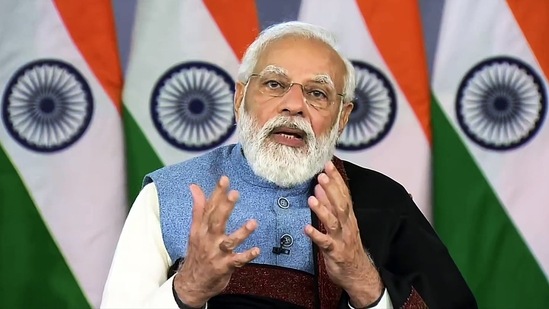
The meeting is the first time Modi met the chief ministers to discuss Covid-19 since the third wave began. Across the country, there were 264,922 new cases on Thursday, according to HT’s tally from data released by states – representing a 253% week-on-week jump propelled by the highly transmissible Omicron variant of the Sars-CoV-2.
“The doubts that were earlier there regarding the Omicron variant are gradually now being cleared. Compared to earlier variants, Omicron is infecting masses at a much higher rate. In a country like America, nearly 14 lakh (1.4 million) new cases have been reported in a single day. In India, our scientists are reviewing the situation and numbers. It’s quite clear that we have to be vigilant and cautious, but at the same time we have to also ensure that we don’t panic,” the PM said during the meeting.
Modi said authorities and the citizens need to ensure Covid-19 precautions do not slacken during the upcoming festive period.
{{/usCountry}}Modi said authorities and the citizens need to ensure Covid-19 precautions do not slacken during the upcoming festive period.
{{/usCountry}}The way central and state governments have adopted pre-emptive, proactive and collective approach in the past will be key going forward, he said.
“India’s fight against the biggest pandemic in over 100 years has now entered its third year. Hard work is our only path and victory is our only option. With our efforts, we, close to 1.3 billion people, will emerge victorious against Corona.”
The PM outlined some important steps that he said were necessary to be adequately prepared. “We will have to keep scaling up our medical infrastructure and manpower along with strengthening our scientific understanding of the disease.”
“Most experts globally have to say that irrespective of the variant, the most potent weapons to fight the coronavirus are vaccines. India-made vaccines are known to be of quality globally, which is a matter of pride for every Indian,” he added.
Union ministers Amit Shah, Mansukh Mandaviya, and minister of state Bharati Pravin Pawar were among those present during the review.
The chief ministers of several states, too, spoke at the meeting.
Tamil Nadu chief minister MK Stalin said the state has activated war rooms at the state and district levels. “I have instructed all officials to strictly enforce Covid-appropriate protocols. The entire state machinery is fully ready to meet the situation. I assure you Tamil Nadu will stand with all your efforts in managing this wave,” he said, according to a state official.
The Maharashtra government, represented by health minister Rajesh Tope who gave a written submission to Centre, sought nine million additional doses of Covid-19 vaccines and urged the Union government to make vaccination mandatory by law.
The chief ministers of Assam and Karnataka said they briefed the Prime Minister on their preparations and both said they were optimistic that things will be under control.
Modi said states have adequate amounts of vaccine doses with them and encouraged them to make efforts to deliver “precaution doses” to front-line workers and senior citizens.
Precaution doses refer to third doses of a Covid-19 vaccine, or boosters, which are being given to people above the age of 60 with some comorbid conditions, health care and front-line workers if they have completed more than nine months after the primary vaccination course.
“For 100% vaccination coverage, we have to further scale-up our har ghar dastak campaign. I commend efforts of our health care workers, asha workers, who work even through the adverse climatic condition to ensure vaccination drive speeds up,” he said.
“Har ghar dastak” is a door-to-door vaccination outreach campaign.
The Prime Minister said it was important to stop rumours that can hit vaccine acceptance. “Many a times we get to hear that despite vaccination, people are getting infected; therefore there is no point (in taking the shot). About masks also people are spreading rumour that wearing it has no benefit. There is immense need to counter such baseless rumours,” he said.
Modi said after two years, there is adequate experience to combat the pandemic and strategies must be made in a way that the impact on livelihoods is mitigated.
“So, it would be better to focus more on local containment; scale up testing from where most cases are being reported. We should also ensure that maximum treatment and care is provided in home isolation situations, for which home isolation guidelines should be strictly followed and regularly updated so that the need for hospitaliation is reduced. The use of tele-medicine facilities in treating will also help a great deal,” he added.
The PM said under the ₹23,000 crore emergency Covid response package by the Centre to states, 800 paediatric units, 150,000 new intensive care unit (ICU) and high dependency unit (HDU) beds, at least 5,000 special ambulances, and 950 liquid medical oxygen storage tank capacity have been added across the country.
Experts said that even though hospitalisations are increasing in some places, most cases are still mild.
“Our numbers are high owing to country’s population, therefore, even a small percentage of infected that may require hospitalisation, will be a big number for us. People need to be careful; especially strictly adhering to Covid appropriate behaviour,” said Dr Suranjit Chatterjee, senior consultant, department of internal medicine, Apollo Hospitals.