Farm laws repeal could set stage for four-cornered fight, hung House in Punjab
Given that assembly polls are weeks away in the agrarian states of Punjab and UP, PM Narendra Modi has stooped to conquer, for it was time for him to show the human side of his carefully cultivated strong persona
There undoubtedly is an element of political expediency in the way Prime Minister Narendra Modi has timed his decision to take back the three farm laws. Regardless of the motive, it shows as much the government’s sensitivity to popular opinion despite disagreement.
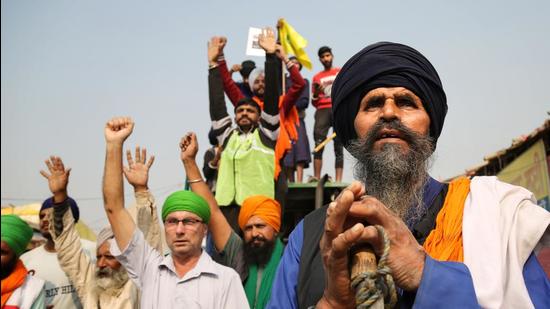
Farmers celebrate at Delhi’s Singhu border protest site after PM Narendra Modi announced that the three contentious farm laws will be repealed. (Sanchit Khanna/ Hindustan Times)
The PM had insisted that reforms were needed to make farming remunerative. The practitioners disagreed and had their way.
Given that assembly polls are weeks away in the agrarian states of Punjab and Uttar Pradesh, Modi has stooped to conquer, for it was time for him to show the human side of his carefully cultivated strong persona. Reforms can be deferred to another day, not the elections!
If nothing else, the rollback, to be formalised in the upcoming winter session of Parliament, begets the Bharatiya Janata Party (BJP) the talking points it lacked to recoup ground in Punjab and western UP where the farmers’ stir has apparently dented its ability to repeat its impressive 2017 poll record.
It wasn’t a coincidence that Modi’s early morning national telecast came on the 552nd birth anniversary of Guru Nanak, the founder of the Sikh faith. Just a couple of days ago, his government had opened the Kartarpur Corridor to a highly revered pilgrimage spot in Pakistan where the first Guru spent the last 18 years of his life.
Shortly before the official notice reopening the corridor, a BJP delegation from Punjab had called on the PM to open the passageway that was shut during the Covid-induced lockdown.
The chronology of events showed the scrapping of the farm laws was in the works for some time; the steps choreographed to rebuilding social connect with the Sikh community, especially those engaged in farming and allied activities. Till then, such was the farmers’ alienation from the BJP that its leaders had problems venturing out of their homes and offices, leave alone canvass for votes.
But will New Delhi’s submission to the farmers’ relentless pitch to see the back of the ‘black laws’ alter the ground situation in Punjab or western UP, which was another hotbed of protests that swept through Haryana, variedly impacting agriculture communities in Rajasthan and other states? It’s early days still to make a definitive assessment, what with the Samyukta Kisan Morcha (SKM), a fountainhead of 32 farm unions, refusing to the call off the agitation till Parliament repealed the laws and passed another legislation giving legal cover to the minimum support price (MSP) for their produce. Many economists consider that demand un-implementable. “Not all produce can be bought by governments. What will we do with the surplus?” they ask.
Leaving aside the MSP issue, it can be tentatively stated that the BJP whom the farm laws had made politically ‘untouchable’ in agrarian belts, might acquire a modicum of acceptability in the wake of the PM’s announcement. Its potential allies in Punjab could include the splinter Congress group led by former chief minister Capt. Amarinder Singh and the breakaway Akali faction helmed by SS Dhindsa and RS Brahmpura. The latter goes by the name of Shiromani Akali Dal (Samyukta).
In fact, former Rajya Sabha member and chairman of the national commission of minorities, Tarlochan Singh, was certain about a tie-up between the BJP and the fledgling entities helmed by the Captain and Dhindsa, who was a union minister in the AB Vajpayee regime at the Centre.
The alignments, if they come about, cannot be good news for the Congress government led by Charanjit Singh Channi, who, in recent weeks, has announced a slew of sops for the farm sector, including loan waivers and a drastic reduction in power tariffs. The going might get tougher for the incumbent regime if a proximate pre-poll understanding happens between the BJP-led formation and Sukhbir Badal’s SAD, which quit the National Democratic Alliance (NDA) upon gauging public mood against the farm legislations.
Senior SAD leader and RS member, Naresh Gujral, wasn’t willing to speculate beyond the point of suggesting a possible post-poll tie-up with the BJP and its cohorts. ”Sukhbir is getting big response from the people. Even breakaway Akali groups may have to rethink,” he said.
The Captain, for his part, welcomed Modi’s announcement in a tweet, expectedly calling it “great news” as he had made a distant or direct alliance with the BJP conditional to the withdrawal of the farm laws. According to people in the know, his talks with the BJP are at an advanced stage, the fresh development making a deal between the two a near-certainty.
Including the Aam Admi Party, a four-cornered contest in Punjab could be a distinct possibility. It’s anybody’s guess whether that’ll throw up a hung house.
Get the latest India News, breaking headlines and real-time updates from across the country. Stay informed about politics, government policies, crime, weather and major national developments.
Home/India News/Farm Laws Repeal Could Set Stage For Four-cornered Fight, Hung House In Punjab

 E-Paper