
The Bharatiya Janata Party (BJP) and the Shiromani Akali Dal (SAD) on Tuesday revived their alliance ahead of the Punjab assembly elections, six years after the Akali Dal walked out of the National Democratic Alliance (NDA) on the issue of the now withdrawn three farm laws.
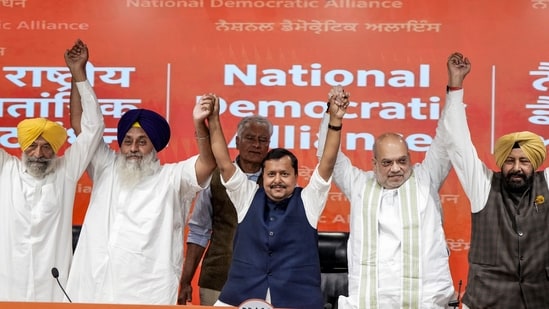
The two parties had first come together in the 1996 Lok Sabha elections. The alliance formed governments in Punjab in 1997, 2007 and 2012, with Parkash Singh Badal becoming chief minister.
Ahead of the high-stakes polls, here's a look at what a BJP-SAD alliance could mean for Punjab's electoral arithmetic.
Both the SAD and BJP have suffered since parting ways in Punjab
Deep Dive
Why did the BJP-SAD alliance break up in 2020?
Why have the BJP and SAD reunited for the 2027 Punjab elections?
How could the BJP-SAD alliance affect Punjab’s 2027 election contest?
The alliance between the two parties ended after the SAD withdrew from the National Democratic Alliance (NDA) in 2020 in protest against the (now-withdrawn) three farm laws, which triggered a large farmers’ protest in Punjab. The rupture cost a lot for both the SAD and the BJP. While the BJP-SAD alliance won the highest number of assembly constituencies (AC) or parliamentary constituencies (PC) in six of the 12 elections held between 1996 and 2019, the two parties put together won just 4.3% and 7.7% of the ACs and PCs in the 2022 assembly and 2024 Lok Sabha elections, the worst performance for both these parties in a long time. To be sure, things had started going downhill for the SAD-BJP alliance even before they parted ways in 2020. The 2020 breakup also came in the backdrop of two back-to-back electoral losses: the 2017 assembly and 2019 Lok Sabha elections.
Punjab’s political churn goes beyond the rupture between BJP and SAD
Punjab, today, is India’s only major state with a polity that is decidedly not bipolar. The median Effective Number of Participants (ENOP) for Punjab in the 2022 assembly elections is 3.23, the highest among all states and union territories with at least seven PCs or more. ENOP is the reciprocal of the sum of squares of the vote share of each candidate in a constituency and decreases with decreasing fragmentation. For example, if three parties poll 40%, 35%, and 25% votes, the ENOP in the AC is 2.9. If this distribution changes to 80%, 15%, and 5%, the ENOP is 1.5. Punjab’s median ENOP was just 2.4 in 2007. The rise in political fragmentation in Punjab is primarily a result of the Aam Aadmi Party’s (AAP) entry in the state’s politics in 2014, and increased further when the BJP and the SAD parted ways.
{{/usCountry}}Punjab, today, is India’s only major state with a polity that is decidedly not bipolar. The median Effective Number of Participants (ENOP) for Punjab in the 2022 assembly elections is 3.23, the highest among all states and union territories with at least seven PCs or more. ENOP is the reciprocal of the sum of squares of the vote share of each candidate in a constituency and decreases with decreasing fragmentation. For example, if three parties poll 40%, 35%, and 25% votes, the ENOP in the AC is 2.9. If this distribution changes to 80%, 15%, and 5%, the ENOP is 1.5. Punjab’s median ENOP was just 2.4 in 2007. The rise in political fragmentation in Punjab is primarily a result of the Aam Aadmi Party’s (AAP) entry in the state’s politics in 2014, and increased further when the BJP and the SAD parted ways.
{{/usCountry}}At this level of political fragmentation, the Congress can gain disproportionately
The Congress won seven out of the 13 PCs in Punjab in the 2024 Lok Sabha elections with a vote share of just 26%. Not only was Congress’s seat share to vote share ratio the highest for major political parties in the 2024 Lok Sabha election in Punjab, but it was also the highest for any of the four major political parties in the state in all Lok Sabha elections since 2014. If one were to add BJP and SAD votes at the PC level in 2024, the picture would change drastically, and the hypothetical alliance would end up with a vote share and seat share of 32% and 48.7% when results are disaggregated at the AC level.
Compelling as the mathematical case is for the resurrection of the alliance between the BJP and the SAD, politics is not always driven by arithmetic. There was a lot of bad blood between the two parties during the farmers’ agitation, and there is good reason to believe that some of that animosity among farmers vis-à-vis the BJP still persists in the state. However, politics is always the art of the possible, and if the alliance were to indeed happen, the political contest in Punjab could take a new turn. What might also help the SAD-BJP alliance is the infighting in the Congress, which, until the alliance was announced, was seen as the principal challenger to the incumbent AAP.
ABOUT THE AUTHOR
Nishant Ranjan has been working as a data journalist with Hindustan Times since 2023. In this short period, he has established a niche for creating original datasets and utilising them to produce journalistic work that pushes the boundaries of journalism. The list of datasets and stories done by him include the following: a dataset of all 717 chief ministers India has had since 1952, a dataset of all 3,350 members of India’s council of ministers, a dataset of all 190 deputy chief ministers in India and a dataset of all 279 Supreme Court judges in India (1950-2025). He has also profiled each elected Muslim MLA/MP since 1952. He is a mining engineer by training who decided to pursue a Master's in Development Studies from TISS after working in a coal mine for 10 months. He also worked as a research associate at the Centre for Policy Research, researching local governance in India. He also has a keen interest in analyzing electoral politics and political executives in India.
Roshan Kishore is the Data and Political Economy Editor at Hindustan Times. He heads the newsroom's data journalism team, which produces Number Theory, a daily data-driven feature for the print edition and the HT app. Number Theory uses data analysis and story-telling based on it to add value to the newsroom’s daily coverage by putting stories in a larger context on a range of issues, including politics, macroeconomy, markets, global affairs and climate. Under his leadership HT’s data journalism work has established itself as a niche product in Indian journalism and pushed the boundaries of marrying academic rigour with news sense and speed. Along with writing and editing data stories, he has also been writing a weekly political economy column called Terms of Trade for HT Premium. A trained economist with an MPhil degree from Jawaharlal Nehru University, Kishore has also been a visiting fellow at the Centre for Advanced Studies of India (CASI) at the University of Pennsylvania. Along with his journalistic work, his writings have also appeared in journals such as the Economic and Political Weekly and working papers for CASI and UNESCAP.