Bengaluru: The Bharatiya Janata Party (BJP) which won just 3 seats out of 19 in coastal Karnataka in the 2013 assembly elections, changed the tables by 2018. The BJP’s biggest gain came here as it won 16 of the total 19 seats in Dakshina Kannada, Udupi and Uttara Kannada — 13 more than in 2013. The Congress was reduced to only 3 seats against 13 in 2013.
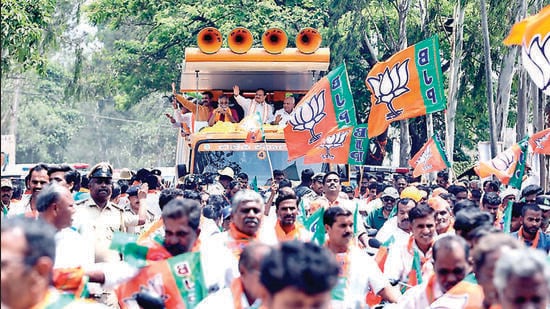
A closer look at BJP’s strategy shows that the party created a social coalition involving the upper castes, OBCs and the scheduled castes in the region using Hindutva as a glue. But, Hindutva politics as well as the party’s vote share in the region has peaked. This means in 2023, as marginal utility theory dictates, the BJP will find it difficult to maintain the lead they gained in 2018, experts say.
The anti-incumbency and the inability of Hindutva to increase the size of the core voters or retain swing voters provide the Congress with a chance to make gains in the region, but considering the communal undercurrent in the region, the Congress too may find it difficult to repeat 2013 results, experts say.
The lone Congress MLA, UT Khader, argues that the perception that coastal Karnataka is a BJP bastion is not correct. “In 2008, out of the eight seats in Dakshina Kannada, four were won by the BJP and four went to Congress. In 2013, Congress won seven seats and BJP won only 1 seat. In 2018, BJP won seven seats and we won one. So, every five years there is a change,” he said, adding that this year people look up to the Congress as the BJP MLAs have failed to deliver on promises.
{{/usCountry}}The lone Congress MLA, UT Khader, argues that the perception that coastal Karnataka is a BJP bastion is not correct. “In 2008, out of the eight seats in Dakshina Kannada, four were won by the BJP and four went to Congress. In 2013, Congress won seven seats and BJP won only 1 seat. In 2018, BJP won seven seats and we won one. So, every five years there is a change,” he said, adding that this year people look up to the Congress as the BJP MLAs have failed to deliver on promises.
{{/usCountry}}“The Hindutva politics of the BJP might have increased over the years, but when it comes to voting, the trend was never a permanent either in the BJP’s favour or ours. People decide based on the party’s work and undercurrent. I am confident that we will emerge victorious in coastal Karnataka,” added Khader, but even he doesn’t think the party could repeat a victory like 2013.
BJP counts of fresh faces
Ahead of the election, the BJP has changed several candidates in Udupi and Dakshina Kannada districts. While the Congress claims it is fear of anti-incumbency that forced this step, the BJP argues that their stronghold was the perfect place to implement the Prime Minister’s wish to have new faces in the elections. In coastal Karnataka, six sitting MLAs have been replaced by fresh faces.
In Dakshina Kannada district, the BJP has fielded three new faces and five sitting MLAs. Instead of Puttur MLA Sanjeev Matandoor, the BJP has fielded zilla panchayat former president Asha Thimmappa Gowda. The BJP has denied ticket to minister and six-time MLA S Angara from the Sullia constituency and fielded a new face - Bhagirathi Murulya.
In Udupi district, only the state energy minister and Karkala MLA Sunil Kumar was renominated. Yashpal Suvarna has been given a party ticket to replace sitting Udupi MLA Raghupati Bhat. In Kaup, Bunt community leader Gurme Suresh Shetty has been given a ticket to replace sitting MLA Lalaji R Mendon. Kiran Kumar Kodgi has been fielded from Kundapur, replacing the five-time MLA of Kundapur, Halady Srinivas Shetty.
But experts say the changes may not be as radical as the BJP claims. “Among those counted as new faces are also those fielded in constituencies where the sitting MLAs had announced their retirement like Kundapur, or where the incumbents were caught in serious allegations making it difficult for the party to nominate them again like Puttur,” said A Narayana, a political analyst.
The caste equations
For the Congress, the fact that some sections of OBC voters are unhappy with the BJP is a big window. But their candidate selection has created unrest among the Billava community leaders. The Billava community is one of the biggest vote banks in the region with around 18% of votes.
Pranavananda seer of Brahmashree Narayana Guru Shakti Peetha alleged disparity in the distribution of seats by the Congress and said that the Billava community was ignored by the Congress while issuing tickets to aspirants. “Political parties speak about social justice, but Billava community has been ignored by the Congress in Dakshina Kannada district. Out of eight constituencies in the district, the Congress has given ticket to Billava community only in Belthangady constituency. A total of eight aspirants from the community, including Billava leader R Padmaraj, had applied for Congress ticket in Dakshina Kannada, but only one has been considered,” he said.
If the seer’s concerns are echoed by the voters in the region, the limited Billava representation could backfire for the Congress. “The coastal vote bank is very polarised, which means the Muslims will support the Congress and they constitute around 20% of the population. So, any amount of Billava votes moving to Congress would affect the BJP. In 2018, several Billava leaders remained neutral but how many will move this year to Congress is to be seen,” said political analyst Valerian Valerian Rodrigues.
According to political observers, the Hindu vote bank in the region consists mainly of Billavas, Bunts, Mogaveera and Gowdas. Bunts and Mogaveeras have voted for the BJP in the last two decades. The Mogaveera community (3-4%), which has seen conflict with the Muslims in the communal riots in the region, has stayed away from the Congress. The Bunt community, which constitutes around 12-14% of the population, has over the years supported the BJP, but there is anger against the party within the community.
Kokkarne Surendranath Shetty, former head of the political science department at Mangaluru University, said caste is going to be more crucial than Hindutva in the upcoming elections. “The fact that the BJP has not managed to create an environment of crisis as they did in 2018, caste becomes all important,” he said.
Two months before the assembly polls in 2018, the BJP launched a four-day rally, Jana Suraksha Yatre, deeming the then Congress government led by Siddaramaiah “anti-Hindu” and highlighting the cause of “protecting Hindutva workers”. The Jana Suraksha Yatra was focused on highlighting the deaths of 23 alleged Hindutva workers and was strategically held in coastal Karnataka
“In absence of such polarisation, people talk of caste and anti-incumbency. The ticket distribution is a good example. Let’s take the example of Udupi, the sitting MLA (Raghupathi Bhat) who is Brahmin has been replaced by Yashpal Suvarana, who is Mogaveera leader. So, BJP has allocated tickets based on caste than ideology,” he said.
BJP relies on its network
While Congress is counting on anti-incumbency to shift votes from the BJP, the ruling party is relying on its cadre and network to change its fortunes around. A senior BJP social media cell in-charge said the party devised a plan by segregating voters into three categories – A, B and C. While category A has the core voters of the party, under section B are those who voted for the party in the last election but could shift camp over caste, unhappiness with the MLAs etc.