With the State Election Commission moving ahead with plans to conduct long-delayed civic elections in Bengaluru next month, political parties in Karnataka have begun rigorous preparations for what is expected to become a major electoral contest and an early indicator of political momentum ahead of the 2028 assembly elections.
The Bharatiya Janata Party accelerated its campaign planning on Sunday after Prime Minister Narendra Modi met elected representatives, aspirants and senior party leaders from Bengaluru during his visit to the city. The party has scheduled a strategy meeting on May 15 involving MLAs, MPs and city office-bearers to discuss candidate selection and election management for the Greater Bengaluru Authority polls.
The elections to the five corporations under the Greater Bengaluru Authority are tentatively expected to be held between June 14 and June 24, according to State Election Commissioner G.S. Sangreshi, after the Supreme Court directed that the entire process be completed before June 30.
While the BJP has begun mobilising its organisation, the Congress and Janata Dal (Secular) have also started groundwork for the elections, which will be Bengaluru’s first civic vote since the Bruhat Bengaluru Mahanagara Palike ceased to have an elected body in 2020.
The stakes are unusually high for all parties. Bengaluru accounts for nearly one-sixth of Karnataka’s population, contributes close to 40% of the state’s gross domestic product and includes 28 Assembly constituencies along with four Lok Sabha seats, including Bengaluru Rural.
{{/usCountry}}The stakes are unusually high for all parties. Bengaluru accounts for nearly one-sixth of Karnataka’s population, contributes close to 40% of the state’s gross domestic product and includes 28 Assembly constituencies along with four Lok Sabha seats, including Bengaluru Rural.
{{/usCountry}}For the ruling Congress, the elections are expected to become the most significant political test yet for Deputy Chief Minister and Karnataka Congress president D.K. Shivakumar, who also holds the Bengaluru Development portfolio. Unlike recent Assembly bypolls, where the Congress campaigned under collective leadership, the condition of Bengaluru’s infrastructure is closely associated with Shivakumar’s administration.
Congress leaders believe welfare guarantees may continue to retain support among sections of voters, but privately acknowledge that urban voters are likely to focus more sharply on civic issues such as roads, flooding, waste management, water shortages and traffic congestion.
The timing of the elections could also create difficulties for the government. Heavy monsoon rains routinely expose Bengaluru’s infrastructure failures, with potholes and flooding becoming recurring political flashpoints. Last month, seven people were killed after a compound wall at Bowring Hospital collapsed during heavy rain, while hundreds of trees were uprooted across the city.
The State Election Commission, however, has maintained that it is bound by the Supreme Court’s order and is proceeding with preparations accordingly.
Addressing reporters, Sangreshi said the process of determining the poll schedule had formally begun and that consultations had already been held with the government and officials of the Greater Bengaluru Authority under provisions of the Greater Bengaluru Governance Act.
Officials from the civic administration had cited practical difficulties including the monsoon, ongoing examinations, census work, revision of electoral rolls and staff shortages while requesting additional time, he said.
However, Sangreshi said the Commission would follow the Supreme Court’s directive to complete the elections before June 30. “A final indulgence has already been granted. A compliance report must be placed before the Supreme Court by June 30. We will be prepared from our side,” he said.
He clarified that the meeting convened by the Commission was intended only to work out the election schedule and not to discuss postponing the polls. “The Supreme Court’s directions leave no room for deferment,” he said.
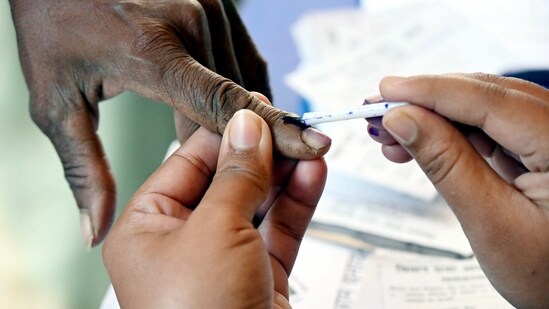
The Greater Bengaluru Authority elections will be conducted across 369 wards in five corporations created under the Greater Bengaluru Governance Act, 2024, which replaced the BBMP structure. According to electoral rolls released in April, nearly 89 lakh voters are eligible to participate in the elections, which will be conducted using ballot papers rather than electronic voting machines.
The BJP, meanwhile, has begun shaping its campaign around dissatisfaction over Bengaluru’s infrastructure and civic administration. Karnataka BJP president BY Vijayendra accused the Congress government of failing to deliver on promises made under its “Brand Bengaluru” initiative.
“There are several issues to take to the people, including bad roads, garbage and water problems. We will fight not just to win the polls, but in the interest of Bengaluru’s citizens who are fed up with the Congress government,” he said.
“The government promised a ‘Brand Bengaluru’ but has failed to deliver. We are determined to win all five corporations under the GBA,” Vijayendra added.
Leader of Opposition R. Ashoka said the BJP had already formed constituency-level committees to recommend candidates for each ward. “We have already constituted constituency-level committees that will submit a panel of three candidates each. The party will finalise candidates in the coming days,” Ashoka said.