
 E-Paper



Bengaluru's love affair that grinds corporates’ gears
Bengaluru's Kadalekai Parishe celebrates groundnuts with a vibrant festival, blending tradition and community, despite modern city's challenges.

 Prefer HTon Google


You can tell the character of a city by what it is willing to stop traffic for. In London, roads are cordoned off for royal processions; in Paris, for a marathon and in New York, for a Thanksgiving Day parade. In South Bengaluru, for three days each year, we block off roads…for a peanut. The groundnut, or what we call the kadalekai.
Until it became known as a source of allergies, this legume (Arachis hypogaea) that ripens under the earth was viewed in many cultures as a healthy snack. It brings texture to soups and stews in Africa, Asia and South America— where it originated.
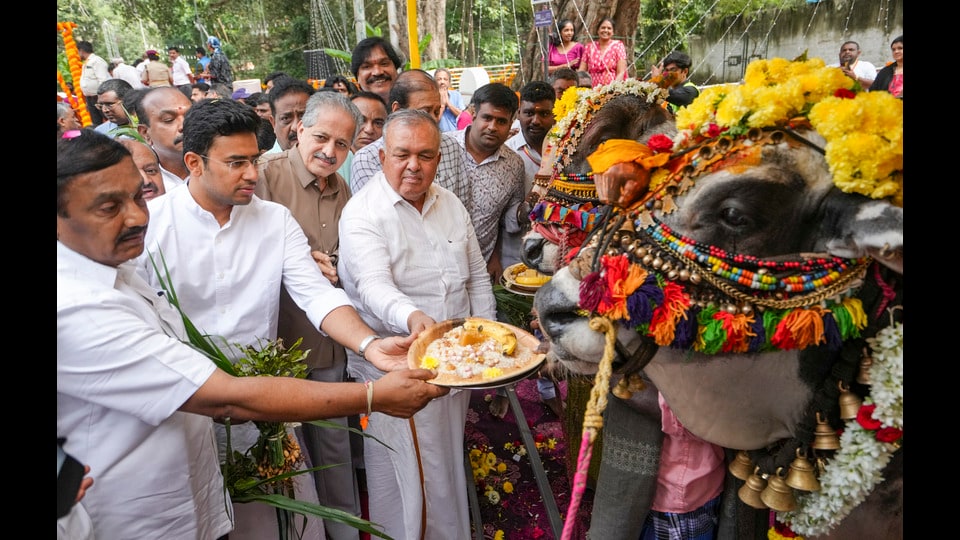
But no other culture celebrates it the way we do in Bengaluru. Parishe is a Kannada word meaning fair, but the Kadalekai Parishe is a religious festival, street market and yes, civic nuisance, all rolled into one. Its date, linked to the Vedic calendar, occurs on the last Monday of the month of Karthika (mid-October to mid-November). On this day, November 17 this year, farmers come from surrounding villages to both pray and sell. A bird’s eye view would show trucks trundling in at the crack of dawn from Guttahalli, Mavalli, Gavipuram, Sunkenahalli, and other hamlets, their trucks loaded with fragrant, freshly harvested groundnuts, smelling of earth and oil. Each year, they take over pavements and large sections of Bull Temple Road to begin their trade. If you don’t like peanuts or have an allergy, this is your nightmare. But for those of us who either love this legume or love the direct interaction with farmers, it is heaven. The air is redolent with the smell of roasting peanuts as vendors boil, fry, spice, salt and sell sugar-coated or roasted peanuts to eager crowds. Together they are part of an annual and sacred ritual that involves appeasing, well, a rogue bull. Which is where this story begins.
Legend has it that the groundnut farmers of the area were troubled by a marauding bull that ate up their crop. The panicked farmers prayed to the Nandi or sacred bull in the Dodda Ganeshana Gudi (Gudi means temple. Dodda means big. Ganeshana means Ganesha’s), and pledged their first harvest if the Basava ceased its marauding. Since it did, the pact had to be kept and thus began the tradition of offering their first harvest to the bull.
The other version says that farmers chased the rogue bull one moonlit night up the hillock. When they reached the top, the bull was nowhere to be seen. In its place was an idol of Nandi (the bull steed of Lord Shiva). The farmers began worshipping this Nandi, which kept growing. So they hammered a nail on its head to get it to stop. This Nandi remains and it remains huge. Referred to as Basava, it gives the area its name: Basavanagudi or Bull Temple. After the fair, the bull that is worshipped comes at night and eats up all the discarded shells. So the story goes, which the PKs or the Poura Karmikas (the women who clean our roads) have to corroborate.
This is what I love about living in Bengaluru. Amidst this tech and startup-driven city lies an agrarian festival that has somehow survived and thrived. For two days each year, game designers from Shivamogga, or app developers from Badami stop coding to return to their childhood when they frequented village Habbas or festivals just like this one. They come, buy raw or roasted groundnuts by the kilo and take it home to munch on amid zoom calls.
We have some fifteen varieties of groundnuts growing in Karnataka, of which about six grow in Bengaluru and its environs, according to farmers I interviewed at the fair. The growers preferred the smaller peanuts with tight pods and a crunchy flavour. Customers, though, preferred “size to taste,” they said, grinning, showing me the fat oval varieties, which suddenly fell into disregard in my eyes. The way that the groundnuts are used also varies. Of course, the base level is to boil them in massive vats of salt water until soft. The other version, followed by roadside vendors, is to roast them in sand-filled thick kadhais and then toss them with salt and spices before wrapping them quickly in a newspaper cone. This isn’t artisanal produce that you procure in air-conditioned aisles. This is raw and ready, straight from the earth to your hands.
Of course, the kadalekai parishe is also a civic headache, the kind that makes Bengaluru’s head honchos vent on social media about gridlocked roads. Locals of Basavanagudi both cherish and dread this season. And yet, against all odds, it continues. In a city of shiny towers branching out across metro lines, the Kadalekai Parishe is our root, anchoring us in an analog world that existed before the internet. A space where people talk and bargain, barter and trade. A mela that reminds Bangaloreans that before it became a boomtown, the city was a small clutch of villages where farmers grew groundnuts and brinjals, which together became that triumphant dish served with jolada or jowar rotis: badanekai ennegaior (spicy brinjals in peanut sauce).
(Shoba Narayan is Bengaluru-based award-winning author. She is also a freelance contributor who writes about art, food, fashion and travel for a number of publications.)
-k4lD-U204025897261YmH-250x250%40HT-Web.jpg)


