
 E-Paper



Book Box | Walking with Margaret Atwood in the Himalayas
An ancient goddess, a modern author, school bullies, and the village women washing clothes all come together to provide a soundtrack of life and living

 Prefer HTon Google


Dear Reader,
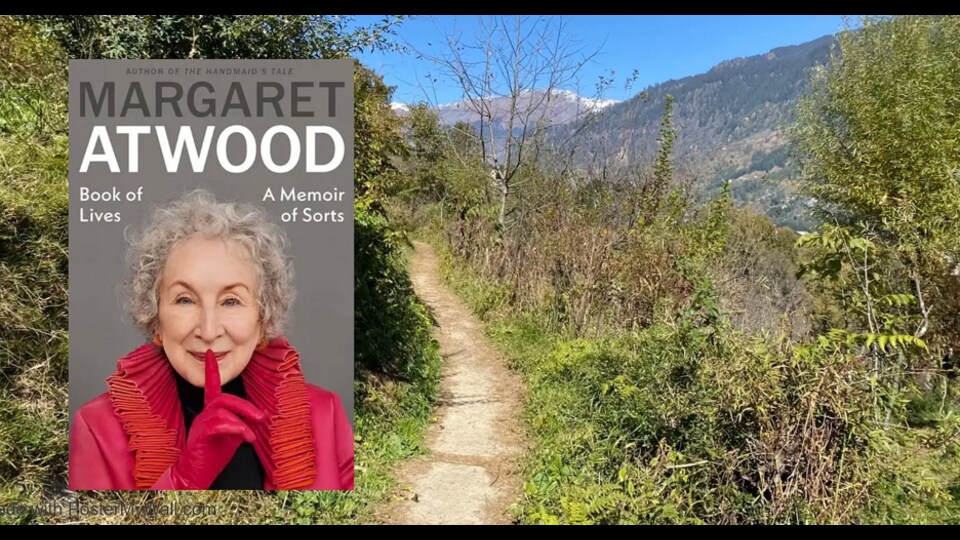
Margaret Atwood and I are spending a lot of time together. Every morning we set off through a street full of tourist shops, bursting with bric-a-brac like Kullu shawls and Turkish charm bracelets.
Atwood talks to me. Her voice has a low, raspy, textured quality; a gravelly tone gives it a sense of weathered wisdom and authenticity.
She plays with words. “In what style should I tell you my story?” she asks. “Eighteenth-century couplet, or like Edgar Allen Poe?”
I laugh out loud at her rendition of Poe. I can hear the raised eyebrow in her tone, the slight smile at the corner of her mouth as she delivers a dramatic line or an ironic observation.
I listen to Margaret tell her story in the audiobook version of Book of Lives as I walk by two temples—one dedicated to the goddess Hidimba Devi, whose story I am going to re-read in yet another retelling - this one by Kavita Kane in the novel Bhima’s Wife. Then the next, dedicated to her son, Ghatotkacha.
Margaret tells me about her family - her father Carl, an entomologist who worked in the Canadian boreal forests, studying insects that threaten the trees. Margaret’s mother, also named Margaret, is a tomboy who happily leaves the comfort of city life in Toronto to spend summers and autumns living in a log cabin in the forest with her husband, and their two children - the toddler Harold and baby Margaret Atwood.
And now we are in the village of Nasogi, past beautiful traditional Kathkuni houses made of deodar wood, with large cobbled courtyards. The ground floors are piled with mountains of hay, and the cows there look at us placidly and with some interest as we walk rapidly along.
Now Margaret tells me about being bullied at school in Toronto. There is a resonant, sometimes weary quality to her voice, as if it carries the weight of the dystopias she has imagined and the histories she has analysed, of someone who has seen patterns and is telling you, with clarity and a hint of sorrow, how things work.
“Anyone who thinks that females are perfect, that girls are nicer, that every sadistic thing girls and women do is the fault of the ‘patriarchy’, has either forgotten a lot or never been a nine-year-old girl at school. The desire for power is a human constant...,” Margaret says. Some of this finds their way into her novel Cat’s Eye. The bullying goes on and on, until one day, after a summer away, Margaret returns and just refuses to be bullied.
I think back to a bullying episode in my days where a group of girls began a game of inviting themselves to be chased by me. “Come, come doggie, they would tease. And inexplicably, I would oblige them by chasing them, instead of walking away. Perhaps I wanted to pretend it was a game and that I didn’t care. That I’d rather be teased than burst into tears and show them how miserable their game made me.
When Margaret Atwood shares her story, her analysis of bullying and of gaslighting, the emotions of anyone who has been a victim of it, and the books that helped her make sense of it, like The Bounty and Alice in Wonderland, I am comforted and consoled and awed by the power of books and storytelling.
By now, we are walking past a little bridge over a trail of water that comes running down a mountain, and then an open area where the water bubbles out of a mountain spring, and the village women come and wash their clothes here, finally turning into a path that wends its way through apple orchards and then comes to our building site.
This is where Margaret Atwood and I part company. For a while at least. I must leave her to talk to the mason who is laying stone in the casement of the windows. He needs more marble, he says. He needs specialised fasteners to hold the stone up . They are not available in Manali, so these must be ordered from Chandigarh.
The plumbers should have been here, but I don’t see them. They ran out of waterproofing chemical, they told me when I called, so they’ve taken a break. The stone masons aren’t here either; they had some medical emergency today, says another workman. All of them? I ask with incredulity. The workman nods.
And then it’s time to leave. As I walk back, Margaret Atwood is with me again, and I am transported from this Himalayan valley to the boreal forests of Canada and then to school in Toronto. I laugh out loud. An eye-tester has come to school, telling the teenage Atwood she needs glasses. “My life is over!” she is quoted as saying. And so it goes on.
Tomorrow I have a long journey ahead, a six-hour drive, a flight, and lots of waiting time in between. But I am unfazed, for the six-hour drive will just be more time to listen to Margaret Atwood.
Books referred to in this edition of Book Box
Book of Lives by Margaret Atwood
Bhima’s Wife by Kavita Kane
Cats Eye by Margaret Atwood
Mutiny on the Bounty by John Boyne
Alice in Wonderland by Lewis Carroll
(Sonya Dutta Choudhury is a Mumbai-based journalist and the founder of Sonya’s Book Box, a bespoke book service. Each week, she brings you specially curated books to give you an immersive understanding of people and places. If you have any reading recommendations or suggestions, write to her at sonyasbookbox@gmail.com. The views expressed are personal.)


