The Brics grouping on Tuesday endorsed an India-South Africa proposal for patent waivers for Covid-19 vaccines and called for sharing of doses, transfer of technology, and development of vaccine production capacities in order to turn the tide in the fight against the coronavirus disease.
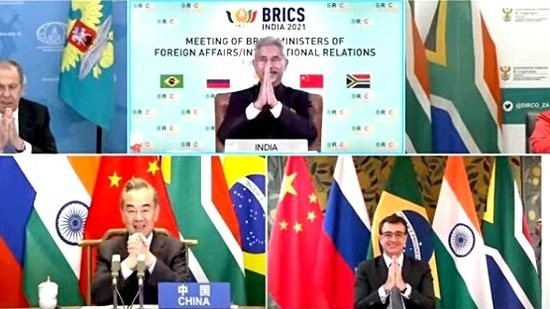
Against the backdrop of the India-China border standoff, members of the Brazil-Russia-India-China-South Africa (Brics) grouping reaffirmed the importance of territorial integrity and sovereignty of states and the need to resolve problems through peaceful means.
A virtual meeting of foreign ministers of Brics states, which was chaired by external affairs minister S Jaishankar, also resolved to combat all forms of terrorism, including cross-border movement of terrorists, terror financing networks, and safe havens.
Jaishankar and his counterparts from the four other countries – China’s Wang Yi, Brazil’s Carlos Alberto Franco França, Russia’s Sergey Lavrov and South Africa’s Grace Naledi Mandisa Pandor – focused on the response to the Covid-19 crisis and equitable access to vaccines during their deliberations.
India and South Africa have been pushing for a waiver of patent protections for Covid-19 vaccines at the World Trade Organization (WTO) since last year, and all the Brics members agreed on Tuesday to support this measure as part of efforts to ensure timely, affordable and equitable access to diagnostics, vaccines and essential health products and technologies and their components to combat the pandemic.
{{/usCountry}}India and South Africa have been pushing for a waiver of patent protections for Covid-19 vaccines at the World Trade Organization (WTO) since last year, and all the Brics members agreed on Tuesday to support this measure as part of efforts to ensure timely, affordable and equitable access to diagnostics, vaccines and essential health products and technologies and their components to combat the pandemic.
{{/usCountry}}“The ministers reaffirmed the need to use all relevant measures...including supporting ongoing consideration in WTO on a Covid-19 vaccine intellectual property rights waiver and the use of flexibilities of the TRIPS agreement and the Doha Declaration on TRIPS Agreement and Public Health,” said a joint statement on reforming the multilateral system that was adopted at the meeting.
The ministers reiterated the need for sharing vaccine doses, transfer of technology, development of local production capacities and supply chains for medical products, and promotion of price transparency, and sought “due restraint in the implementation of measures that could hinder the flow of vaccines, health products and essential inputs”. They also called for timely operationalisation of the Brics vaccine research and development centre.
This was the first time the Brics foreign ministers agreed on a stand-alone joint statement on strengthening and reforming the multilateral system. They agreed that such reforms have to cover all key multilateral institutions, including the UN and its organs such as the Security Council and General Assembly, global financial institutions such as the IMF and World Bank, the multilateral trading system including WTO, and the global health system with the WHO at its core.
The foreign ministers also agreed on six principles that should guide such reforms, including making instruments of global governance more inclusive and representative, changes based on inclusive consultations while respecting sovereign independence, making multilateral organisations more responsive and transparent, and strengthening countries and global organisations to better respond to emerging and non- traditional challenges such as terrorism, cybersecurity and fake news.
Though there was no official word on whether the India-China standoff figured in the discussions, Jaishankar said in his opening remarks that Brics strives for an inclusive and equitable multipolar international system that respects the territorial integrity of all states.
Such a multipolar system is “based on international law and the UN Charter, that recognises the sovereign equality of all states, and respects their territorial integrity while displaying mutual respect for interests and concerns of all”, he said.
Asked about the India-China differences at a press conference after the meeting, Russian foreign minister Lavrov said the Brics members reaffirmed the principles of the UN Charter, including respect for sovereignty and territorial integrity of countries, and the need to “resolve any problems with peaceful means”.
People familiar with developments said on condition of anonymity that the Indian side was able to get Brics members to agree to strong language on counterterror cooperation, including the reference in a joint media statement to “cross-border movement of terrorists, terror financing networks and safe havens”.
The Brics members referred to the counterterrorism strategy adopted at the grouping’s summit last year, and reiterated their commitment to finalise a “result-oriented action plan” by the Counter-Terrorism Working Group in 2021.
The statement on reforming the multilateral system said the foreign ministers reaffirmed the sole authority of the UN Security Council for imposing sanctions and called for “further consolidation and strengthening of the working methods of UN Security Council sanctions committees to ensure their effectiveness, responsiveness and transparency”.
On the issue of Afghanistan, the other Brics states echoed India’s consistent stand and underline the need to preserve gains made over the past 20 years in the war-torn country. They stressed the need to protect the rights of all Afghan nationals, especially women, children and minorities, and called for an immediate ceasefire. They also stressed the “urgent necessity of the elimination of the threat of UNSC proscribed terrorist groups to lasting peace in Afghanistan”.