Three years ago on May 5, 2020, the Chinese Army began aggression on patrolling point 14 in the Galwan Valley of East Ladakh with the objective to dominate the Darbuk-Shyok-Daulet Beg Oldi (DBO) road running parallel to the Galwan-Shyok river confluence. This was followed by PLA transgressions in Chang Chemo sector and Pangong Tso on May 17-18 by throwing all the existing bilateral border pacts in the dustbin.
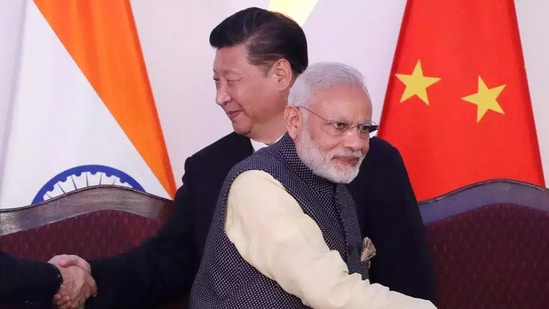
Since that day, the Indian Army and Air Force have been on standby to meet the Chinese military challenge in East Ladakh and all along the 3488 km Line of Actual Control (LAC), braving arctic conditions on the spine of the Himalayas.
While the Narendra Modi government has stood up to the military challenge posed by the PLA, it is rather exasperated with the Indian private sector which is allowing Beijing a crucial economic lever to put pressure on Bharat.
Notwithstanding the dip in 2020, the year of transgression and near war, the Indian bilateral trade deficit with China has grown from USD 37.8 billion in 2014 to USD 101.28 billion in 2022 with the gap increasing by the day. This is due to the fact that the Indian private sector prefers importing goods like machinery and even furniture from China rather than manufacturing in India despite PM Modi calling for “Atmanirbhar Bharat” from the rooftop. To complicate matters, the Indian exports to China have decreased in 2022 as compared to 2020 and 2021 with the Modi government imposing restrictions on natural resources export. It is the lack of manufacturing by the private sector that is allowing China that extra leverage against India but the Indian private sector unlike in Germany and France cannot push the Modi government to normalize relations and increase trade ties with Beijing.
While the national security planners and the Ministry of External Affairs have been red-flagging the growing trade deficit and its impact on equally concerned Finance and Commerce Ministries, some of the biggest names in the Indian private sector are playing footsie with China when it comes to importing manufactured goods from the Communist nation. Behind the doors, South Block believes that only additional duties on imported items could reduce the trade deficit as they are frustrated by the lack of response from the private sector.
{{/usCountry}}While the national security planners and the Ministry of External Affairs have been red-flagging the growing trade deficit and its impact on equally concerned Finance and Commerce Ministries, some of the biggest names in the Indian private sector are playing footsie with China when it comes to importing manufactured goods from the Communist nation. Behind the doors, South Block believes that only additional duties on imported items could reduce the trade deficit as they are frustrated by the lack of response from the private sector.
{{/usCountry}}The private sector has its own grouse of manufacturing in India due to additional costs incurred on account of greasing the bureaucracy in Indian states. Fact is that it is still not easy doing manufacturing in Indian states due to unnecessary overhead costs despite forward movement recorded in ease of doing business in the country. And the Modi government cannot be faulted for a lack of other initiatives to attract manufacturing.
In March 2020, before the Galwan transgressions, a ₹1.97 lakh crore production-linked incentive (PLI) scheme was launched initially with three sectors in March 2020, and subsequently extended to 11 others. Apart from the large-scale electronics, mobile manufacturing, and medical equipment sector PLI launched in March, the scheme now extends to advance chemistry cell battery, IT hardware, automobiles and auto components, pharmaceuticals drugs, telecom and networking products, technical textiles, food products, high-efficiency solar PV modules, white goods, speciality steel, drones, and drone components. So far the PLI scheme has attracted ₹53,500 crore investments, generated 3 lakh jobs, and augmented incremental output worth ₹5 lakh crore. The achievements are significant as the government has so far only spent less than ₹3,000 crore in giving PLIs to industries. More than 717 units have been found eligible for the PLI scheme. This is not all.
Concerned over its widening trade deficit with China because of the dumping of substandard Chinese goods India is resorting to stringent quality control measures for hundreds of items. The Modi government has decided to bring 675 new products under the quality control order (QCO) with a view to replicating the success in eliminating substandard toys, mainly imported from China affecting the health of Indian kids. After 2014, the government had already notified 387 QCOs even though the move is not targeting any particular country as it is equally applicable for both domestic manufacturers and imports. Some recent examples of such QCO measures have been seen in helmets, air-conditioners, refrigerators, domestic cookers, cooking gas stoves, safety glasses, footwear, and the wheel rims industry.
While the Modi government is proactively trying to encourage manufacturing in India and curb the trade deficit, the time has come for the private sector to set up manufacturing in India rather than import machinery from China and increase its leverage over the country. It may result in less profits for the Indian private sector but will also muscle up India’s strategic autonomy.