Chief of Defence Staff (CDS) General Anil Chauhan on Wednesday warned against dependence on foreign niche technology, adding that Pakistan used unarmed drones and loitering munitions on May 10 during Operation Sindoor but could not inflict any damage on Indian military or civilian infrastructure.
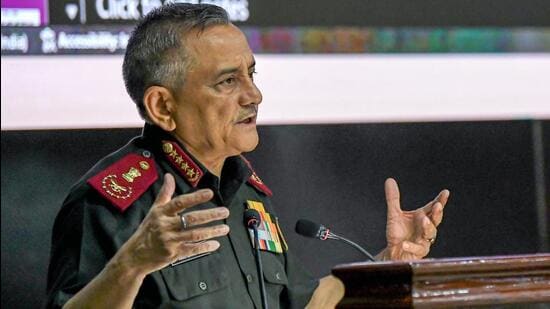
“Most of them were neutralised through a combination of kinetic and non-kinetic means. And some of them were recovered in almost intact condition,” he said at a seminar at the Manekshaw Centre in Delhi
India launched Operation Sindoor in the early hours of May 7 and struck nine terror and military installations in Pakistan and Pakistan-occupied Kashmir (PoK) following the April 22 Pahalgam terror strike that killed 26 people.
In his keynote address, the CDS said that Operation Sindoor showed why locally developed unmanned aerial systems (UAS) and counter-UAS built for Indian terrain and Indian needs were crucial.
“We cannot rely on imported niche technologies that are crucial for our offensive and defensive missions; we must invest, build and safeguard ourselves…Dependence on foreign technologies weakens our preparedness, limits our ability to scale up production, and results in a shortfall of critical spares for sustenance and round-the-clock availability,” he said.
“Foreign capability is known to all and adversaries can predict tactics based on the capability of these systems,” he added.
{{/usCountry}}“Foreign capability is known to all and adversaries can predict tactics based on the capability of these systems,” he added.
{{/usCountry}}Operation Sindoor triggered a four-day military confrontation with Pakistan involving fighter jets, missiles, drones, long-range weapons and heavy artillery before the two sides reached an understanding on stopping all military action on May 10.
Highlighting the flip side of imported military hardware, Chauhan said the capabilities of foreign weapons and sensors were known to all. “Our adversaries can predict our tactics and operational concepts based on the capabilities of the particular (imported) system. If you are developing your own systems, their capabilities are not known to the enemy and that may add an element of surprise in the initial encounters at least,” he said.
Counter-UAS operations are extremely complicated, he said. “Detecting, identifying, tracking and neutralising drones involves the creation of a counter-UAS grid that must be capable of integrating and networking multiple technologies such as radars, sensors, jammers and directed-energy weapons.”
The effectiveness of this architecture, he said, will hinge on seamless coordination and integration across air defence networks, civil aviation regulators and local command and control systems to avoid gaps, fratricide and operational blind spots.
Defence minister Rajnath Singh had earlier hailed the performance and reach of locally made weapons and systems deployed during Operation Sindoor.
The CDS also said the widespread utility of drones in recent conflicts demonstrated how they can shift the tactical balance disproportionately to their size or price. “Asymmetric drone warfare is making large platforms vulnerable and driving militaries to rethink the conceptual aspects of air doctrines, development of C-UAS and adaptive moves of engagement,” he said.
The CDS emphasised the importance of technology in warfare and underlined the evolutionary phases through which rifles, guns, ammunition and other platforms have gone through to become smaller, more potent, and convenient to use. “Talk about drones, what do you think these are introducing, a kind of evolutionary change or a revolutionary change in warfare?” he asked.
“I think their development is kind of evolutionary, but their employment has been very, very revolutionary, as far as warfare is concerned. Initially, their development was for small applications, limited ranges, restricted payloads. As the realisation of their scope of deployment, utility and success increased, the Army started using drones in a revolutionary way,” the CDS asserted.
A locally developed air defence control and reporting system, called Akashteer, emerged as the centrepiece of India’s air defence grid during the four-day clash; it punctured multiple waves of Pakistani aerial attacks on Indian military installations, airbases and civilian areas by guaranteeing prompt detection and targeting of the incoming threats.
The locally produced military hardware that packed a formidable punch during the confrontation included Akash surface-to-air missiles, the Samar (surface-to-air missile for assured retaliation) system, loitering munitions and several counter-drone weapons.
Between the launch of the operation in the early hours of May 7 and the ceasefire on May 10 evening, Indian forces bombed nine terror camps in Pakistan and PoK, killing at least 100 terrorists, and the Indian Air Force struck targets at 13 Pakistani airbases and military installations.
Military leaders, defence experts, scientists, policymakers and private industry representatives gathered as part of the workshop-cum-exhibition to develop a “strategic roadmap” for indigenisation, with an overarching aim to reduce dependency on foreign companies for critical UAV and C-UAS components.
“In the rapidly evolving landscape of non-contact warfare, UAVs have emerged as a transformative force. For India, self-reliance in UAVs and C-UAS technologies is not only a strategic imperative, but it is also about empowering itself to chart its destiny, safeguard its interests and seize the opportunities of the future,” the CDS wrote in his message for the workshop.