A team of zoologists from Gauhati University, Lady Keane College in Shillong, and the ICAR-National Bureau of Fish Genetic Resources in Lucknow discovered Schistura densiclava — a new species of fish that thrives underground but can adapt to surface conditions as well — in Krem Mawjingbuiñ, a cave in Meghalaya.
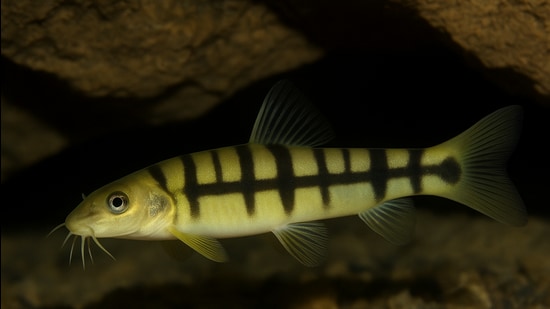
The limestone cave is located just 15 kilometres from Mawsynram, one of the wettest places on earth. Most hypogean (underground-dwelling) species lose their eyesight and pigmentation over generations, relying on heightened non-visual senses to navigate pitch-dark waters. Unlike them, this unique species of stone loach has eyes and shows off its colours too.
Published in the Journal of Fish Biology, a prestigious journal by the Fisheries Society of the British Isles, the discovery has drawn international attention and national applause. Assam’s education minister Ranoj Pegu took to social media platform X to congratulate the team, calling it “a proud moment for Northeast India’s scientific community.”
With a pale yellow-green body and bold black bars numbering between 14 and 20, the fish sports a distinctive thick stripe near its dorsal fin — the very feature that earned it the species name densiclava, meaning “dense stripe” in Latin.
“This discovery highlights the untapped biodiversity thriving in Meghalaya’s underground ecosystems. It’s the ninth new fish species we’ve described from Northeast India, and the sixth known cave-associated fish from Meghalaya” said Professor Dandadhar Sarma, head of Zoology department at Gauhati University.
{{/usCountry}}“This discovery highlights the untapped biodiversity thriving in Meghalaya’s underground ecosystems. It’s the ninth new fish species we’ve described from Northeast India, and the sixth known cave-associated fish from Meghalaya” said Professor Dandadhar Sarma, head of Zoology department at Gauhati University.
{{/usCountry}}Unlike fully cave-adapted species such as Schistura papulifera and Neolissochilus pnar — which are pigmentless, blind, and cannot survive in a surface environment— Schistura densiclava thrives inside caves but isn’t entirely dependent on subterranean life.
Researchers said that the fish was found exclusively in a cool, fast-flowing stream some 60 metres inside the cave, where water temperatures hover at a chilly 18°C and oxygen levels are low. The fish’s resilience in such nutrient-scarce conditions is remarkable.
Its diet includes copepods, tiny shrimp, insect fragments, and even bat guano.
According to Kangkan Sarma, one of the study’s lead authors, the species shows clear sexual dimorphism. “Males are slimmer with irregular patterns and puffier cheeks, while females are more robust and display more uniform markings,” he noted, adding, “DNA sequencing confirms that this is a genetically distinct species, unlike any other Schistura found in the region.”
The East Khasi Hills region, where Krem Mawjingbuiñ lies, is a part of Meghalaya’s celebrated cave systems — one of the richest and least explored subterranean landscapes in the world. With over 1,700 caves and cave locations documented, but only a fraction thoroughly studied, Meghalaya is considered a global hotspot for cave biodiversity.
“There were no visible signs of human disturbance inside Krem Mawjingbuiñ,” said one researcher, noting how seasonal access and the surrounding dense forest have kept the cave largely untouched by tourism or development.This ecological isolation, researchers said, is a double-edged sword — protecting species for now, but making them vulnerable to even minor intrusions.