With Gen Anil Chauhan settling into his job as the principal military advisor to Narendra Modi government, the second Chief of Defence Staff (CDS) has started building consensus among the three services over the proposed creation of military theatre commands.
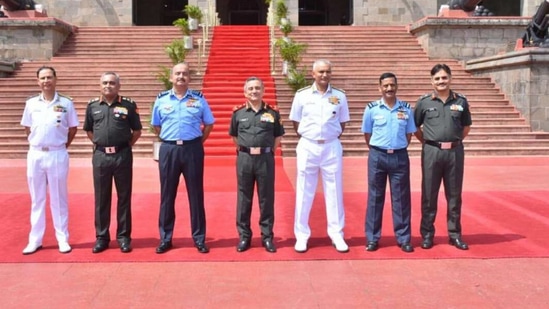
It is understood that a detailed discussion was held between the CDS and the three services chiefs—Gen Manoj Pandey, Admiral R Hari Kumar and Air Chief Marshal V R Chaudhari—on the proposed commands on October 22 at NDA at Khadakvasla in Pune on October 22.
The new CDS took the three chiefs to Khadakvasla to remind them of their beginnings at National Defence Academy (NDA) and the need to synergize military operations in future as the country’s focus is shifted to China as the principal threat from Pakistan. It is learnt that CDS Chauhan let the three chiefs speak about their perspective on the military theatre commands in detail in a bid to build consensus among themselves. Gen Chauhan belongs to the 58th course of NDA, while the three chiefs passed out from the 61st group. The new CDS also has a distinct advantage: as during his tenure as military advisor to the National Security Council Secretariat, he was made a member of the high-powered China Study Group.
Although the new CDS does not want to impose theatre commands on the three services, he has given them three months to streamline their perspectives over the issue as theatre commands cannot be delayed any longer. It is learnt that Gen Chauhan believes in bottom to top approach---that is by promoting joint man ship from the soldier rather than imposing a theatre commander on the top without basic architecture and war doctrine. China has five theatre commands under the Central Military Commission headed by President Xi Jinping. The entire 3488 km Line of Actual Control with India is covered by Western Theatre Command with dedicated army, air force and naval assets (if required).
{{/usCountry}}Although the new CDS does not want to impose theatre commands on the three services, he has given them three months to streamline their perspectives over the issue as theatre commands cannot be delayed any longer. It is learnt that Gen Chauhan believes in bottom to top approach---that is by promoting joint man ship from the soldier rather than imposing a theatre commander on the top without basic architecture and war doctrine. China has five theatre commands under the Central Military Commission headed by President Xi Jinping. The entire 3488 km Line of Actual Control with India is covered by Western Theatre Command with dedicated army, air force and naval assets (if required).
{{/usCountry}}While the Army and Navy are prepared for the creation of theatre commands, the Indian Air Force has legitimate concerns over splitting its limited air assets among the respective theatres. However, the air warfare now has evolved from manned fighter planes to armed drones and kamikaze drones with most advanced and long range surface to air missile systems like the Iron Dome and S-400, the air force will have to rethink its war doctrine. The on-going Ukraine was has shown that despite having a massive air force, the Russian Air Force is still to achieve dominance over Ukraine air space and is vulnerable to shoulder fired Stinger missiles. The Ukraine war has shown the power of stand-off weapons with the Indian national security planners working on creating a separate rocket and missile command under the Air Force. Besides missiles, the armed drones have also wreaked havoc in the Ukraine war with Russia using Iranian drones for targeting key infrastructure within the Central European nation.
Whatever be the inter-services reservations, the answer to coordinated and rapid military response lies with a military theatre commander with ground, air and sea assets under his disposal so that fast decisions can be taken and communicated to troops on ground.