New Delhi: The Centre has refused to grant remission to life convict and forest brigand Veerappan’s aide Gnanaprakash as his crime of killing 22 policemen in a 1993 landmine blast in Karnataka was a “serious crime” and had a bearing on the country’s internal security.
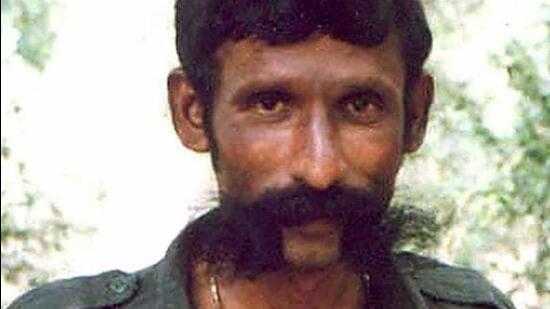
The decision of the Centre taken on September 25, 2023 was conveyed to the Supreme Court last week during the hearing of a petition filed by Gnanaprakash’s wife Selva Mary seeking his release. The top court recorded the order passed by the Centre and closed the proceedings by extending his interim bail for three months and allowing his wife to approach the Karnataka high court against the Centre’s refusal to grant premature release.
Gnanaprakash is the sole surviving convict in the case as the other three associates of sandalwood smuggler Veerappan – Simon, Meesekaara Madaiah and Bilavendran -- have died in jail due to old age and health complications. Gnanaprakash has undergone 30 years of incarceration and was granted interim bail by the top court in November last year as he was detected with fourth stage lung cancer.
A bench of justices Sanjiv Khanna and Bela M Trivedi in its order said, “... the representation/mercy petition filed by Selva Mary, wife of Gnanaprakash, seeking premature release of Gnanaprakash, has been rejected. The petitioner (Selva Mary) will be at liberty to challenge this order before the jurisdictional high court by way of a petition under Article 226 of the Constitution of India.”
{{/usCountry}}A bench of justices Sanjiv Khanna and Bela M Trivedi in its order said, “... the representation/mercy petition filed by Selva Mary, wife of Gnanaprakash, seeking premature release of Gnanaprakash, has been rejected. The petitioner (Selva Mary) will be at liberty to challenge this order before the jurisdictional high court by way of a petition under Article 226 of the Constitution of India.”
{{/usCountry}}In the proceedings that took place before the top court on October 19, additional solicitor general (ASG) Aishwarya Bhati presented the communication issued by the Ministry of Home Affairs (MHA) to the Principal Secretary, Home department, Government of Karnataka.
A copy of the order, reviewed by HT, said, “The life convict Gnanaprakash was involved in laying land mines knowing fully well the blasts would kill and injure many persons. It is a serious crime which has bearing on the internal security of the country.”
The Court had on November 28 last year released Gnanaprakash on interim bail owing to his health condition. Senior advocate S Nagamuthu appearing for the petitioner along with advocate S Prabhu Ramasubramanian informed the Court that they will be moving the high court against the September 25 decision. The top court continued the interim bail for another three months and said, “After the writ petition is filed (before the high court), the petitioner Selva Mary to press for extension of interim bail till decision of the writ petition, which prayer will be considered in accordance with law.”
Selva Mary had filed the mercy petition for her husband’s release on September 19, 2020 seeking clemency from the President of India under Article 72. At that time, he had completed 27 years of imprisonment. The Centre forwarded the mercy petition to the Karnataka government to seek its view. In April 2021, the state did not endorse Gnanaprakash’s release. Later, on April 1, 2023, the Karnataka government sent a fresh proposal recommending Gnanaprakash’s release based on his good conduct.
Disposing the mercy petition and the state’s proposal, the MHA order noted that the incident involved blasting of two buses that caused death of 22 policemen and injuring several persons at Palar by laying landmines. It said, “After considering the above facts, documents and materials on record, the competent authority as rejected the mercy petition filed by Selva Mary for pre-mature release of life convict Gnanaprakash.”
Gnanaprakash and three others were sentenced to life by the trial court in 2001 for offences under the Terrorists and Disruptive Activities Act (TADA) besides other provisions of the Indian Penal Code, Explosives Act and Arms Act. Their sentence was later enhanced to death penalty by the Supreme Court in 2004. But in 2013, their capital punishment was commuted to life on account of the long delay in deciding the mercy petitions filed by the four convicts.