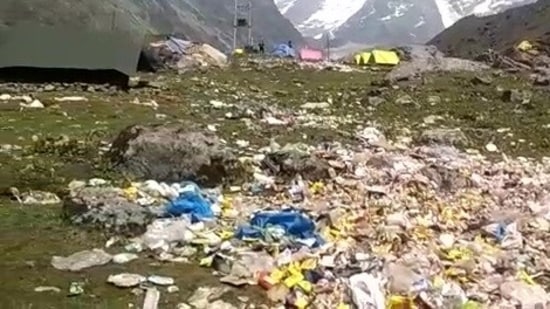
Over eight lakh pilgrims have undertaken the Char Dham yatrain Uttarakhand so far this year, news agency ANI reported Sunday. Coming from across the country and the world, they have visitedthe shrines of Badrinath, Kedarnath, Gangotri and Yamunotri, and lakhs more have registered. These lakhs bring much-needed revenue to the state's coffers, but also bring something sinister and dangerous - tons of garbage, specifically plastic bags and wrappers that threaten the environment.
Visuals shared by ANI show large stretches of what are usually beautiful rolling green hills with majestic snow-capped mountains in the background.
{{^usCountry}}{{/usCountry}}
Only now these are littered with discarded plastic items, like bags and bottles, and other waste materials that make it look like a city garbage dump.
And this has left scientists and environmental experts worried, not just because of the pollution but also because of the impact on a state prone to natural disasters like landslides.
"The way plastic garbage has piled up in a sensitive place like Kedarnath is hazardous for our ecology. It'll lead to erosion which can cause landslides. We must keep in mind tragedy of 2013," professor MS Negi, head of the geography department at Garhwal Central University, told ANI.
{{^htLoading}} {{/htLoading}}
{{^usCountry}}
In June 2013 a cloudburst led to devastating floods and landslides across Uttarakhand - it was India's worst natural disaster since the tsunami that struck coastal communities along the Bay of Bengal in 2004.
{{/usCountry}}
{{#usCountry}}
In June 2013 a cloudburst led to devastating floods and landslides across Uttarakhand - it was India's worst natural disaster since the tsunami that struck coastal communities along the Bay of Bengal in 2004.
{{/usCountry}}
And it isn't just pollution and natural disasters that threaten the state.
{{^htLoading}} {{/htLoading}}
Professor MC Nautiyal, director of the High Altitude Plant Physiology Research Centre in Uttarakhand, told ANI: "Tourist inflow has risen manifold due to which plastic garbage has increased… we don't have proper sanitation facilities. This has affected natural vegetation. Medicinal plants are getting extinct."
Tens of thousands of pilgrims visit each of the shrines every day; up to 16,000 can visit Badrinath per day, 13,000 at Kedarnath, 8,000 at Gangotri, and 5,000 each at Yamunotri and Hemkund Sahib. All of this adds up to a horrifying amount of garbage - plastic and other waste materials.
Follow the latest breaking news, major developments and agenda-setting stories from India and around the world with the newsdesk at Hindustan Times. Operating round the clock, the desk brings together experienced editors, reporters and correspondents to deliver fast, accurate and contextual reporting across subjects that influence public policy, governance, business, society and international affairs. The HT News Desk covers politics, elections, government policies, the economy, business and markets, science and technology, the environment, law and order, infrastructure, education, climate issues and geopolitics, while closely tracking developments across states, institutions and global capitals. The team also leads coverage of major breaking news events, policy announcements, court proceedings, natural disasters, public emergencies and significant international developments. Reports published by the newsdesk are based on information gathered from reporters on the ground, official statements, government agencies, court records, regulatory filings, recognised institutions and other authoritative sources. Stories undergo editorial scrutiny and verification processes to ensure accuracy, fairness and relevance, and are updated as events evolve and additional information becomes available. Whether covering a key political decision in New Delhi, an economic policy shift affecting millions, a landmark court ruling or a major global event, the HT News Desk aims to provide readers with reliable, fact-based journalism that delivers not only the latest developments but also the context and analysis needed to understand their wider implications.
Get Latest News, breaking headlines, and top India News, and today real-time updates from across the nation. Stay informed on politics, government policies, crime, Today Weather, and major developments on Hindustan Times
Get Latest News, breaking headlines, and top India News, and today real-time updates from across the nation. Stay informed on politics, government policies, crime, Today Weather, and major developments on Hindustan Times
Home/India News/'Garbage has piled up…': Experts worry over pollution on Char Dham Yatra route
{{^htLoading}}
Advertisement
{{/htLoading}}
SHARE THIS ARTICLE ON
{{#usCountry}}{{/usCountry}}
Notifications
Get breaking alerts directly from the newsroom
Notifications are on!You'll be notified when news breaks