Further gains by Myanmar’s anti-junta groups in recent weeks, including resistance fighters overrunning 440 military posts, have added to worries about the fragile security situation in the neighbouring country impacting India’s strategic northeastern region, people familiar with the matter said.
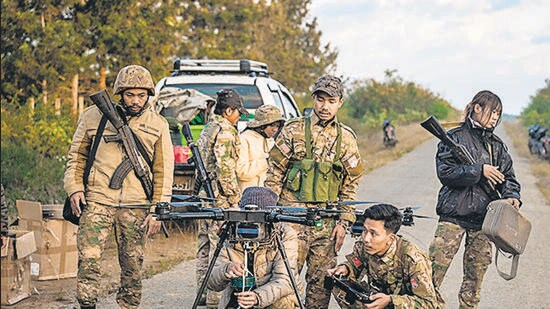
Three powerful anti-junta groups – Myanmar National Democratic Alliance Army (MNDAA), Arakan Army and Ta’ang National Liberation Army (TNLA) – that launched an offensive against the military last October agreed to a temporary ceasefire in areas on the border with China on Thursday night, but there will be no halt in operations in other parts of Myanmar, the people said on condition of anonymity.
The truce was finalised in talks held at Kunming during January 10-11 between the groups known as the Three Brotherhood Alliance and representatives of Myanmar’s State Administration Council (SAC). This was the third round of China-brokered dialogue since December and another truce last month collapsed within days.
The temporary ceasefire will be limited to Myanmar’s Shan state bordering China and will have no impact in other areas such as Rakhine state and Sagaing region, which are located close to the border with India and have witnessed intense fighting in recent weeks, the people said.
There was no immediate response from Indian officials to the latest developments in Myanmar.
{{/usCountry}}There was no immediate response from Indian officials to the latest developments in Myanmar.
{{/usCountry}}Earlier this week, about 700 Myanmar military personnel, including officers, surrendered to the Arakan Army in Rakhine state, the people said. This followed the surrender of nearly 2,500 military personnel and their families at Laukkai in Shan state early in January. Nearly 230 officers, including six brigadier generals and three colonels, were among those who surrendered in Laukkai.
In addition to capturing vast swathes of territory, the resistance forces have taken control of more than 30 important towns, including 16 in Shan state, seven in Chin state and four in Sagaing region.
The anti-junta forces have also retained control of Rihkhawdar, located a short distance from Zokhawthar town in Mizoram and home to one of only two official land border crossing points with India, and Khampat, a key town located 50 km from the second border crossing point between Tamu in Myanmar and Moreh in Manipur, the people said.
The fighting in areas close to the border with India has heightened concerns that militant groups from the northeast with bases in Myanmar’s Sagaing region may attempt to sneak back into the country, the people said. Besides Kuki and Meitei militant groups, the United Liberation Front of Asom-Independent (ULFA-I), which is opposed to peace talks, has bases in Myanmar.
Hundreds of Myanmarese civilians and troops have sought refuge in Manipur and Mizoram in recent weeks, and 416 soldiers were subsequently repatriated.
Indian Army chief Gen Manoj Pande alluded to these concerns at a news conference on Thursday, saying the Indian side is “closely watching” the situation along the border and has strengthened its posture by deploying close to 20 Assam Rifles battalions.
Policy-makers in New Delhi are also keeping a close watch on China’s role in brokering talks between the Three Brotherhood Alliance and SAC, a move that will only enhance Beijing’s influence in Myanmar. China’s special envoy for Myanmar, Deng Xijun, facilitated the talks in Kunming and witnessed the finalisation of the ceasefire on Thursday.
China’s former envoy to India, Sun Weidong, now a vice foreign minister, too has played a key role in Beijing’s efforts to end fighting in Shan state. These efforts, the people said, were primarily focused on resumption of border trade and protection of Chinese nationals and investments in infrastructure projects.
Toe Kyaw Hlaing, a councillor of the National Unity Consultative Council (NUCC), an advisory body to Myanmar’s government in exile, said the world community has no comprehensive approach towards Myanmar at a time when its focus remains on conflicts in Ukraine and Israel.
“India is very important for Myanmar and can play an important role, but it needs to understand the situation correctly and it should have a smart strategy. Instead of a one-sided relationship with the SAC it should reach out to the National Unity Government (NUG) and other stakeholders,” Hlaing said.
Another person close to the NUG or government-in-exile, who declined to be identified, said India shouldn’t see the situation in Myanmar only in the context of China and should focus on the situation on the ground and the reasons for which the people are fighting the junta.
India informed Myanmar of its security concerns, especially refugee flows, during foreign office consultations in New Delhi in December. At the time, the external affairs ministry spokesperson had said the Indian side has backed a peaceful resolution and a return to democracy as the way forward in Myanmar.