A couple in Madhya Pradesh renounced their three-year-old daughter and property worth Rs 100 crore to become Jain monks. The decision by Sumit and Anamika Rathore to leave their daughter Ibhya this week prompted social activists to appeal to the National Human Rights Commission.
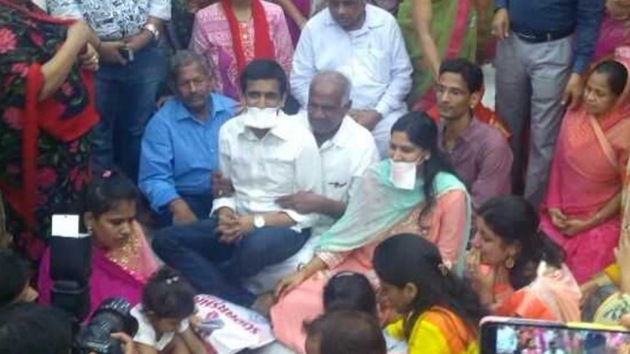
Sumit and Anamika had decided to become monks when Ibhya was only eight months old and, as preparation, started living separately. The couple, who married four years ago, have taken a vow of silence.
A teenager, Varshil Shah, who scored 99.9 percentile in Class 12, announced in June that he would renounce the world to become a Jain monk. “... To attain and maintain peace, I think renouncing the world is the only way,” his uncle quoted Shah as saying.
Shah’s family follows the Jain principle of Jivdaya, or compassion for all living beings. The use of electricity is restricted in their house as they believe many aquatic animals are killed in the process of power generation, which is also against the Jain vow of ahmisa, or non-violence. The Shahs don’t keep a television or a refrigerator at home.
Monkhood in Jainism, one of the oldest religions in India that is followed by less than 1% of the Indian population, means rising above corporeal existence. Although Jains worship deities, they don’t believe in God as a creator, protector and destroyer. According to the book ‘Faith and Philosophy of Jainism’ by Arun Kumar Jain, the preachers are those who have attained ideal knowledge, mastered self control and achieved ‘moksha’, the ideal state of being.
{{/usCountry}}Monkhood in Jainism, one of the oldest religions in India that is followed by less than 1% of the Indian population, means rising above corporeal existence. Although Jains worship deities, they don’t believe in God as a creator, protector and destroyer. According to the book ‘Faith and Philosophy of Jainism’ by Arun Kumar Jain, the preachers are those who have attained ideal knowledge, mastered self control and achieved ‘moksha’, the ideal state of being.
{{/usCountry}}Jains believe every living being has a soul and for this reason, devotees and monks are vegetarians. They also avoid eating root vegetables such as onions and some turn vegans because they believe animals are subjected to cruelty in dairy farms.
Before becoming a monk, the diksha ceremony is performed. It is the last ritual in which an individual can indulge in worldly possessions before devoting oneself to a life of spiritual fulfilment that includes celibacy. Some families take out rath yatras called ‘varghodas’ to mark the ceremony and throw money, utensils, clothes etc to the public.
Monkhood means following the principles of non-violence and tolerance strictly. They cover their mouths with a piece of cloth after the diksha ceremony so they don’t swallow any living creature while talking. “Accidentally sitting on an ant, touching a flower or a person of the opposite sex is a grave sin. The morning starts with repentance during which the monks decide whether he or she will eat both meals, drink water or fast partially,” an article by India Today read.
In the Svetambar sect, the monks’ hair is plucked out (kesh lok), they wear white seamless clothes and their daily routine involves praying for hours and walking barefoot. “They don’t eat, drink or travel after sunset and always rise before sunrise,” wrote Jain.
“My life was full of materialistic things — going for movies, shopping and meeting friends. One day I happened to accidentally listen to an audio CD of Gurudev and since then began to question myself and what my life was about. Then came a day when I made up my mind to give up everything,” Ghatkopar’s Pooja Vegda told The Times of India last year.
Controversies
Social activists have spoken against ‘bal diksha’, in which a child embraces monkhood. There have been previous attempts to outlaw Santhara, a practice in which a person who is nearing death stops eating and drinking. “No other world religion takes its fasts to this fanatical point; neither do any of them endorse the extinguishment of human life — even if voluntarily by the victim himself,” said Shekhar Hattangadi, a law professor and documentary filmmaker.