
 E-Paper



Court blasts Delhi Police for ‘abject failure’ in conducting proper probe in 1984 anti-Sikh riots
A bench of Justice S Muralidhar and Justice Vinod Goel stated that there was an “abject failure” of the Delhi police in registering FIRs and probing the cases, which let the accused roam free for several years.


The role of Delhi police as an investigating agency has yet again come under scanner with the Delhi High Court slamming it for its failure (in 1984) to control anti-Sikh riots that killed 2,733 people and shielding the accused by not registering cases against them.
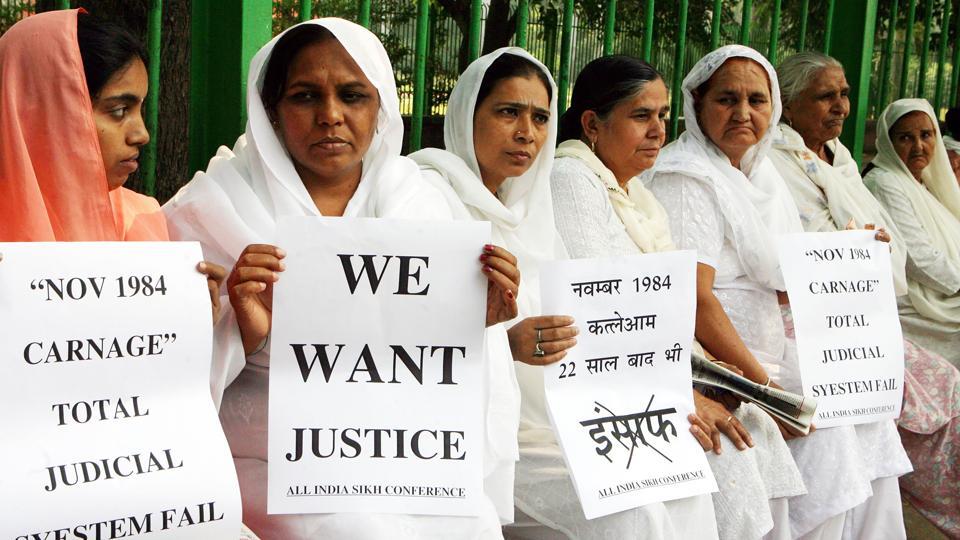
A bench of Justice S Muralidhar and Justice Vinod Goel stated that there was an “abject failure” of the Delhi police in registering FIRs and probing the cases, which let the accused roam free for several years.
“….it requires to be noticed that this is a case where there was an abject failure by the Delhi Police to conduct a proper investigation and this has already been adverted to extensively hereinbefore,” the court said in its judgment.
The court said that the “law and order machinery had clearly broken down and it was literally a “free for all” situation which persisted. “The aftershocks of those atrocities are still being felt. That many cases remained to be properly investigated was acknowledged recently by the Supreme Court by which it was considered appropriate to constitute a three-member Special Investigating Team (SIT) to proceed to investigate as many as 186 cases in which further investigation had not taken place”.
The judgment also noted that many witnesses, at several occasions, deposed in their statements of how the police did not register an FIR and even if they did, the cases were not investigated fairly.
The court also stated that the police did not prepare the site plan and it was prepared only in 2006, 22 years after the incident.
A site plan is a drawing prepared by the investigating officer to explain the crime spot, which is submitted along with other case papers to the court.
“This is a case based on direct evidence and not circumstantial evidence. Had it been prepared contemporaneously at the earliest point in time, the site plan might have been an important document. In the present case, however, the site plan was prepared in 2006, i.e. 22 years later,” the court noted.
Addressing the issue on the credibility of the witnesses, the court said, “The fact of the matter is that many of these witnesses were living in fear and had completely lost confidence in Delhi Police and were therefore, unsure about coming forward to speak the truth. They could gather confidence only after the CBI took over the investigation”.
The judge said it was “extraordinary that despite there being as many as 341 deaths in the Delhi Cantonment area alone over the span of four days beginning Nov 1 1984, only 21 FIRs were registered and, of these, only 15 pertained to deaths/murders”.
Terming it to be “strange”, the court said that despite widespread killings in the area, no mention was found in the Daily Diary Register (DDR).
“It is clear, therefore, that in those chaotic conditions, the local police force was inadequate for the task at hand,” the court said adding that there was an utter failure to register separate FIRs with respect to each of the five deaths that form the subject matter of the present appeals.


