Some high-frequency economic indicators — those released more often than a quarter, perhaps every month, even week — could see a sharp rise in June. The lockdown imposed to slow the spread of the coronavirus disease officially ended on May 31, after 68 days, and we are in a phase (till June 30), that the government calls Unlock 1.0. The Prime Minister himself referred to some of these indicators last week.
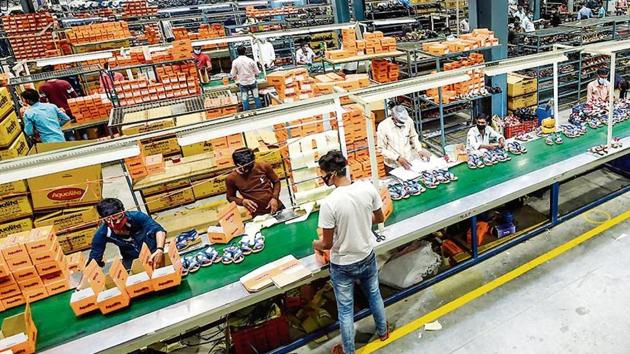
Nomura’s latest India Business Resumption Index, for the week ended June 21, says that almost 70% of business activity in the country has resumed (the base is February). And CMIE data shows that the unemployment rate for the same week was 8.5%, near pre-lockdown levels, and far off the peaks seen in April and May. Sure, urban unemployment is still, at 11.2%, a couple of percentage points higher than the levels before the lockdown, but rural unemployment, at 7.26%, was actually around a percentage point lower than what it was pre-lockdown. That isn’t surprising — the rural job guarantee scheme is in full swing, and sowing activity this year (for the summer or monsoon crop or Kharif) is higher than what it was in 2019. Hindustan Times has been reporting for weeks now that agriculture could be the one (and only) bright spot in the economy this year.
Meanwhile, the International Monetary Fund has revised its growth estimates for India. It now expects the country’s economy to shrink by 4.5% in 2020-21, a revision (and also a change in direction) from its previous rosy estimate of 1.9% growth. It also revised its estimate for the following year, 2021-22, from 7.4% to a much more moderate 6%. IMF also predicts that the global economy will contract by 4.9% in 2020 (its previous estimate was a 3% contraction).
{{/usCountry}}Meanwhile, the International Monetary Fund has revised its growth estimates for India. It now expects the country’s economy to shrink by 4.5% in 2020-21, a revision (and also a change in direction) from its previous rosy estimate of 1.9% growth. It also revised its estimate for the following year, 2021-22, from 7.4% to a much more moderate 6%. IMF also predicts that the global economy will contract by 4.9% in 2020 (its previous estimate was a 3% contraction).
{{/usCountry}}Also read | The government imposed a flawed lockdown. It has caused immense suffering
With the first wave of infections continuing to rage across the world, and the number of cases expected to cross 10 million soon (and the number of deaths half a million), and a cure some distance away, it’s entirely possible that IMF may have to revise these numbers again.
The IMF forecast is broadly in line with what most economists have been predicting for India, a contraction of anything between 3% and 5%. Agriculture, many admit, may help cushion the fall, but it will still be a hard landing.
It’s a hardness that may not be evident in the numbers. Assuming IMF’s numbers for 2020-21 and 2021-22 prove accurate, the Indian economy, at the end of 2021-22 would be marginally larger than what it was at the end of 2019-20. In effect, it would have lost just a year.
Over the past few weeks, I have spoken to a lot of smart people — bankers, venture capitalists, chief executives, economists, start-up founders, even a few people who run small businesses — and the general consensus seems to be that, including the opportunity cost, we have lost at least a decade.
Small businesses (and small businessmen) have been hit the hardest; many have gone out of business. At least some start-ups are in shutdown mode. Many large companies are dealing with a sharp dip in business (and revenue). Salaries have been cut; people have been laid off; and there is a lot of pain everywhere. Sure, business activity has resumed, but many of the high-frequency indicators flashing green may be doing so because of pent-up demand (from the 68-day-long lockdown when no one bought anything other than the bare necessities).
Also read | Masks, bleach: Europe’s cities gear up for post-coronavirus lockdown tourism
The Covid-19 pandemic, and the lockdown, hit India at a point when the country was already vulnerable — its economic growth was steadily declining at the time, plagued by both structural and cyclical issues and showing a decline in both investment and consumption.
Some of those structural factors may have been addressed by the policy changes announced as part of India’s Rs 20-lakh-crore stimulus package (of which just around a tenth is a direct fiscal stimulus), but some have not. The pent-up demand will soon burn itself out, and in the absence of measures to boost aggregate demand, and a cure for the coronavirus disease this year, the Indian economy’s revival is going to be slow — and painful.