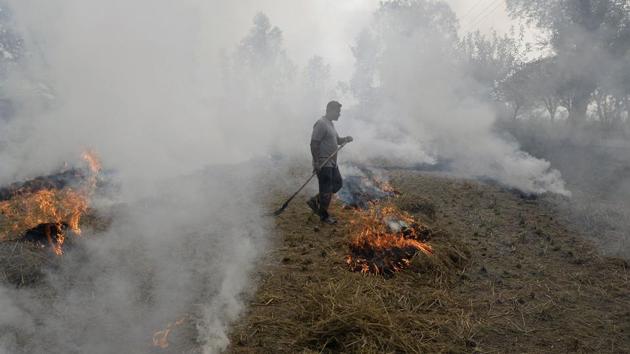
Crop burning is over, officials of Punjab and Haryana said on Friday when top bureaucrats of several states and the Union government held an emergency meeting to discuss ways to reduce the blanket of toxic pollution that has enveloped much of north India.
The meeting, chaired by environment ministry’s secretary, was attended by the chief secretaries of Haryana and Delhi, the principal secretary of Uttar Pradesh department of environment, the chairman of Punjab’s state Pollution Control Board and the secretary of Rajasthan’s department of environment.
Burning of paddy residue by farmers in Punjab and Haryana is regarded as the source of the thick haze, an annual occurrence during this time of the year. But this year, the haze was particularly bad, prompting doctors to urge people to stay indoors.
Paddy is a summer crop and most fields in the region have to be cleared of their residue – stubble – before sowing for winter crops begins in second week of November.
With the no new stubble burning and the Indian Meteorological Department forecasting rainfall in northwestern India next week, air quality is expected to improve significantly.
On top of the agenda of Friday’s meeting were ways to improve compliance with the Graded Response Action Plan notified this January to tackle alarming levels of air pollution in Delhi-NCR. Officials identified effective implementation of bans on diesel generator sets, brick kilns, and other polluting industries, as well as on the entry of unauthorised trucks into the capital and methods to contain dust.
{{/usCountry}}On top of the agenda of Friday’s meeting were ways to improve compliance with the Graded Response Action Plan notified this January to tackle alarming levels of air pollution in Delhi-NCR. Officials identified effective implementation of bans on diesel generator sets, brick kilns, and other polluting industries, as well as on the entry of unauthorised trucks into the capital and methods to contain dust.
{{/usCountry}}Environment minister Harsh Vardhan dismissed allegations on Friday that the Centre was not doing enough to tackle the problem. He noted that a “surgical strike” against air pollution would not be effective.
“We already know what we have to do, it is only a question of implementation,” CK Mishra, secretary, environment ministry, told HT.
Strict enforcement of fines on defaulters was also discussed.
State government’s were asked to set up monitoring groups that will ensure compliance. The possibility of setting up Flying Squads that can reach possible violation sites quickly was discussed.
The ministry on Thursday set up a high-level 7-member committee, to look into short and long term solutions to the air pollution problem that grips the Indo-Gangetic belt almost every winter.
The committee is expected to meet every 10 days during the peak pollution period and at least once every month after that.