Citizens heaved a sigh of relief as cyclonic storm ‘Dana’ crossed the Odisha coast in Kendrapara district late on Thursday night at a windspeed of 100-110kmph without wreaking much havoc as anticipated, an event chief minister Mohan Charan Majhi attributed to the blessings of Lord Jagannath, the ruling deity of people in the state.
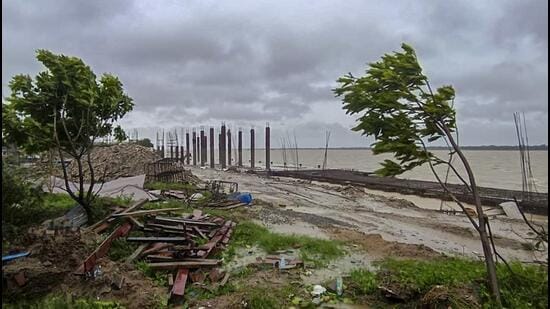
“By the grace of Lord Jagannath and everyone’s cooperation, the government has succeeded in saving human lives. Timely precautionary measures, administrative promptness, and teamwork helped in successfully managing the disaster. The government has achieved the target of ‘zero casualty’. Our administrative officers and rescue teams were on the ground for over 72 hours,” Majhi said after a post-cyclone review meeting on Friday.
It must be noted here that an elderly woman, aged 82, died at a cyclone shelter in Kendrapara on Thursday night of suspected cardiac arrest, officials said, though her demise cannot be directed linked to the extreme weather event.
Meanwhile, IMD officials said ‘Dana’ was a little different from normal cyclones as the landfall process continued for over 8 hours, much like severe cyclonic storm ‘Michaung’, which caused widespread devastation on the southern coast of Andhra Pradesh in December last year. Cyclone Michaung, after hitting the coast at Baptala in Andhra Pradesh on December 3, continued the landfall process for over eight-and-a-half hours as against a normal period of 3-4 hours.
“Like Michaung, cyclone Dana moved parallel to the Odisha coast for a long time and that led to a longer landfall time. While one part of the cyclone was drawing moisture from the sea, the other part was inside the coast before the entire system entered,” said Uma Shankar Das, scientist at IMD’s regional office in Bhubaneswar.
{{/usCountry}}“Like Michaung, cyclone Dana moved parallel to the Odisha coast for a long time and that led to a longer landfall time. While one part of the cyclone was drawing moisture from the sea, the other part was inside the coast before the entire system entered,” said Uma Shankar Das, scientist at IMD’s regional office in Bhubaneswar.
{{/usCountry}}‘Dana’ also got sandwiched due to two anticyclonic circulations in east and west, which made it weaker. “The system was sandwiched between two anticyclones on either side. However, the anticyclone to the east remained dominant and steered it northwestward,” he added.
Sarat Sahu, weather scientist at Bhubaneswar’s SOA University, said anticyclones are not uncommon and play a crucial role in the forward movement of cyclones after landfall.
“Anticyclones are large-scale high-pressure systems that block the atmospheric jet stream and prevent other pressure systems from moving into an area. At times they also cause a lot of precipitation as well as humidity. In April this year, a massive anticyclone caused a major heatwave in Mumbai while triggering a record downpour in Dubai that saw 116mm of rainfall in 24 hours, leading to massive flooding in the desert city. Both these events were precipitated by a single weather system, a massive anticyclone, along with some localised weather phenomena, and further fuelled by general warming and increased moisture levels in the atmosphere,” Sahu said.
Sahu said the 1999 super cyclone, the most intense one to hit India for over last five decades, took a long time to make landfall because it became quasi-stationary over the coastal Jajpur area of the state.
“The cyclone was in a weak steering region between two upper-level anticyclones. However, not many studies have been done due to lack of data,” he said.
IMD officials have now said that ‘Dana’ has reduced in intensity into a depression and moved north-northwestwards.