One day, Bhubaneswar airport had its roof blown-off. The next day, it was back to operating flights.
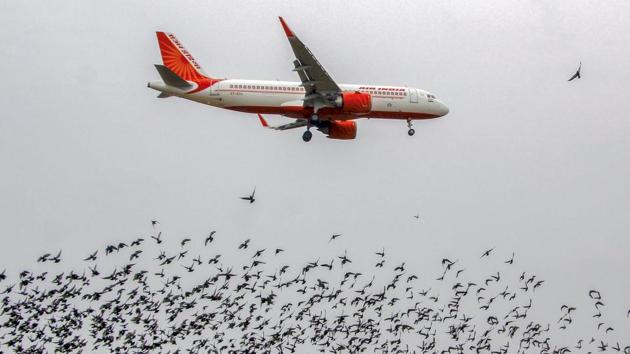
In one of the happier stories emerging from the aftermath of Cyclone Fani, it emerges that the Airports Authority of India which runs the airport took just 12 hours to make it operational after the cyclone.
Hindustan Times learns that this required a lot of planning — from ensuring supply of enough handheld devices to monitor the landing of aircraft, to housing staff and critical equipment in the basement, out of harms way while winds of close to 250 km/hr wreaked havoc outside.
Once the airport became operational, Air India managed to take relief material to the city.
“We have a staff colony there and they didn’t have access to food and water. The day after airport became operational, we took loads of food items and bottles. Many passengers on that flight were carrying water bottles in bulk to give to their relatives. Since no other mode of transport was available, operation of flights means relief material reached the affected area,” said an Air India official, who went there the next day.
Fani brought the state to its knees on May 3, although Odisha’s impressive planning limited the number of casualties. At Bhubaneswar airport, operations were suspended for a day, but most critical equipment was moved to safety, and around 50 essential staff members were asked to stay back. Fani hit the airport hard. There was flooding, the terminal building was damaged and lost its roof; as did the ATC (air trafic control) tower.
{{/usCountry}}Fani brought the state to its knees on May 3, although Odisha’s impressive planning limited the number of casualties. At Bhubaneswar airport, operations were suspended for a day, but most critical equipment was moved to safety, and around 50 essential staff members were asked to stay back. Fani hit the airport hard. There was flooding, the terminal building was damaged and lost its roof; as did the ATC (air trafic control) tower.
{{/usCountry}}“Once the cyclone passed, the first task was to assess the impact of damage. A meeting was conducted at midnight on May 3 and different teams were formed; tasks were allotted,” said Vineet Gulati, member (air navigation services) of AAI.
“The most critical part of restoring operations was to clear the runway and ensure we had enough devices to assist pilot for the landing. We didn’t have full fledged Air Traffic Control (ATC) tower but we had kept backup of antennas and very high frequency (VHF) devices for communication. As expected, the ATC tower was flooded and the first landing, of an Alliance air flight was done using these handheld devices,” Gulati added .
Another airport official said that the Doppler VHF Omni Directional Range (DVOR) and Instrument Landing System (ILS) were working fine, which worked in their favour and helped in restoring the operation. “The next few hours were spent clearing the runway of foreign objects. The government gave us sanitation staff to help. Then, we had to check the availability of water and power. We had kept backup fuel for generator and water for 10 days as a matter of precaution. Based on the assessment, we gave a deadline of 1 pm on May 4 for the operationalisation of the airport. We operationalised it at 12 noon itself,” said this person, an AAI official who asked not to be named.
Airports Authority of India has estimated that it will cost around ₹30 crore to repair the damage.
Even as it operationalised the airport , AAI realised that the handheld devices could only do so much. It decided to move a mobile ATC to bolster regional connectivity and stationed at Bokaro. But this was easier said than done. “A truck and crane was arranged from Kolkata and Jamshedpur and an escort was provided since we needed height clearance along the way as tower was 20 feet high. The equipment was costly so we had to do the travel insurance also on Saturday, May 4. Overcoming all these difficulties, the mobile tower with three monitors was made operational on May 9,” Gulati said.
Chief minister Naveen Patnaik on Sunday announced that all families whose houses were completely or substantially damaged due to cyclone Fani would get a pucca house. The government also revised the death toll to 64 with Puri accounting for 39 deaths. As per preliminary assessment, more than 5.08 lakh houses were left damaged, partially or fully, after winds exceeding 250 kmph battered Puri and Khurda affecting 1.4 crore people in over 16,000 villages and 51 urban local bodies. Meteorologists have described Fani as India’s strongest summertime cyclone in the last 43 years.