Bhubaneswar: Adding fuel to the controversy over the ASI’s affidavit in the Orissa high court last week that some archaeological remains may have been destroyed during excavations around the prohibited zone of the 12th century Jagannath Temple, a broken stone sculpture resembling a lion was found on the premises of the historic Emar Mutt near the temple on Monday.
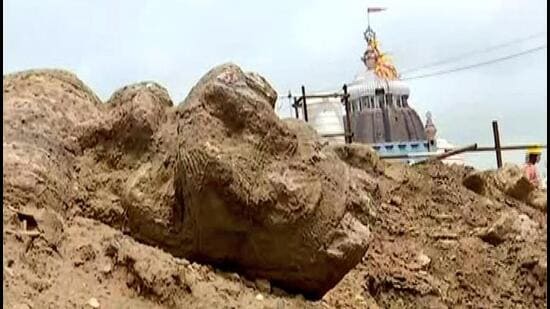
The local people of Puri found the stone sculpture resembling a lion on the premises of the demolished Emar Mutt within the 75 metre radius of the temple on Monday morning. “It was lying under the debris of the excavated materials. It may have become visible after the recent spell of rain,” said Sarat Rayaguru, a Puri resident.
Archaeological Survey of India officials said they have already seen it and submitted the photograph to the Orissa high court as part of the affidavit in the public interest litigation filed raising apprehension about the excavations around Jagannath Temple affecting the structural safety of the monument. The petitioner also alleged that any construction within the 100 metre area of a protected monument was illegal as it violated the Ancient Monuments and Archaeological Sites and Remains Act.
“During inspection of the excavation site at Emar Mutt on April 29 following court orders, our engineer had had seen the damaged lion sculpture and taken a photograph of it. However, we are yet to determine its age as it will take some time. When we submitted the affidavit in the HC that some archaeological remains around the temple may have been destroyed, we were referring to this,” said Arun Malik, superintending archaeologist of ASI in Odisha.
{{/usCountry}}“During inspection of the excavation site at Emar Mutt on April 29 following court orders, our engineer had had seen the damaged lion sculpture and taken a photograph of it. However, we are yet to determine its age as it will take some time. When we submitted the affidavit in the HC that some archaeological remains around the temple may have been destroyed, we were referring to this,” said Arun Malik, superintending archaeologist of ASI in Odisha.
{{/usCountry}}The ASI in its affidavit said at several locations around the temple, it was evident that removal of about 15 to 20 feet stratified deposit has taken place, which has caused irreparable damage to the heritage site. “No heritage impact assessment studies were conducted before commencement of the project and no ground-penetrating radar survey (GPRS) were conducted to ascertain the archaeological and historical importance lying buried in the subsoil of 75 metre radius of the monument before undertaking any digging. Odisha Bridge and Construction Corporation officials were clueless about the method of soil removal and cultural findings from the digging,” the affidavit said.
The HC which heard the matter on May 9 has posted the matter to June 22 for further hearing, but did not put a stay on the work around the temple.
The 900-year-old Emar Mutt was among the dozens of ancient mutts in Puri that were demolished in August-September 2019 to make way for the Sri Jagannath Temple corridor project. A prominent landmark in Puri, it was used by non-Hindus to see the inside of the 12th century shrine as they were banned entry into the temple. After demolition, the Odisha Bridge Construction Corporation in February this year started digging up deep in that area for construction of a reception centre as part of the ₹800 crore Jagannath temple corridor project.
Neither Puri district collector Samarth Verma nor managing director of Odisha Bridge Construction Corporation, JK Das replied to queries sent by HT.
In a related development, the state government has initiated the process to file a caveat in the Supreme Court as there is every possibility that a PIL may be filed by any individual/group/organisation against the May 9 order of the Orissa High Court in connection with the Puri Heritage Corridor project.
Meanwhile, the National Monument Authority has asked the Shree Jagannath Temple Administration to reduce the height of its proposed reception centre so as to prevent overshadowing of the temple complex by a tall structure. Last week, the state government had decided to shift the proposed reception centre beyond the 100 metre perimeter of the temple.