
 E-Paper



Delhi banks on ‘green crackers’ this Diwali: What are they? Risks and concerns | Explained
Green crackers are eco-friendly fireworks developed by CSIR-NEERI.

 Prefer HTon Google


Delhi is likely to witness legal fireworks this Diwali in a first in years, with the Supreme Court indicating that it may temporarily lift the ban on bursting of green firecrackers in the National Capital Region (NCR).
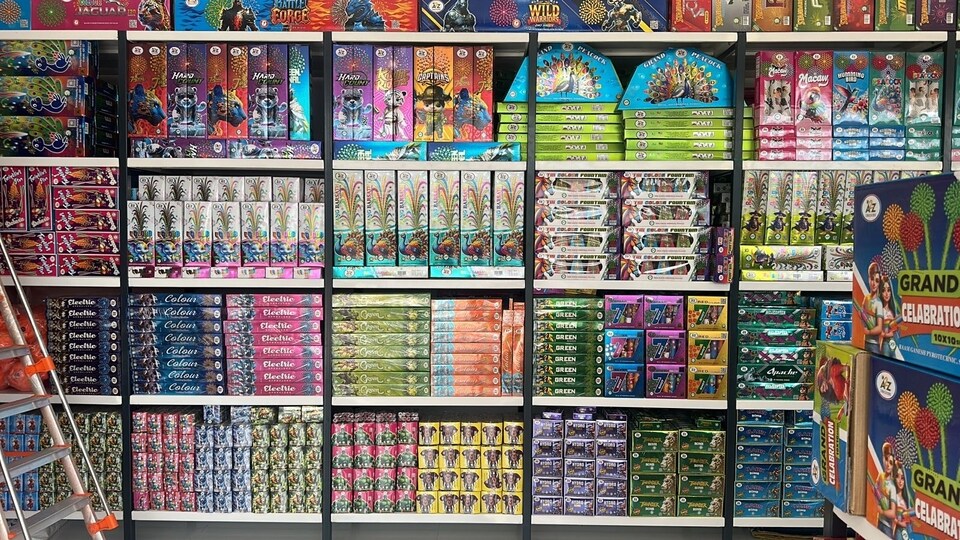
A bench led by Chief Justice of India BR Gavai, and including Justice K Vinod Chandran reserved its order, while stating that it would decide on relaxing the absolute ban on firecrackers in Delhi-NCR.
However, the SC bench “for the time being” permitted for the ban to be lifted, thus clearing the way for “green fireworks” under the Centre’s new guidelines next week.
What are green crackers?
Eco-friendly fireworks developed by the Council of Scientific & Industrial Research-National Environmental Engineering Research Institute (CSIR-NEERI), green crackers release a reduced amount of harmful pollutants.
These are made with a reduction in the size of the shell and usage of raw materials in composition, elimination of the ash usage, and the use of additives as dust suppressants to reduce emissions, according to CSIR-NEERI.
“Anything that involves combustion cannot be truly green, but it has lesser harmful chemicals, including barium or aluminium,” Dipankar Saha, former head of the Central Pollution Control Board’s (CPCB) air laboratory, said. Saha was one of the scientists involved in developing green firecrackers in 2018.
The green crackers were first developed by the CSIR-NEERI in 2018. The institute introduced three variants – SWAS (Safe Water Releaser), STAR (Safe Thermite Cracker), and SAFAL (Safe Minimal Aluminium).
The above versions eliminate potassium nitrate and sulphur, thus reducing particulate matter and gas emissions by 30 to 40 per cent.
Green crackers do not contain banned and highly toxic chemicals like barium nitrate, arsenic, and lead. They use alternative chemical formulations that produce less smoke and noise.
Concerns and risks posed
CSIR-NEERI said green crackers cause a decline in nitrous oxide and sulphur dioxide, in comparison to the composition of conventional firecrackers.
However, a study conducted by the Delhi Technological University in 2022 found that green crackers produce high concentrations of ultra-fine particles, which are more harmful than PM2.5 and PM10, Times of India reported.
The green crackers can be identified by the green logo of CSIR-NEERI, along with encypted QR codes on the packets.
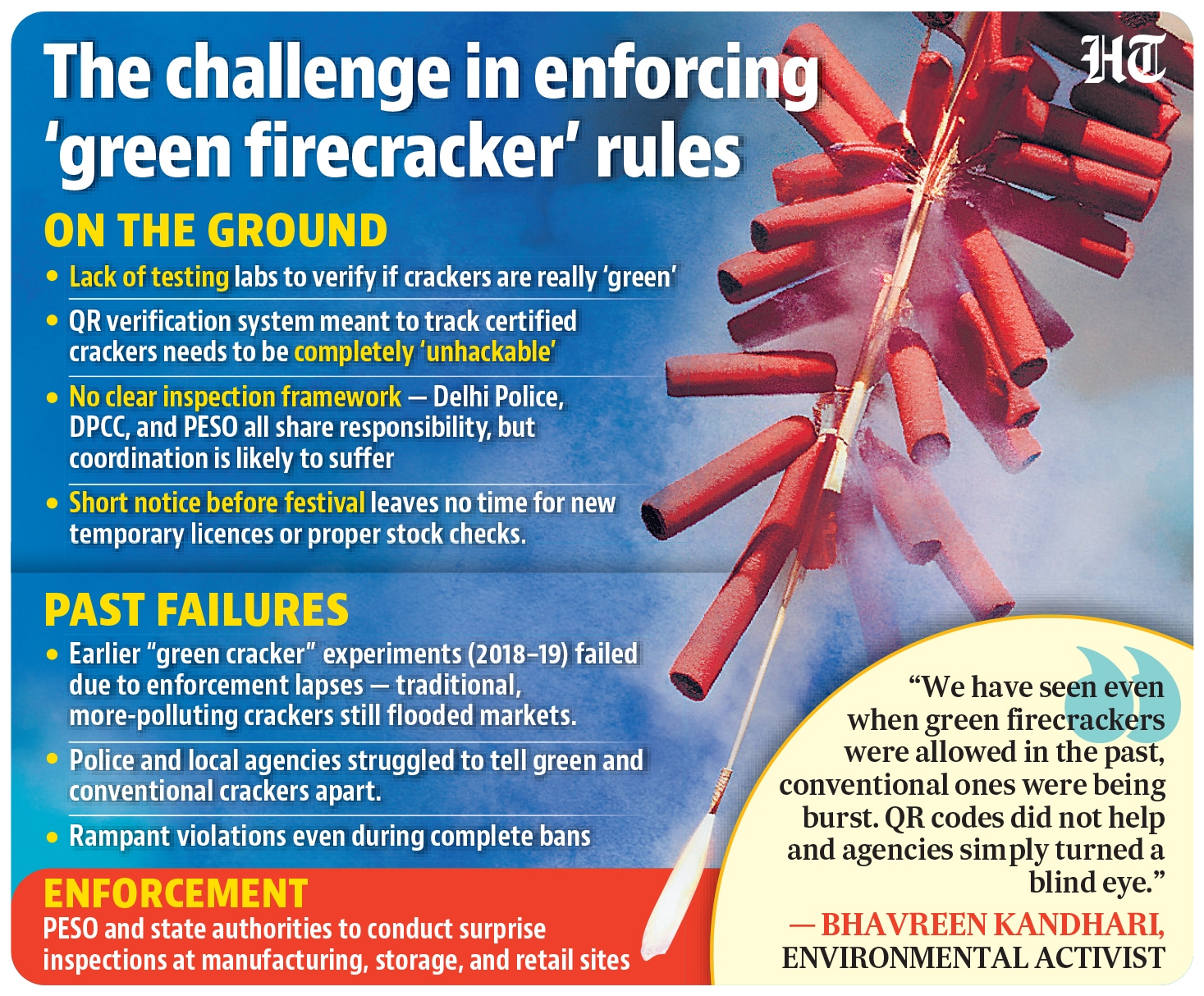
However, the infrastructure for its manufacturing, including testing labs, certification systems, and on-ground inspection, have not been established in Delhi yet.
Under the plan submitted to the apex court, only the companies which have been certified by the National Environmental Engineering Research Institute (NEERI) and the Petroleum and Explosives Safety Organisation (PESO) are permitted to manufacture green crackers.
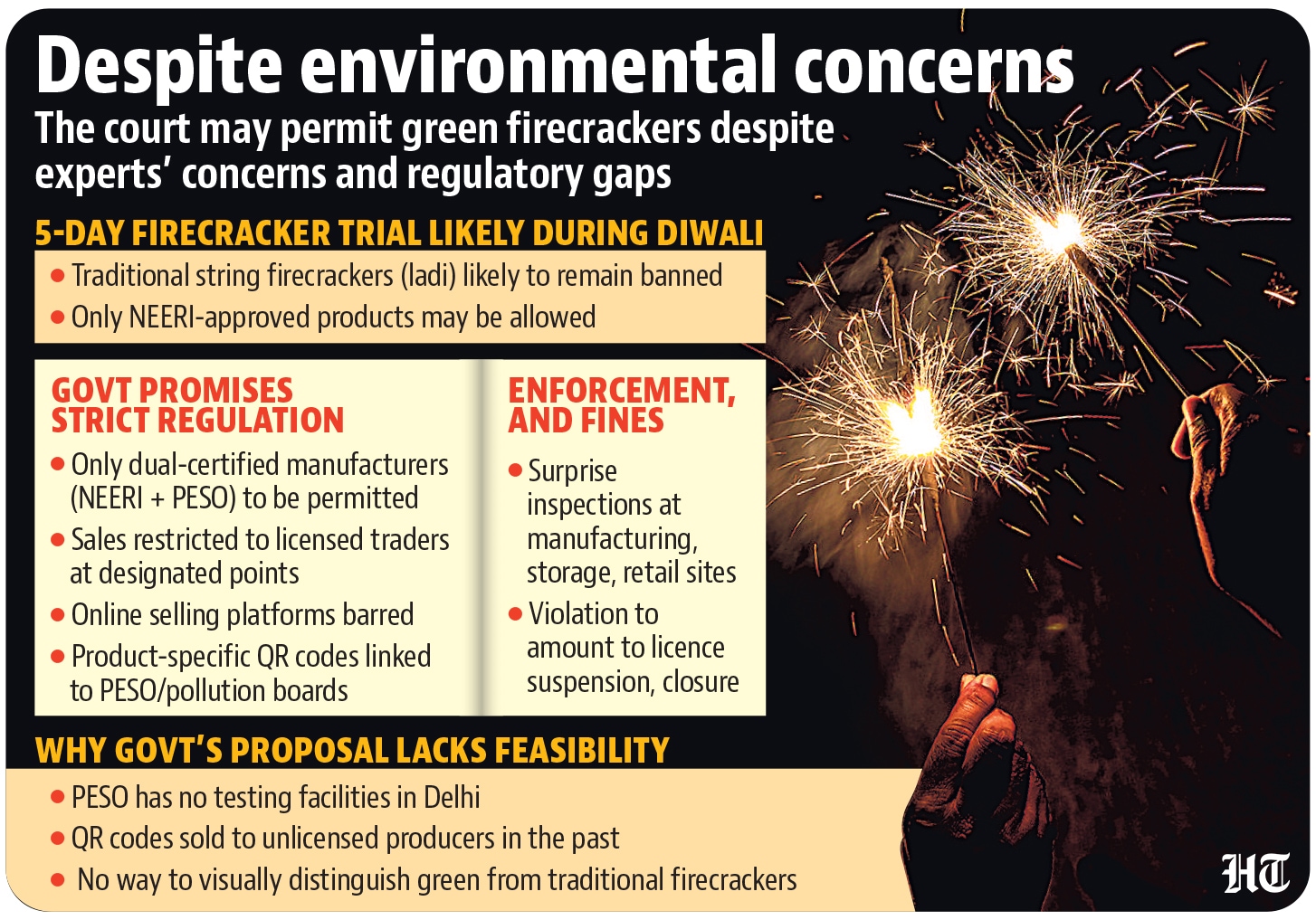
The sale of the crackers will be restricted to licensed vendors, with each product linked to a specific QR code traceable to the manufacturer.
However, experts have warned that the Capital has no testing facility to confirm if the firecrackers being sold are genuinely “green”. The QR verification system, introduced for the identification of fake products, has also reportedly been cloned by unlicensed manufacturers.
Less polluting still causes pollution, experts say
Moreover, scientists have stressed upon the fact that “less polluting” does not mean “no pollution”, with NEERI guidelines acknowledging that the goal is to reduce and not eliminate emissions.
Chetan Sharma, general secretary of the Confederation of RWAs and chairman of the Greater Kailash-II RWA, said that even the “so-called green crackers still release harmful pollutants.” “Allowing them so close to winter, when the city’s air quality is at its worst, is reckless. The government must ensure fake or duplicate crackers aren’t passed off as green,” Sharma added.
Activist Bhavreen Kandhari said that the CSIR-NEERI data reveals that the crackers cut particulate emissions by 30 per cent. “During Diwali, PM2.5 levels shoot up 800 to 1500 per cent above WHO limits,” Kandhari said, adding that in this context, the 30 per cent reduction was “statistically meaningless.”
“In a toxic baseline, ‘less harmful’ does not mean safe; it's the same flawed logic once used to defend low-tar cigarettes,” Kandhari told Times of India.


