PM2.5 readings, which capture levels of smoke, at many of Delhi’s air monitoring stations went blank on Diwali night as they climbed towards 1,000 micrograms per cubic metre, pulling down the capital’s official air quality index (AQI) for the day after, HT’s analysis of records kept by the Central Pollution Control Board (CPCB) shows.
The missing hours, filled partially by on Monday evening by the Delhi Pollution Control Committee (DPCC), one of the three agencies that run the stations, show the smoke reaching a peak level of 3,744 µg/m³, more than 60 times the national 24-hour standard of 60.
CPCB did not explain the outage. A Delhi government official, who asked not to be named, acknowledged a glitch but gave no details: “The air quality monitors are giving hourly data. There were some technical glitches but all our 43 stations are giving data.”
Deep Dive
Why did Delhi’s PM2.5 readings disappear on Diwali night?
How high did Delhi’s PM2.5 levels reach after the missing Diwali readings were released?
How did the missing PM2.5 readings affect Delhi’s official AQI after Diwali?
While the PM2.5 data was missing, the stations were still working. All through the night they kept sending readings for gases such as nitrogen dioxide, carbon monoxide and ozone. For the 1am hour on November 9, 38 of the 39 long-standing Delhi stations HT examined sent a nitrogen dioxide reading while 13 sent one for PM2.5. The PM2.5 readings mostly stopped just as they neared 1,000 µg/m³, and no reading in CPCB’s records for the night went past that figure.
DPCC’s release on Monday evening showed how high the missing readings had gone. Every one of the 125 station-hours missing from CPCB’s records at DPCC’s stations was above 1,000 on DPCC’s site. A station hour is one station’s reading for one hour. The readings dropped out somewhere between the stations and CPCB’s records, and the pattern points to a cut-off at about 1,000 µg/m³. Why it exists, and whether it is new, was not clear.
{{/usCountry}}DPCC’s release on Monday evening showed how high the missing readings had gone. Every one of the 125 station-hours missing from CPCB’s records at DPCC’s stations was above 1,000 on DPCC’s site. A station hour is one station’s reading for one hour. The readings dropped out somewhere between the stations and CPCB’s records, and the pattern points to a cut-off at about 1,000 µg/m³. Why it exists, and whether it is new, was not clear.
{{/usCountry}}Also Read | AQI of 387 in India would be nearly 1,500 in US and 10 in UK. Why the range is so wide
The data gaps pulled the official figure down. Delhi’s AQI, the average of its stations’ scores over the past 24 hours, came in at 344 in CPCB’s 4pm bulletin on Monday, the day’s official reading, with the night’s worst hours missing from the stations’ averages. AQI is a composite number, capped at 500 for the official figure, that factors in readings of individual pollutants such as PM2.5.
In CPCB’s 4pm bulletins since 2015, Delhi’s air has been worse the day after Diwali than in the day before it every year. This year’s initially published figures broke that run: 344 the day after, against 369 on Diwali eve.
The late evening revision by DPCC changed how air pollution this Diwali will be recorded. Counting the readings DPCC released, HT’s estimates show, the AQI in the bulletin would have read about 360. The 9am figure, 370 as published, would have been about 384. Both estimates leave the blanks at stations run by CPCB and the Indian Institute of Tropical Meteorology (IITM) as they are, so both are a floor.
PM2.5 is fine dust, particles 2.5 micrometres across or smaller, and micrograms per cubic metre (µg/m³) is the unit for measuring how much of it is in the air. PM2.5 originates from burning, such as of firecrackers or paddy stubble.
The highest reading in CPCB’s records for the night was exactly 1,000.0, at Sirifort for the 15 minutes from 4.45am and at ITO for the 15 minutes from 6.15am. Last Diwali, 29 of the 39 stations recorded at least one hour averaging above 1,000, the highest 2,224 at NSIT Dwarka, according to OpenAQ’s copy of CPCB’s live feed.
Also Read | The Air We Breathe
At the worst of the night, the 1am hour, PM2.5 across the 22 stations with a full night of readings averaged 1,480 µg/m³, HT’s analysis of DPCC’s released readings shows. In CPCB’s records, where only eight of the 39 stations had a full night of readings, that hour had averaged 547.
Both figures are worked out as HT measured last Diwali: an average over the stations with a PM2.5 reading for every hour from 10pm to 6am, so that each hour is compared on one set of stations.
The released readings also show where the night was worst. Mundka recorded 3,744 µg/m³ at 2am, JNU 3,023 at 4am and NSUT’s West Campus 3,008 at 5am; Mandir Marg, Nehru Nagar and Wazirpur all went past 2,700.
Eleven of DPCC’s 30 stations went past 2,000. Where both sources had a reading, the figures matched in every hour.
Last Diwali, the worst hour of the night averaged 1,137 µg/m³ of PM2.5 across the 27 stations with a reading for every hour. This Diwali, once DPCC’s readings are counted, it averaged 1,480 across 22 stations. The two sets of stations differ, so HT also compared like with like.
Thirteen stations have a full set of readings for both nights. On those 13, this year’s worst hour averaged 1,173, against 1,017 last Diwali, about 15% higher.
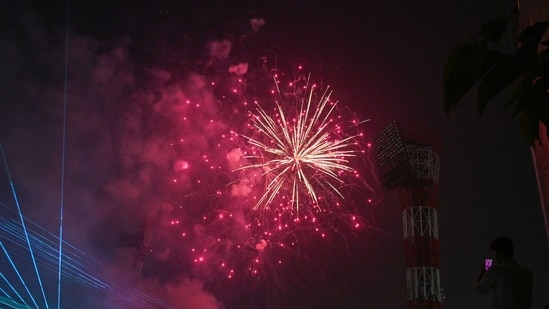
The Supreme Court allowed firecrackers on Diwali only from 6am to 7am and from 8pm to 10pm, but they were burst across the city well beyond that window. PM2.5 rose steeply through the last hours of the window and stopped soon after. At North Campus, an IITM station, the 15-minute reading climbed from 291 µg/m³ at 8pm to 999 at 10pm, and the next readings were blank. Moreover, farm fire smoke and calm winds held pollution at a high level even before the city went into the festival. Diwali eve was the most polluted in a decade, HT reported on Sunday.
For this year’s Diwali analysis, HT considered the 39 stations that were also live last Diwali. Since then, 20 more have been added, including 13 in October, many of them on the outer edge of the city ,that have dragged down the city’s overall AQI, HT reported on November 6.
Across all 59 Delhi stations, 43 had a gap in PM2.5 between 10pm and 6am. Of those, 23 sent a last reading of 800 µg/m³ or more before it, and 14 of 900 or more. Stations run by all three operators went blank: CPCB, IITM and DPCC.
Between 10pm and 6am, 148, or 42%, of the 351 station-hours across the 39 long-standing stations were blank . The rate of failure was about six times the season’s baseline: on CPCB’s hourly data feed, which HT has stored since October 3, these stations had a blank in only 7% of their PM2.5 station-hours between 10pm and 6am, up to Diwali eve. .
HT had flagged a similar problem of unreliable data last year, when stations went dark. But even then, 27 of the 39 reported PM2.5 every hour from 10pm to 6am; this year, only eight did until DPCC updated the data. The DPCC update came late in the evening, meaning the 4pm bulletin -- the official record for the day -- for day the day after Diwali 2026 would not account for these emissions -- or the others from CPCB and IITM sources that remained blank.
Also Read | SC turns focus to vehicular pollution, seeks action plan from Delhi, 3 states
Manoj Kumar, an analyst at the Centre for Research on Energy and Clean Air (CREA) who examined CPCB’s data, said many of the readings went missing as PM2.5 approached what he described as the instruments’ upper measurement limit of 1,000 µg/m³. “These observations should not simply be treated as missing when calculating hourly or daily averages or deriving AQI. Doing so could underestimate pollution levels,” he said, adding that 1,000 µg/m³ should be taken as a lower bound.
“This requires attention and transparency as one cannot completely blank out data when readings are expected to be alarming,” said Sunil Dahiya, founder and lead analyst at Envirocatalysts.
Political parties attacked the Delhi government over the readings on Monday. Aam Aadmi Party leader Saurabh Bharadwaj accused it of “AQI data fraud” in a video posted on X, alleging that the 20 new monitoring stations had been put in open, green areas and that water was being sprinkled around stations in heavily polluted localities to lower their readings.
Responses from CPCB, DPCC, IITM, the Delhi government and the Commission for Air Quality Management (CAQM) were awaited at the time of going to print.