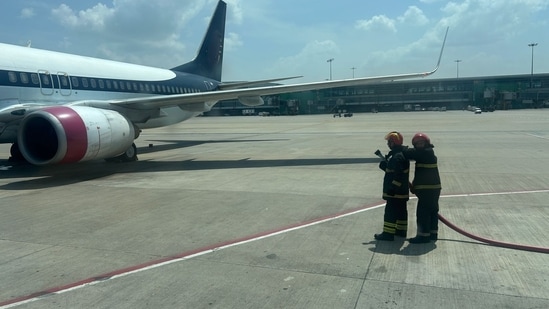
A SpiceJet plane enroute to Nepal's capital Kathmandu faced a suspected tailpipe fire while it was taxiing at the Delhi Airport on Thursday, prompting the flight's return to the bay. The fire on the tailpipe was spotted by another aircraft, as per the airline.
SpiceJet said in a statement that no warnings or indications were observed in the cockpit (HT Photo)
{{^htLoading}} {{/htLoading}}
According to the airline, no abnormalities were found on the aircraft during detailed engineering checks.
{{^usCountry}}{{/usCountry}}
"On September 11, 2025, a SpiceJet aircraft scheduled to operate from Delhi to Kathmandu returned to bay after another aircraft on the ground reported a suspected tailpipe fire. No warnings or indications were observed in the cockpit, but the pilots decided to return as a precautionary safety measure," the airline said in a statement, according to a PTI news agency report.
The flight, a Boeing 737-8 aircraft, was grounded.
The flight, SG041, faced a delay of over four hours before it was about to take off, the report said citing sources. It was supposed to depart in the morning.
What is a tailpipe fire?
{{^htLoading}} {{/htLoading}}
{{^usCountry}}
A tail pipe fire typically occurs during ground engine start or shutdown and results from an excess of fuel in the combustion chamber or in the turbine area, according to Airbus' safety manual. Consequently, this is an event that may occur on ground only during engine start or shutdown sequence.
{{/usCountry}}
{{#usCountry}}
A tail pipe fire typically occurs during ground engine start or shutdown and results from an excess of fuel in the combustion chamber or in the turbine area, according to Airbus' safety manual. Consequently, this is an event that may occur on ground only during engine start or shutdown sequence.
{{/usCountry}}
According to the manual, which is written by Michel Palomeque, a flight safety advisor, a tailpipe fire usually burns within the engine core, that is the combustion chamber and the turbine race. “It mainly affects the turbine area which is not a sensitive part of the engine with regards to the fire protection. Thus, the turbine area is not fitted with fire detectors,” it said.
{{^htLoading}} {{/htLoading}}
“Consequently, a tail pipe (an internal) fire will not be detected by the fire detectors fitted in the nacelle compartment (for external fire detection) and will not result in the triggering of the engine fire warning,” it added.
Since a tailpipe fire typically occurs at engine start or shutdown, the crew is mainly made aware of a tail pipe fire by a visual report from either ground crew, cabin crew or tower, said the manual.
Follow the latest breaking news, major developments and agenda-setting stories from India and around the world with the newsdesk at Hindustan Times. Operating round the clock, the desk brings together experienced editors, reporters and correspondents to deliver fast, accurate and contextual reporting across subjects that influence public policy, governance, business, society and international affairs. The HT News Desk covers politics, elections, government policies, the economy, business and markets, science and technology, the environment, law and order, infrastructure, education, climate issues and geopolitics, while closely tracking developments across states, institutions and global capitals. The team also leads coverage of major breaking news events, policy announcements, court proceedings, natural disasters, public emergencies and significant international developments. Reports published by the newsdesk are based on information gathered from reporters on the ground, official statements, government agencies, court records, regulatory filings, recognised institutions and other authoritative sources. Stories undergo editorial scrutiny and verification processes to ensure accuracy, fairness and relevance, and are updated as events evolve and additional information becomes available. Whether covering a key political decision in New Delhi, an economic policy shift affecting millions, a landmark court ruling or a major global event, the HT News Desk aims to provide readers with reliable, fact-based journalism that delivers not only the latest developments but also the context and analysis needed to understand their wider implications.
Get Latest News, breaking headlines, and top India News, and today real-time updates from across the nation. Stay informed on politics, government policies, crime, Today Weather, and major developments on Hindustan Times
Get Latest News, breaking headlines, and top India News, and today real-time updates from across the nation. Stay informed on politics, government policies, crime, Today Weather, and major developments on Hindustan Times
Home/India News/Delhi-Kathmandu SpiceJet flight returns after another aircraft spots its tail on fire
{{^htLoading}}
Advertisement
{{/htLoading}}
SHARE THIS ARTICLE ON
{{#usCountry}}{{/usCountry}}
Notifications
Get breaking alerts directly from the newsroom
Notifications are on!You'll be notified when news breaks