Delhi’s average air quality improved to the lower end of the “poor” category on Wednesday with several stations recording “moderate” pollution levels as bright sunshine and blue skies continued. Meteorological experts said strong surface winds played a key role in this improved spell of air quality.
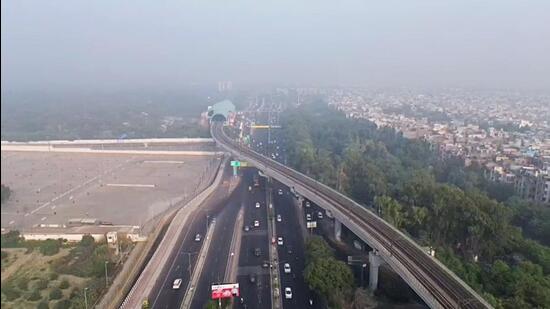
An average AQI of 205 (poor) was recorded at 9 am, Delhi’s lowest since October 15 when it was 198 (moderate). The AQI was 268 (poor) at 4pm on Tuesday and 280 at the same time on Monday.
“There were surface winds up to 10 km/hr in the first half of Tuesday and around 15 km/hr post noon. Similar wind speeds of 15 to 20 km/hr are likely until Friday with the AQI expected to improve even further,” said private forecaster Skymet Meteorology vice president Mahesh Palawat.
The Early Warning System for Delhi (EWS) said the AQI should be in “poor” until Friday. The chances of a return to the “poor” category were in the subsequent six days.
The India Meteorological Department (IMD) said no fog was reported on Wednesday, with the lowest visibility being around 1200 metres. The minimum temperature of 12°C was three degrees above normal. It was 10.5°C a day earlier. Both maximum and minimum temperatures have risen across northwest India aiding the dispersion of pollutants.
The maximum temperature on Tuesday was three degrees above normal (28.2°C). It is expected to be around 27°C on Wednesday. The IMD has forecast a mild December this year, with both average maximum and minimum expected to be above normal similar to the rest of northwest India.
{{/usCountry}}The maximum temperature on Tuesday was three degrees above normal (28.2°C). It is expected to be around 27°C on Wednesday. The IMD has forecast a mild December this year, with both average maximum and minimum expected to be above normal similar to the rest of northwest India.
{{/usCountry}}At 9am on Wednesday, none of the 39 air quality stations online recorded “severe” or “very poor” air quality. As many as 16 were in the “moderate” range with an AQI below 200. The highest AQI was 283 (poor) at Shadipur and the lowest was 152 (moderate) at ITO.
The average AQI was 348 last December with three severe air days. The lowest AQI recorded last December was 286, while the highest was 450 on December 23. There is a spike in pollution in the second half of December when temperatures dip below 5°C, wind speeds drop, and dense fog returns.