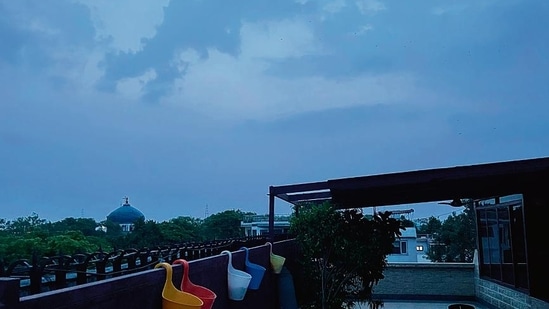
Delhiwale: But it's not raining barsatis
Stealing its name from the Urdu for rain, barsati was a tiny room with a large terrace that went on to spawn a bohemian Delhi civilisation. Holed up high in these airy bubbles, eclectic migrants from small towns came of age in style and sensibility.
It is raining hard on the terrace of an 18th floor flat in Gurugram’s Golf Course Road. Monsoon is giddily beating down on this multitude of high-rises. Yet, it feels like a draught — to a connoisseur of the barsati.

Stealing its name from the Urdu for rain, barsati was a tiny room with a large terrace that went on to spawn a bohemian Delhi civilisation. Holed up high in these airy bubbles, eclectic migrants from small towns came of age in style and sensibility. Many barsatiwallas became famous. MF Husain had a barsati in Jangpura. William Dalrymple, who lives in a farmhouse, spent the early 1990s in Delhi in a Golf Links barsati. Pankaj Mishra, who cohabits with the literary jet-set in London, was cooped up in a Defence Colony barsati. Anita Desai made barsati the setting of her short story The Rooftop Dwellers.
A freak of chance, barsati was borne out of Delhi’s real estate regulations. Residences in many neighbourhoods were permitted to have nothing taller than a small room at best on the second floor. This spare room in the house evolved into barsati, the rain shelter. From the 1970s onwards, house owners started to rent out these to students and young artists/professionals who were unencumbered by family or furniture. Later on, the relaxation of rules enabled the construction of higher floors, turning bungalows into multi-stories. Barsati became less common, and hairstylist Sylvie left her Green Park barsati for Gurugram. The decline is neatly traced in the life of author and curator D Bhattacharjya Tato, who used to live in a BK Dutt Colony barsati. “There was this huge terrace that separated my room from the staircase… on a rainy day when I would be coming back to my pad, I would have to run through the entire open space if I didn’t want to get wet.” He would always get wet.
Some years ago Tato moved into his own two-room flat in Mandi village on the southernmost extremity of Delhi. “In the BK Dutt barsati, I enjoyed a view of the dense trees of Jor Bagh. Now, my window looks to Gurugram, just across the road from my flat.”
Meanwhile, his former landlord has added more rooms to the terrace. “That barsati is no longer a barsati.”
ABOUT THE AUTHORMayank Austen SoofiMayank Austen Soofi is a writer-snapper trying to capture Delhi by heart.

E-Paper