The Congress and other Opposition leaders forced a vote in the Lok Sabha against the introduction of The Criminal Procedure (Identification) Bill, 2022 on Monday, opposing the legislation on the grounds that it violates the Constitution. Minister of state for home, Ajay Kumar Mishra (Teni), rejected the charges and assured the House that “all the provisions have been carefully drafted to protect all the rights and maintain Constitutional validity.”
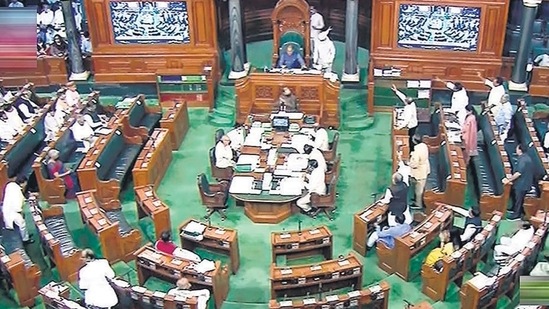
The bill was introduced after 120 MPs voted in its favour while 58 lawmakers opposed it.
Introducing the bill in the Lok Sabha, Mishra also found an opportunity to hit back at the Opposition that has sought his resignation over the Lakhimpur Kheri incident where his son is one of the main accused.
As Congress floor leader Adhir Ranjan Chowdhury quipped that Mishra’s fingerprints should be taken -- the new law allows capturing such details of even those detained -- the minister declared: “If there is a single case, or if I had been to police station or jail even for one minute, I will retire from politics now.”
Describing the bill as draconian, Chowdhury said, “The law can ask convicts for their biometric measurements. However, the present Bill seeks to empower the police and court to take measurements of under-trials or suspects. These provisions are violative of Article 21 of the Constitution.”
The Congress leader argued that given the large number of cases of custodial violence, “there is a high possibility of forceful measurements resulting in life-long stigmatization and grave violation of human rights.” Article 21 promises the right to life and liberty.
{{/usCountry}}The Congress leader argued that given the large number of cases of custodial violence, “there is a high possibility of forceful measurements resulting in life-long stigmatization and grave violation of human rights.” Article 21 promises the right to life and liberty.
{{/usCountry}}Another Congress leader, Manish Tewari, apprehended that the words “biological samples and their analysis” in clause 2 (i) (b) of the Bill might extend to narcoanalysis and brain mapping.
“When it is made coercive in terms of clause 5, it is violating Article 20 (3) of the Constitution of India. Further, the implied use of force in clause 6(1) to take measurements violates the rights of prisoners laid down in a catena of Supreme Court judgments”.
Some Indian agencies have continued to use narcoanalysis and brain mapping despite the lack of conclusive scientific evidence that they work.
RSP leader NK Premachandran argued that if he is arrested for protection of civil rights for any genuine demand, and if there is a complaint against him “then a DNA test can be taken? What is this? This is violation of the basic right of an individual. What is the logic? What is the reason? What is the intention of the Bill?”
Refuting the allegations, Mishra pointed out that the current law, enacted in 1920, only allows fingerprints and footprints. “Now, times have changed and technology has expanded. Scientific processes have improved and with the increasing trend of crimes, the process of identification should also be enhanced.”
To be sure, the current law allows the capture of information only of those convicted or arrested , not those detained or suspected of having committed a crime. Mishra claimed that the new law will help investigating agencies and increase prosecution and conviction rates. He added that the Supreme Court’s directive said that fundamental right of privacy is not absolute (the Puttaswamy judgement). He also added that in “1980, there was a proposal to amend the law, but 42 years went by, and nothing happened.
The minister emphasized that both the central and state agencies can make their own rules regarding protection of data and that the Bill was being introduced after extensive consultations.