On Thursday, Delhi High Court pulled up the student bodies, Delhi University and the police for the recurring incidents of violence and vandalism during student elections, saying enough is enough. This, however, is not the first time that DUSU elections are marred by hooliganism, defacement, violence, and court intervention.
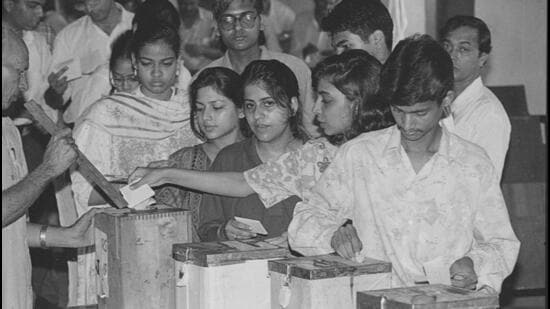
The first Delhi University Students Union (DUSU) election was held in 1954 but the first major controversy erupted in 1972-73 when students took to the streets and demanded a direct say in choosing their leaders. And in 1990-91, national political upheaval was powerful enough to derail the election itself.
By 2009, campaign expenditure and electoral rules becamecentral to disputes, while from 2017 to 2019 DUSU elections were about clashes, questions over voting machines, candidate eligibility and litigation. After the pandemic break, the controversies took to defacement in 2024, victory-procession restrictions in 2025 and physical violence in 2026.
Here are some of the major controversies and clashes that have defined DUSU elections over the years:
1972-73: The first major structural crisis in DUSU’s electoral history came in late 1972, when students challenged the manner in which their representatives were elected. At the time, students did not directly vote for the DUSU president and other central office-bearers. Colleges elected councillors, who then chose the union’s executive through an indirect process. Students alleged that the system was open to manipulation and did not give them a direct say in choosing their leaders. The disagreement turned into a massive campus mobilisation. Student groups, including the Akhil Bharatiya Vidyarthi Parishad (ABVP) led by Arun Jaitley, carried out an agitation that continued for around 50 days between November 1972 and January 1973, severely disrupting university functioning. The administration eventually agreed to change the system. In 1973, DUSU moved to direct elections, giving students a direct vote for the union’s central office-bearers.
1974-75: With Jaitley as DUSU president, the student movement became closely associated with the wider political opposition during the Emergency. Jaitley was arrested, while several student activists became involved in protests against the Emergency. The episode reinforced DUSU’s position as an important arena for political mobilisation in Delhi.
{{/usCountry}}1974-75: With Jaitley as DUSU president, the student movement became closely associated with the wider political opposition during the Emergency. Jaitley was arrested, while several student activists became involved in protests against the Emergency. The episode reinforced DUSU’s position as an important arena for political mobilisation in Delhi.
{{/usCountry}}1990: The implementation of the Mandal Commission recommendations in 1990 triggered some of the most intense student protests Delhi University had seen. Campuses witnessed clashes and confrontations with police, especially during the student elections. Rajiv Goswami, a student of Deshbandhu College, attempted self-immolation during the protests in September 1990 and subsequently became one of the most recognisable faces of the anti-Mandal movement. The events demonstrated how closely DUSU politics could become intertwined with national political issues.
1991: The turmoil surrounding the Mandal protests had a direct impact on the election calendar. DUSU elections were cancelled in 1991 amid the continuing unrest. It was the first time the university’s student union elections had been called off.
2009: By 2009, the focus of controversy had shifted from the structure of elections to the manner in which candidates campaigned. The university barred several candidates from contesting after finding violations related to campaign expenditure, use of cars in rallies, which led to clashes on campus. The Lyngdoh Committee recommendations, which prescribe limits on campaign expenditure and impose restrictions on campaigning, were increasingly becoming a central part of DUSU elections. Also, in an unusual result, independent candidate Manoj Chaudhary won the presidential race by just 11 votes after several candidates were barred.
2017: The 2017 election season unfolded against the backdrop of the violent clashes at Ramjas College. What began as a dispute over a proposed seminar involving JNU students Umar Khalid and Shehla Rashid escalated into clashes between student groups. Students, teachers and journalists were injured. The Ramjas confrontation was not itself an election-related dispute, but it became an important backdrop to that year’s student politics with political differences between rival student organisations becoming increasingly confrontational.
2018: Few recent DUSU elections have generated as many different controversies as 2018. The counting process was disrupted after several electronic voting machines malfunctioned. Rival student organisations questioned the machines and sought greater transparency in the counting process. The dispute subsequently reached the Delhi High Court. Following the results, Ankiv Baisoya, who had been elected DUSU president, faced allegations that he had submitted a fake undergraduate degree while seeking admission to Delhi University. Baisoya resigned as president and his admission was subsequently cancelled.
2019: By 2019, litigation had become a recurring feature of DUSU elections. Candidates approached the Delhi High Court over aspects of the election process, including eligibility, election rules and compliance with the Lyngdoh recommendations.
2024: These elections produced a controversy that was less about what candidates said and more about what they left behind. Posters, graffiti and other campaign material covered walls and public spaces across Delhi. The scale of defacement prompted the Delhi High Court to intervene. The court directed candidates and their supporters to clean up the defaced properties, while imposing a stay on the counting of votes, making the declaration of the election result dependent on compliance.
2025: The Delhi High Court imposed restrictions on victory processions following the 2025 DUSU elections. The court sought responses from several candidates over alleged violations of its directions.
2026: The latest election has brought the focus back to the most familiar and contentious aspect of student politics– physical clashes. The 2026 campaign witnessed clashes at several university locations, including Law Centre-I, Motilal Nehru College and Sri Aurobindo College. An alleged assault involving a teacher added to concerns over the safety of students and faculty members during campaigning. The issue reached the Delhi High Court, which questioned Delhi University and Delhi Police over the incidents. The court has now warned that continued failure to deal with those responsible could result in the counting of votes or declaration of results being stopped.