
 E-Paper



ECI’s query not on right to decide citizenship, says Supreme Court
The Supreme Court on Tuesday said that the Election Commission of India (ECI) did not say it has the right to declare anyone a citizen or non-citizen under the special intensive revision (SIR) but asked if it was within the body’s constitutional powers to conduct an inquiry on doubtful inclusions in voter rolls.

 Prefer HTon Google


The Supreme Court on Tuesday said that the Election Commission of India (ECI) did not say it has the right to declare anyone a citizen or non-citizen under the special intensive revision (SIR) but asked if it was within the body’s constitutional powers to conduct an inquiry on doubtful inclusions in voter rolls.
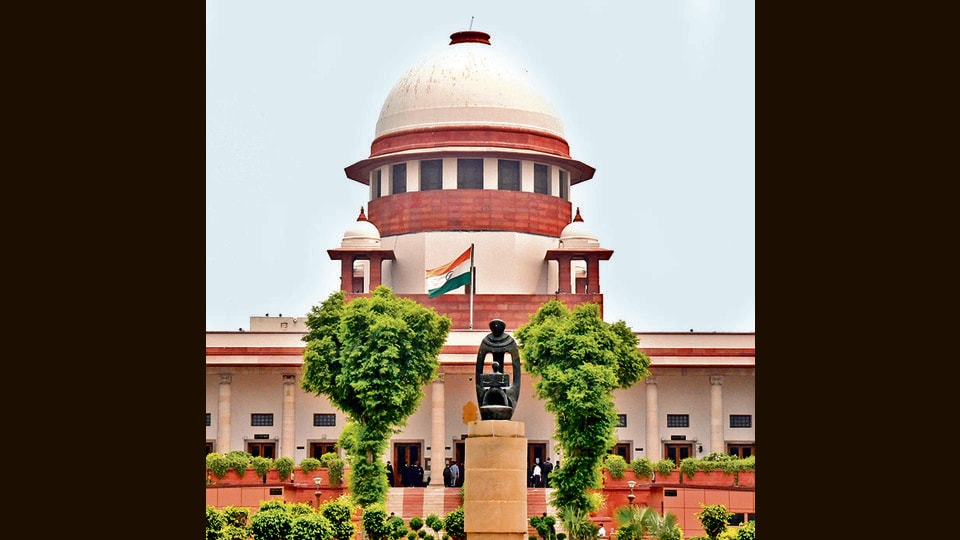
The observation by the top court came while hearing arguments on petitions challenging the recently-concluded SIR in Bihar.
“The ECI has neither said they have a right to declare anybody as a citizen nor do they say I have a right to declare anybody a non-citizen. But if there are inclusions in the electoral roll which are of doubtful integrity, will it not be within the ECI’s Constitutional power to conduct an enquiry which is inquisitorial in nature?” asked a bench of Chief Justice of India (CJI) Surya Kant and justice Joymalya Bagchi.
The court was hearing arguments in a petition by activist Yogendra Yadav, who questioned ECI over the deletions in Bihar. Appearing for Yadav, senior advocate Shadan Farasat said that Article 326 of the Constitution provided that a person who is a citizen of India and is not less than 18 years of age will be entitled to be registered as a voter. “The ECI is free to make an enquiry but the decision whether a person is a citizen is to be done as per the procedure prescribed under law.”
He further stated that the Representation of People Act, 1950 was based on the foundation provided by the Constitution. Sections 16 and 19 of that act list disqualifications and say that anyone who is a resident in a constituency and above 18 is entitled to be registered on the electoral roll. Anyone who clears the Section 16 threshold must stay on the electoral roll till a Section 19 disqualification kicks in - when that individual is held not to be a citizen of India – and till then a presumption of citizenship will operate, Farasat said.
But the bench reasoned further.
“To say citizenship is to be presumed when residence and age is achieved is incorrect. It is independent of it.” The court explained with an illustration, “Look at a hypothetical example that an illegal migrant residing for long in India for about 10 years, do you say he will be entitled to citizenship?”
The court further added, “So ECI asks documents to satisfy their inquiry to take the next possible step, maybe to streamline the electoral roll and to bring it in line with the constitutional and statutory goals. ECI is not inert. It can certainly doubt an entry and refer it to the (foreigner) tribunal. It looks into the documents with regard to relevance and in doing that, does it transgress the jurisdiction in deciding citizenship? The fact it can doubt it is indicative of its power to decide presumptive state of citizenship.”
Farasat told the court that ECI could assume to have this power only if Parliament was silent on who is to determine citizenship. He pointed out that this was not the case as Parliament has vested this power to determine citizenship with the central government and foreigners’ tribunals, and ECI cannot arrogate this power to itself.
Several petitioners represented by senior advocates Kapil Sibal, Abhishek Manu Singhvi and others have already concluded their submissions. The court on Tuesday heard senior advocate Prashanto Chandra Sen along with advocates Shahrukh Alam, Nizam Pasha, Fauzia Shakil, and Neha Rathi among others.
Alam said that the June 24 notification by ECI never declared the SIR exercise to be an “inquisitorial” inquiry on citizenship, responding to the court’s queries. Shakil pointed out that the SIR in Bihar has exposed the flaws of ECI which opposed transparency by not disclosing reasons for deletions and sharing of data. Further, she said that ECI violated its own standard operating procedure (SOP) by carrying out suo motu deletion in an election year.
Rathi told the court that while the ECI affidavit said that upon an “independent appraisal” it decided to have a nationwide SIR, no data is forthcoming on what this appraisal was. She said that similar to the demonetisation case where the court summoned records, ECI should be asked to produce documents to rebut allegations that holding SIR was a “hurried” decision made without any application of mind.
As the arguments remained inconclusive, the bench posted the matter for Thursday.
Meanwhile, the court also dealt with petitions challenging the ongoing SIR in Kerala and Tamil Nadu. ECI informed the bench that pursuant to the court’s direction last week, the deadline for submitting enumeration forms was moved from December 11 to 18 due to the ongoing local body polls in the southern state.
The court asked the poll panel to respond to a similar request for extension of time sought by voters in hilly areas of Tamil Nadu. When advocate Eklavya Dwivedi for ECI disputed the position citing digitisation of 99.27% enumeration forms, the bench said, “Do not give such mechanical answers. These are practical problems. When it is brought to you, find out what is the position instead of giving such cyclostated responses that these many forms have been distributed.”


