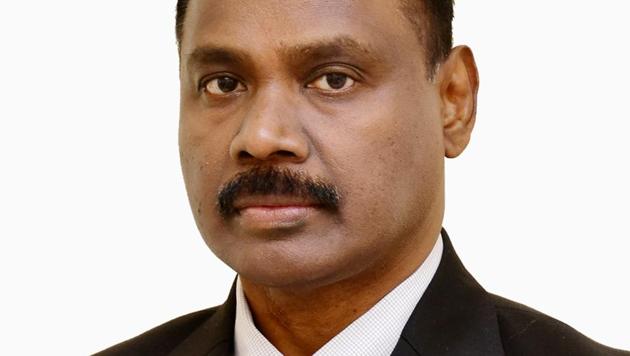
On the eve of the first anniversary of the nullification of Article 370, the first lieutenant governor of the Union Territory of Jammu and Kashmir (J&K), Girish Chandra Murmu, spoke to Ramesh Vinayak over video conference from the Raj Bhavan in Srinagar. Edited excerpts:
What has changed in J&K since the effective abrogation of Article 370?
After this (scrapping of Article 370), Prime Minister Narendra Modi said there will be acceleration in development projects and overall growth. Our priority was to look into the deficiencies, particularly in road connectivity, electricity supply, drinking water and job opportunities. We concentrated our efforts on that and achieved tremendously. To illustrate, the Prime Minister’s Development Project was conceived in 2015 and it has big and small projects. Until a year-and-a-half ago, 27% of funds were spent and only seven projects were completed. Now, 17 projects stand commissioned and over 50% of funds have been used. These relate to hydro-electricity, highways, irrigation and power transmission. Similarly, we had 2,300 languishing projects since 2010. Of them, 606 have been completed in the past year. We have had a unique ‘back-to-village’ programme which, on the basis of the grassroots-level feedback, identified 20,000 small projects of which 7,000 have been executed. Under the Pradhan Mantri Gramin Sadak Yojana, an average of 1,600 km of road stretch is completed annually. J&K will do 5,000 km this year. All this is happening on the ground and is satisfying.
Has the government been unable to meet its objective on the security front?
{{/usCountry}}Has the government been unable to meet its objective on the security front?
{{/usCountry}}I think it is the other way around. Militancy has two aspects. One is to prevent or pre-empt people supporting or joining militancy. That we are addressing by focusing on youngsters, their empowerment, job creation and sports to bring them into the mainstream. This has minimised the recruitment (to militant ranks). The second piece is anti-militancy operations that have become effective due to synergy among security forces. One good thing in all these operations is that there is hardly any civilian casualty.
What is your reading on the mood on the street in Kashmir?
Definitely people are enthusiastic and optimistic. They are looking forward to seeing development and creation of jobs in their areas. They want to prosper and have a better life.
The political space in Kashmir remains in a freeze. What is the way forward to revive stalled politics?
As there is President’s Rule and the legislative assembly is dissolved, obviously there is some pause…some disruption. The parties’ activity as elected representatives is not there. But it is not true that there is complete absence of political activity. At the grassroots level, democracy is thriving and kicking. We have empowered panchayats and municipal bodies in the real sense. Of course, an elected legislature has to be there. That would happen at the appropriate time.
Why has the government not released all mainstream political leaders, including Mehbooba Mufti, who have participated in elections, peaceful politics and committed themselves to the Indian Constitution?
All detentions are reviewed from time to time…now almost on weekly basis. The process looks into the circumstances under which people were detained. When the perception and situation changes, they are released. There is no discrimination.
There appears to be a huge trust deficit between Kashmir’s mainstream politicians and the Centre.
Well, I don’t sense that in my interactions with MLAs and MLCs. Though there is no elected legislature right now, we take their suggestions.
Former chief minister Omar Abdullah has spoken of how he will not participate in elections till J&K remains a UT. Your view?
This is his personal view and I won’t be able to comment. All I can say is that this UT has a legislature, unlike Ladakh, and will have an elected government. The view that only this (Article 370) would ensure political participation is a bit far-fetched.
Both the Prime Minister and home minister have said J&K’s statehood would be restored. Is the government open to restoring statehood as a confidence-building step?
Confidence building is already going on at levels of grassroots and public participation. Whatever the PM and HM have said, they mean it. I don’t subscribe that only this (restoring statehood) will bring confidence. Even a UT with a legislature can have confidence of the people.
When will you be able to hold assembly elections?
Right now we are addressing deficiencies in development works to see that people’s worries and woes are minimised and that they are empowered. On elections, a decision will come at an appropriate time.
While the government spoke of how Kashmiris — after the constitutional changes — will enjoy the same rights as other Indians, there is a view that people in J&K actually now enjoy fewer rights. How would you respond to this?
That is a misnomer and a wrong perception. Regardless of Article 370, people here enjoy the same rights and liberties as citizens elsewhere. The special status was a temporary provision and involved certain things at the local level. Any interpretation that J&K residents have fewer rights now is wrong both constitutionally and legally. It is a blatant lie.
There is apprehension about the new domicile law which is seen as a precursor to changing the demographic profile of the Muslim-majority state.
This again is a misleading narrative…a malicious propaganda. In Kashmir, a particular community is in the majority. How can such a huge population change take place? The domicile law is only empowering those deprived earlier and not recognised as equal citizens; like the displaced persons from West Pakistan, Valmikis who were brought here long back, and the Gurkhas who have been here since the Maharaja’s time. It is nothing like that there will be an influx of outsiders and the demography will change.
The nullification of special status was expected to open up J&K to investments. How have things moved on this front?
Article 370 was not a barrier for investments. That was a policy issue. We have identified 6,000 acres of government land to create industrial clusters. We are not going to touch agricultural land, which is scarce. Already, memoranda of understanding (MOUs) have been signed for investment worth R 20,000 crore. Once the coronavirus pandemic eases out, we shall hold the investment summit that was to happen in May.
How has the coronavirus crisis impacted your plans?
Our biggest recruitment drive for 10,000 jobs which was to happen in March-April has slowed down for the time being. Another 20,000 jobs are lined up. The infra projects have been hit in a substantive way as most labourers and contractors are outsiders and they moved out after the virus outbreak. Also, elections to the remaining panchayats have been delayed.
You have been a bureaucrat and bring in a set of administrative skills. But do you think Kashmir is an issue that requires political outreach and has this happened?
Well, I am giving my 100% to development and public outreach. I will try to strengthen the political institutions at every level and not leave any stone unturned to do what I am supposed to do.