The Union government on Friday termed electoral bonds (EBs) an “absolutely transparent” method of political funding, even as the Supreme Court fixed a clutch of challenges to the Centre’s scheme for a detailed hearing on December 6.
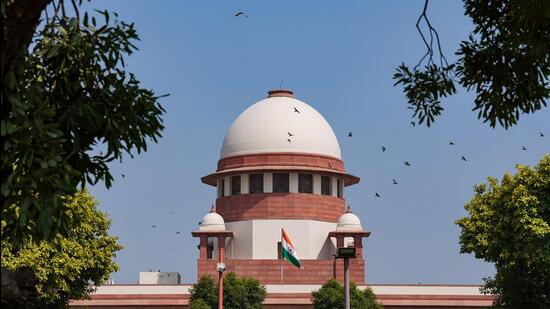
A bench of justices BR Gavai and BV Nagarathna also agreed to examine on the next date a plea by some of the petitioners for referring the case to the Chief Justice of India to set up a constitution bench of five judges to examine issues related to the impact of EBs on free and fair elections.
The top court was hearing the matter after more than 18 months.
The electoral bonds system was introduced in 2017 by way of a money bill introducing amendments in the Finance Act and the Representation of People Act. It was implemented in 2018.
As soon as the case commenced, advocate Prashant Bhushan, appearing for NGO Association for Democratic Reforms (ADR), pressed for an extensive hearing to scrutinise how EBs are polluting the electoral system in the country, besides an amendment in the law that even allows subsidiaries of foreign companies to provide funds to political parties.
Senior advocate Kapil Sibal, representing another petitioner, called EBs “the most opaque system of funding”, adding a constitution bench is ideally suited to hear this case in the wake of the impact of EBs on the constitutional mandate of free and fair elections.
To this, the bench replied: “Unless we notice some inconsistencies in the judgments of the previous benches, we cannot refer it to a larger bench, it would be in the discretion of the hon’ble CJI to set up a larger bench.”
At this point, solicitor general (SG) Tushar Mehta, appearing for the Centre, intervened to rebut Sibal’s arguments. “Let me tell my lords that the methodology of receiving money is so transparent that it is impossible to get any money in black or unaccounted money. Everything is transparent, nothing is in black now.”
{{/usCountry}}At this point, solicitor general (SG) Tushar Mehta, appearing for the Centre, intervened to rebut Sibal’s arguments. “Let me tell my lords that the methodology of receiving money is so transparent that it is impossible to get any money in black or unaccounted money. Everything is transparent, nothing is in black now.”
{{/usCountry}}The bench asked the SG if the system provides for where the money is coming from.
“Absolutely my lords... The system is absolutely and completely transparent,” replied Mehta, adding that there is a complete chain of how money is transferred from one account to another using the draft facility.
On the aspect of the petitioners’ plea to refer the case to a large bench, the SG requested the bench to start hearing the case to vet the request.
Attorney general R Venkataramani also appeared for the Centre in the matter, and assured the bench that he would be able to address all the apprehensions satisfactorily. At the same time, the AG said there is no urgency to hear the matter and that it should be posted in January.
Sibal, Bhushan and other lawyers appearing for the petitioners opposed the AG’s submission, pointing out that elections to Gujarat and Himachal Pradesh are round the corner, and that they want the alleged misuse of EBs to stop immediately.
Mehta reiterated that the EB is a transparent system but the government is willing to consider if there are any suggestions from the top court regarding any “loophole”.
The bench then fixed the matter on December 6, asking all parties to file the documents they wish to submit for the consideration of the court on the next date.
The ADR claimed that EBs are an anonymous route of funding that amounted to legitimising bribery, as corporate donors could fund the party in power in a state or the Centre as a matter of quid pro quo. These donations enjoy 100% tax exemption and even foreign companies can donate through Indian subsidiaries, the petitioners added.
“The electoral bonds scheme has opened the floodgates to unlimited corporate donations to political parties and anonymous financing by Indian as well as foreign companies, which can have serious repercussions on Indian democracy,” the ADR claimed.
It pointed out that the Finance Act of 2017 exempts contributions by way of electoral bonds to be disclosed even to the Election Commission under Section 29C of the Representation of Peoples Act.
This position was, however, changed by virtue of an order by the Supreme Court in April 2019 when it introduced an interim “safeguard” by directing all political parties to submit details of receipts of EBs to the Election Commission in a sealed cover. This was done as an interim measure till the pending petitions challenging the validity of these electoral bonds are decided.
At that time, the Election Commission supported the existing system of political party funding through EBs, although the constitutional body flagged a lack of transparency, which it said could be considered at a later stage.
In March 2021, the court dismissed two stay applications moved by the ADR to stop the sale of the electoral bonds ahead of elections in West Bengal, Tamil Nadu, Assam, Kerala and Puducherry. It held that there was no justification to block their sale over concerns of anonymity in political party funding or apprehensions of their misuse and that the sale had continued “without any impediment” in 2018, 2019 and 2020 as well. After this order, the case did not come up for hearing despite repeated requests made by the petitioners.
Apart from the ADR, the CPI(M) and advocate Ashwini Upadhyay have raised issues pertaining to EBs and all petitions are being heard together.